Chor-Minor: Bukhara's Gatehouse with Four Towers
How to find Chor-Minor in the maze of a Bukhara neighbourhood, what its four towers are said to mean, and whether you can climb to the roof for the view.
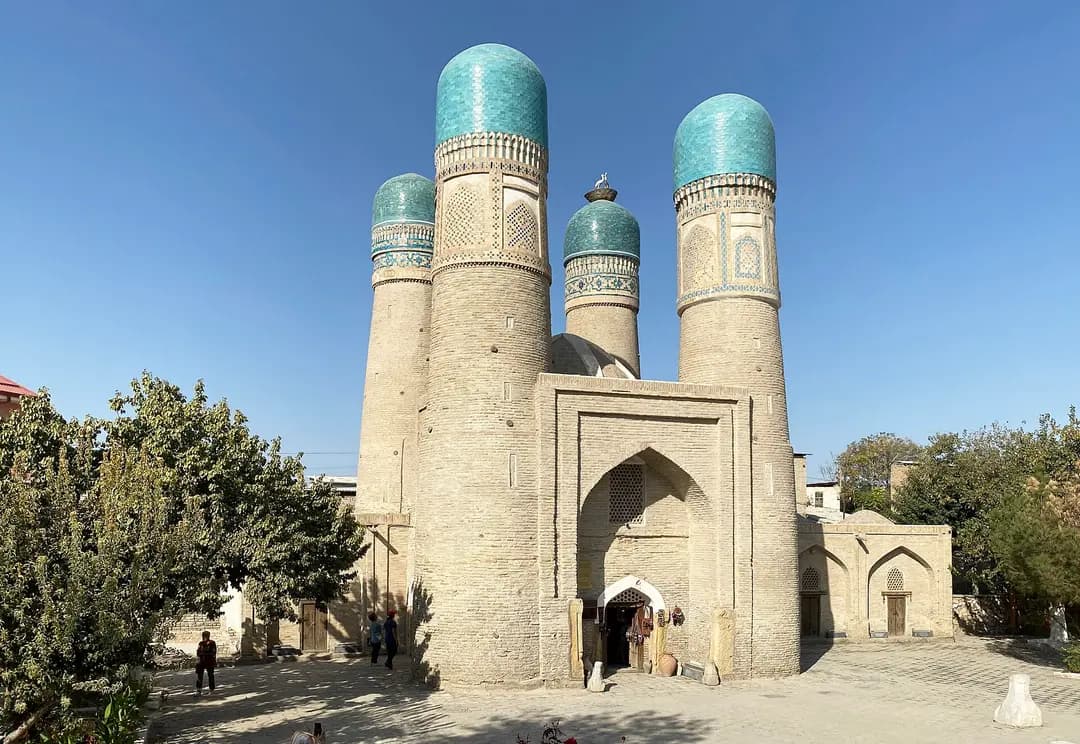
Chor-Minor is one of Bukhara's most recognisable buildings and also one of its most unexpected. It looks nothing like the grand madrasas or the ancient mausoleums. A small cube-shaped building with four little towers topped by turquoise domes, it stands in the middle of an ordinary residential neighbourhood, between blank house walls and narrow lanes. Just finding it on the first try is a small adventure.
What the building is
The name translates from Tajik as "four minarets". Although Chor-Minor is often called a mosque, it is actually the ceremonial gatehouse of a madrasa built in 1807 with funds from a wealthy merchant, Khalif Niyaz-kul. The madrasa itself, with its student cells, has barely survived, but the gatehouse remains and has become a sight in its own right.
The four towers are not real minarets, and no call to prayer was ever made from them. They are decorative, and some contain small rooms. Under the central dome is a small hall that served as a mosque or meeting place.
The structure was not the sturdiest. In the late 20th century one of the towers partly collapsed and had to be rebuilt. Today Chor-Minor is in good condition.
What the four towers mean
Look closely and you will see the towers differ in their decoration. Each has its own pattern of tile inserts and brickwork. Several popular explanations go with this:
- Four daughters. It is said that Niyaz-kul dedicated each tower to one of his daughters, and the differences in decoration reflect their personalities.
- Four religions. Another version holds that the ornaments refer to different religious traditions met along the Silk Road; people find symbols in the patterns resembling a cross, a fish and prayer wheels.
- A journey to India. Sometimes you will hear that the merchant was inspired by a four-minaret building he had seen in India.
None of these versions is documented. But these stories are exactly what makes Chor-Minor so beloved by guides and photographers, and you will certainly hear them.
How to find Chor-Minor
The building is north-east of Lyabi-Hauz, roughly 600-800 metres away. On foot that is 10-15 minutes, but the way leads through the lanes of the mahalla, where it is easy to take a wrong turn. A few tips:
- Use the map on your phone; Chor-Minor is marked on all the popular maps.
- From Lyabi-Hauz head towards the Nadir Divan-Begi Madrasa and continue north-east.
- If you get lost, simply ask passers-by: "Chor-Minor?" Locals will happily point the way.
- There are signposts in the old city, but not at every turn.
If you go in the evening, bear in mind that lighting in the lanes is weak in places and landmarks disappear in the dark, so return the way you came.
The walk through the mahalla is a pleasure in itself. You see how old Bukhara lives: carved wooden doors, children on bicycles, the smell of bread from tandoor ovens, mud-brick walls and quiet courtyards.
Can you go up?
There is usually a souvenir shop on the ground floor. Often, for a small fee, you can climb a narrow staircase to the roof and see the tower domes close up, along with the rooftops of the neighbourhood. It is not an official viewing platform, and whether you can go up depends on who is running the shop and whether the stairs are open. Prices are approximate; ask on site.
If you do go up, be careful: the stairs are steep and cramped, and railings on the roof are minimal. With children or if you are prone to dizziness, it is better to stay below.
How to photograph it
- The best angle is from the small square in front of the building, where there is a little pond. Stand slightly to one side to see three towers at once.
- In the morning the facade is in soft light and there are hardly any people.
- Towards sunset the turquoise domes stand out vividly against the sky.
- Do not photograph residents outside their homes without permission.
What to see nearby
Chor-Minor fits easily into a walk around the eastern part of the old city. Go from Lyabi-Hauz to Chor-Minor, then return through the mahalla to the Kukeldash Madrasa and the trading domes. With stops, the whole loop takes an hour and a half to two hours. Chor-Minor itself takes 20-30 minutes.
Practical tips
- Access to the building is free; only the climb to the roof, when available, is paid.
- Dress modestly: you are walking through a residential area.
- In summer go early in the morning or in the evening, as the lanes get very hot.
- Bring water: there are few cafes in this part of the mahalla.
From Bukhara to Samarkand
After Bukhara many travellers head on to Samarkand. The 270 km drive takes about three and a half to four hours. You can visit Chor-Minor in the morning while the light is soft, then leave after lunch on a shared ride via Yo'ldosh: you book a seat in the app with a verified driver and pay less than for a private taxi.
Trips are on the Bukhara - Samarkand route page. See other directions in the routes section.
Cover photo: Bernard Gagnon, CC0, Wikimedia Commons.
