Khudoyar Khan's Palace in Kokand: Halls, Museum and History
The last palace of the Kokand Khanate was finished only a few years before the khanate fell. What survives of its halls, what the museum shows and why the khan was driven out by his own subjects.
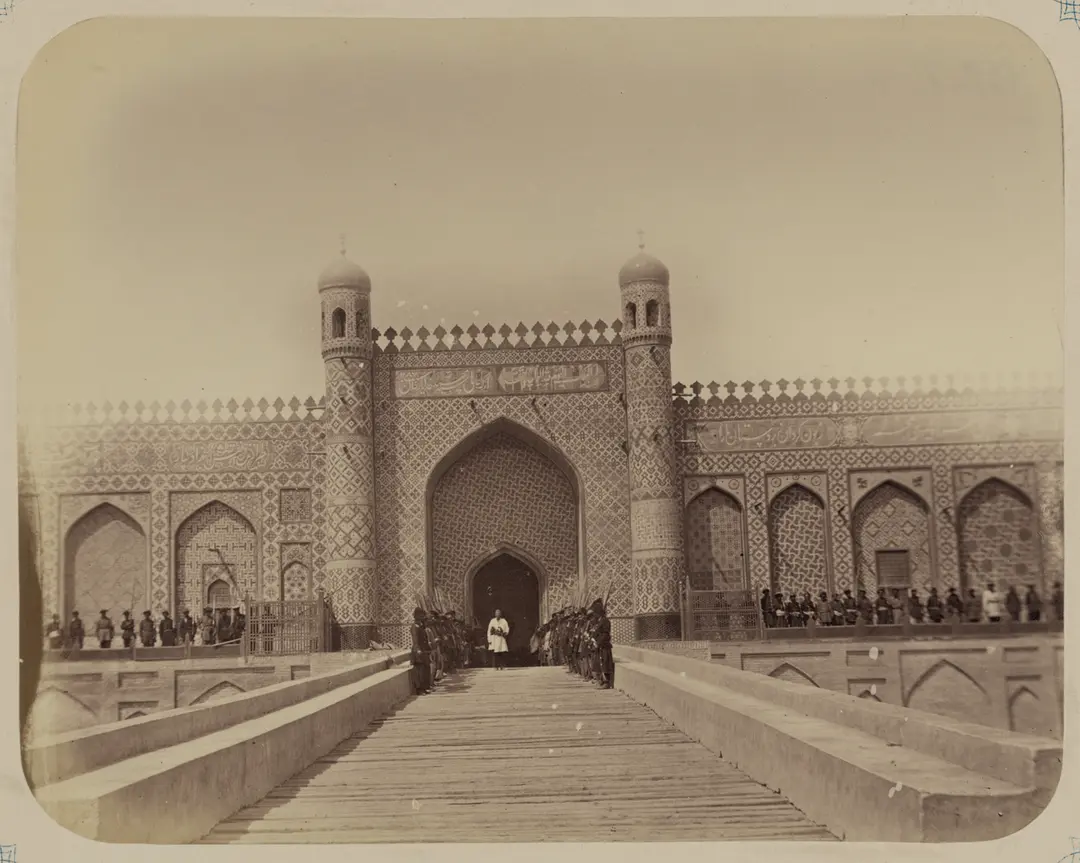
There is a particular irony to Khudoyar Khan's Palace. Its tile-covered facade was meant to symbolise the power of the Kokand Khanate, yet it was completed only a few years before the khanate ceased to exist. Today it is Kokand's main sight and one of the most photogenic monuments in the Fergana Valley. Here is what you will see inside and how the story of the building is tied to the fate of its owner.
Kokand and its khanate
Kokand lies on the western edge of the Fergana Valley. In the 18th and 19th centuries it was the capital of the Kokand Khanate, a state that controlled the entire valley, Tashkent and vast lands to the north. The city was famous for its crafts, madrasas, paper-making and busy bazaars.
Khudoyar Khan ruled the khanate several times between the mid-1840s and 1875: he was overthrown, returned and lost the throne again. It was a time of internal wars and constant pressure from the Russian Empire, which by then had already taken Tashkent.
How the palace was built
The palace was built in the early 1870s. The work was led by the master builder Mir Ubaydulla, and the best craftsmen of the khanate worked on it alongside masters invited from other cities. Originally the complex was enormous: about seven courtyards and more than a hundred rooms — a throne room, reception halls, living quarters, a harem and service rooms.
The main facade faces the square. It is decorated with:
- tile facing with floral and geometric patterns in blue-green and white;
- an inscription above the entrance glorifying the khan;
- small towers at the corners that give the building the look of a fortress.
Why the khan was driven out
Khudoyar Khan is remembered as the ruler under whom taxes became unbearable for ordinary people. Levies were collected on everything, from land to market trade, and building the palace required huge sums of money and labour. Discontent built up for years.
In 1875 a rebellion broke out. Nobles, commoners and part of the army all turned against the khan. Khudoyar Khan fled to the protection of the Russian authorities, and in early 1876 the khanate was abolished and its lands absorbed into the Russian Empire. Khudoyar Khan himself later set out on pilgrimage and died far from home.
So the palace that was built as a symbol of strength became a monument to the last chapter of the khanate.
What survives and what to see
Only part of the complex has survived: two courtyards and about twenty rooms. Today it houses a local history museum.
What to look at:
- The facade. The best photo spot is the square in front of the palace. The light is softer in the morning, while in the middle of the day the tiles shine brightest.
- The reception halls. Notice the painted ceilings and carved wooden doors, some of which date back to the 19th century.
- The museum collection. Objects from the khan's court, weapons, clothing, carpets, ceramics, documents and photographs of Kokand in the late 19th century.
- The inner courtyards. Shady and quiet — a good place to imagine life at court.
An hour to an hour and a half is usually enough. Tickets are inexpensive and prices change from time to time, so check at the ticket desk. There may be a separate fee for taking photos inside.
What else to see in Kokand
| Place | Why it is interesting |
|---|---|
| Juma mosque | An iwan with nearly a hundred carved wooden columns |
| Narbutabey madrasa | One of the largest madrasas in the valley |
| Dakhmai Shakhon necropolis | Burial place of the rulers of Kokand |
| Modari Khan mausoleum | Mausoleum of Umar Khan's mother |
All of these are in the historic centre, and you can see them all in a full day without rushing.
How to get there
From Tashkent
About 230 km, roughly 3.5 to 4 hours. The road crosses the Kamchik Pass, with beautiful mountain views, tunnels and hairpin bends. There is usually a checkpoint on the pass, so keep your documents handy. In winter the weather in the mountains can turn bad, so check the forecast. You can find a ride on the Tashkent — Kokand route on Yo'ldosh: drivers often leave early in the morning, and you will be at the palace by lunchtime.
From Fergana
The distance is about 90 km, an hour and a half on a flat road. Kokand makes an easy day trip from Fergana or Margilan. On the Fergana — Kokand route you can book a seat with a driver and return the same way in the evening.
When to go
- April–May — warm, with orchards blooming around Kokand.
- September–October — the best time for walking, and fruit season.
- Summer — hot, but cool inside the palace's thick walls; head outdoors in the morning and evening.
- Winter — quiet and uncrowded, but the Kamchik Pass can make the journey harder.
Tips
- Start with the palace and then walk to the Juma mosque, which is not far.
- Try Kokand halva and local pastries at the bazaar.
- Do not plan your visit for the museum's last hour, or you may not have time to see everything properly.
- Observe the dress code in mosques: covered shoulders and knees.
The takeaway
Khudoyar Khan's Palace is not just a beautiful facade but a story of how luxury and crushing taxes can hasten the end of a state. After your visit you will look differently at the streets of Kokand, which a century and a half ago were the capital of a large khanate.
When planning a trip to the Fergana Valley, check the Tashkent — Kokand and Fergana — Kokand routes, as well as all routes.
Cover photo: Kun, Aleksandr L., 1840-1888, Public domain, Wikimedia Commons.
