Kokand: The Modari Khan Mausoleum and the Dakhmai Shakhon Necropolis
Kokand's lesser-known monuments: the tiled mausoleum of the khan's mother and the rulers' tomb with carved doors. What to see and how to combine them with Khudayar Khan's palace.
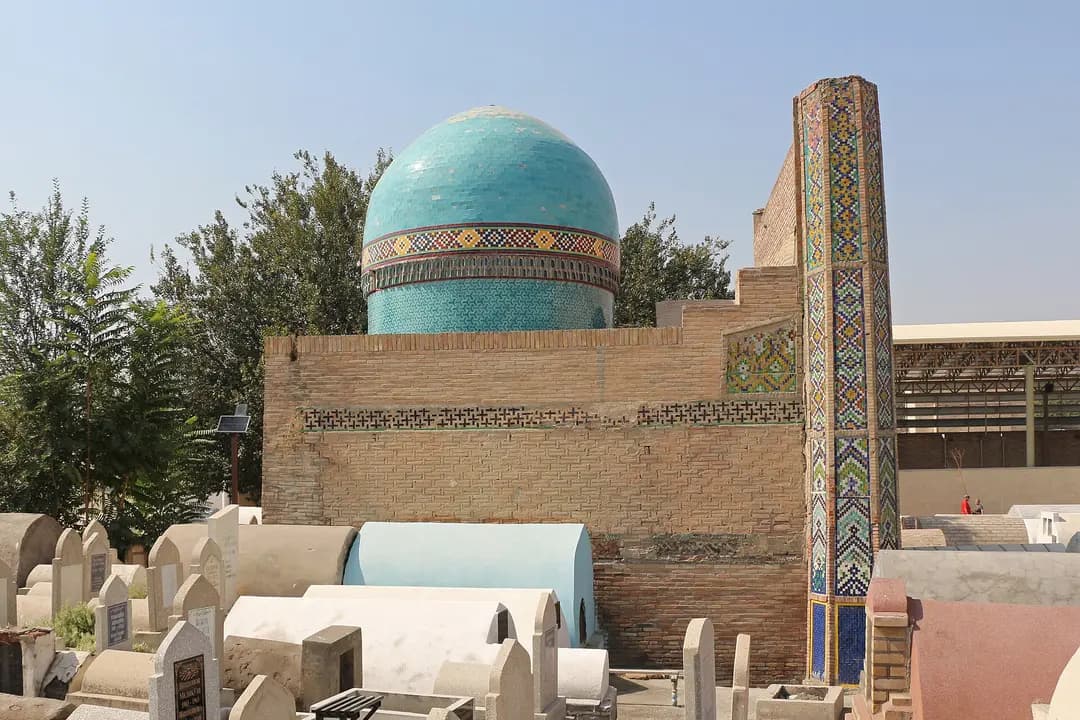
Most visitors to Kokand stop at Khudayar Khan's palace and the Friday mosque. Yet a few minutes' walk from the centre are two monuments that tell a far more personal story of the Kokand Khanate: the Modari Khan mausoleum and the Dakhmai Shakhon tomb. Rulers, their mothers and their wives are buried here, and the woodcarving and tilework show what the art of the Fergana Valley looked like in the nineteenth century.
A little about the Kokand Khanate
In the 18th and 19th centuries Kokand was the capital of a khanate that controlled the Fergana Valley and neighbouring lands, including Tashkent. Its heyday came in the first half of the 19th century, under Umar Khan and his son Madali Khan. Umar Khan's wife Nodira, one of the best-known poets of Central Asia, lived and wrote at his court. Many of Kokand's monuments date from this era.
The Modari Khan mausoleum
The name means "mother of the khan". The mausoleum was built in 1825 for Umar Khan's mother. It is a small but richly decorated building:
- The portal is faced with tiles in blue and turquoise, unusual for Kokand architecture of the time, which favoured carved wood and ganch plaster.
- The dome is low and the building's volume restrained, which makes the portal stand out even more.
- Around it lies the old cemetery of the ruling dynasty, where members of the khan's family are buried.
Tradition holds that Nodira also rests in this cemetery. Her fate was tragic: in 1842, when Emir Nasrullah of Bukhara captured Kokand, the poet was executed. Today she is honoured as a symbol of poetry and wisdom, and many visitors come specifically to pay their respects to her.
Dakhmai Shakhon, the tomb of the rulers
The name means "tomb of the kings". The complex was built in the 1830s over Umar Khan's grave, and tradition says Nodira initiated its construction. Other members of the Kokand dynasty are buried here too.
The main reason to come is the wood:
- The carved doors are among the finest examples of Kokand woodcarving, with delicate floral ornament and inscriptions covering the entire surface.
- The columned iwan with a painted ceiling: bright flowers, geometry and fine work by the valley's craftsmen.
- Inscriptions with lines of verse traditionally associated with the poetic circle at court.
The portal is also tiled, but the real treasure is the carving and painting of the iwan. Step closer and look at the details: every column and door panel was carved by hand.
Visiting rules
- These are burial places, so behave calmly and quietly.
- Wear clothing that covers shoulders and knees.
- Photographing the architecture is usually fine; photograph people only with permission.
- Entry is generally inexpensive, but conditions change, so check on site.
- Opening hours vary with the season; it is best to come in the first half of the day.
Combining them with Kokand's other sights
All the city's main monuments are close together. A day route might look like this:
- Khudayar Khan's palace, the main sight, built in the 1870s, with its bright tiled facade and a museum inside.
- The Jami Friday mosque, with a long iwan resting on dozens of carved wooden columns.
- The Narbuta-biy madrasa, an 18th-century school that still functions.
- Modari Khan and Dakhmai Shakhon in the afternoon, when there are fewer people.
You can have lunch at one of the teahouses in the centre. Kokand is known for its halva and sweets, so drop by the market.
Getting there
Kokand is the gateway to the Fergana Valley and easy to reach from the valley's other cities. From Fergana it is about 90 km, roughly an hour and a half by road. On the way you can stop in Rishtan, famous for its blue ceramics.
Yo'ldosh drivers regularly publish shared rides in both directions on the Kokand to Fergana route. It is a convenient alternative to waiting at the bus station: you book a seat in the app, agree on a pickup point with the driver and travel at the time you need. Read more about booking on the for passengers page.
When to go
The best time for the Fergana Valley is spring and autumn. Summer is hot, but you can sit out the midday heat in the shade of iwans and courtyards. In autumn the markets are full of fruit, and the soft light brings out the colours of the tiles and carving especially well.
Modari Khan and Dakhmai Shakhon are not the biggest names in the guidebooks, but this is where you feel the human side of Kokand's history: mothers, wives, poets and rulers remembered through the beauty of the buildings raised for them.
Cover photo: Bgag, CC0, Wikimedia Commons.
