Suzani and the Gold Embroidery of Bukhara
How to read suzani patterns, how Bukhara, Nurata and Samarkand styles differ, what Bukhara gold embroidery is and how to tell an old piece from a new one.
In the trading domes of Bukhara the walls are literally covered in embroidery: huge hangings with red circles, cushions with floral designs, velvet robes worked in gold. To avoid getting lost among all this and to buy something you will enjoy for years, it helps to know what you are looking at. Here is a guide to the two main kinds of Uzbek embroidery: suzani and gold embroidery.
What a suzani is
The word suzani comes from the Persian suzan, meaning needle. It is a large embroidered textile traditionally prepared for a wedding. A girl, together with her mother and female relatives, would spend years embroidering suzanis, which became part of her dowry: they decorated walls, covered beds and draped over cradles.
A classic suzani is assembled from several strips of fabric. The design is drawn across the whole cloth, then the strips are separated and embroidered by different women before being sewn back together. That is why old pieces often show small mismatches in colour and pattern at the seams. This is not a flaw but a trace of collective work.
Symbols on a suzani
Most motifs carry a meaning:
- Circles and rosettes (palak): sky, sun and moon, symbols of eternity and protection.
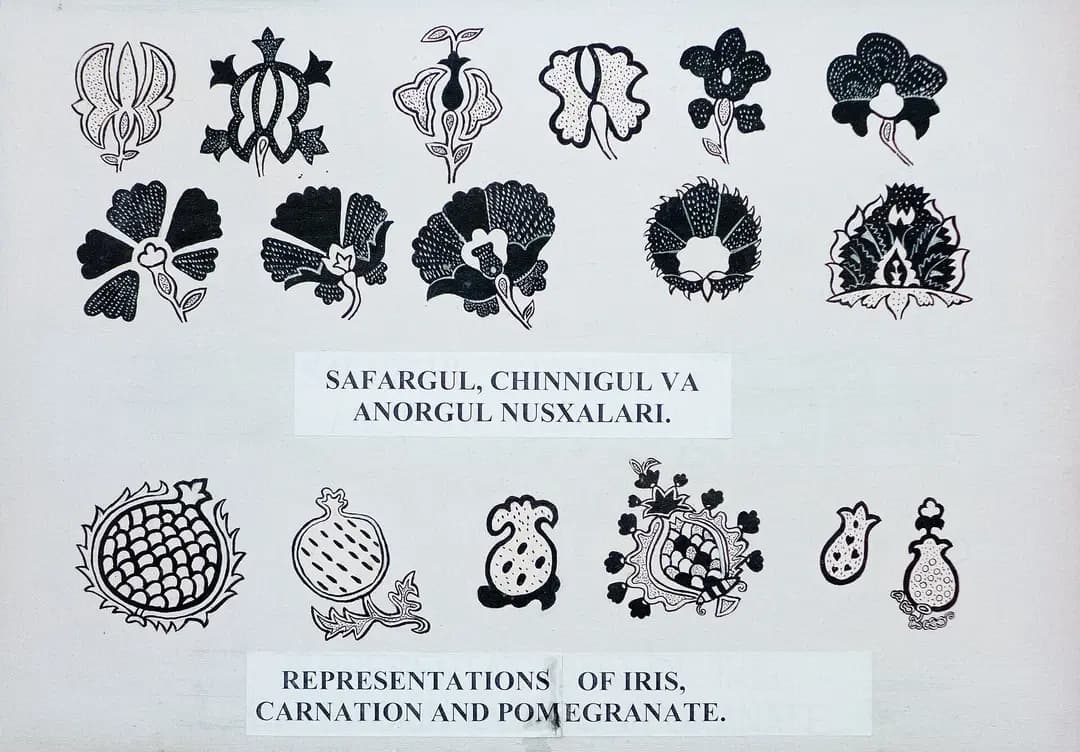
- Pomegranate: fertility and the wish for a large family.
- Chilli pepper: a charm against the evil eye.
- Flowers and branches: the garden as an image of paradise.
- Jugs, birds, fish: abundance, freedom, life.
Regional styles
| Style | How to recognise it |
|---|---|
| Bukhara | Fine, graceful floral design, plenty of open background, branches and flowers |
| Nurata | Central star or rosette surrounded by naturalistic flowers, light background |
| Samarkand | Large dark red and black circles, dense, graphic design |
| Shahrisabz | Bright colours, very dense stitching, background barely visible |
| Urgut | Bold, large rosettes in contrasting combinations |
This is a simplified scheme. Embroiderers always mixed influences, and sometimes only a specialist can pin down exactly where a piece was made.
Stitches and technique
The main stitches sellers will mention:
- Basma: long stitches held down by short cross stitches. It covers large areas quickly.
- Yurma: chain stitch, a line of loops that gives a crisp outline and a dense surface.
- Kanda khayol: a fine satin-type stitch for small details.
Traditionally, silk thread was embroidered onto cotton, later also onto silk and velvet. Today many suzanis are machine-made. You can spot them by identical, perfectly even stitches and an identical pattern on the back.
Bukhara gold embroidery
Bukhara's gold embroidery, known as zardozi, was once a court art of the emirs. Gold and silver threads decorated ceremonial robes, skullcaps, slippers and horse cloths. In the past it was the work of male masters; today many women work in the craft.
How the technique works: metallic thread is laid on the fabric over a cardboard or paper template and stitched down with fine silk thread, creating a raised, gleaming pattern. The base is usually dark velvet in burgundy, navy or green.
What to buy in zardozi:
- a skullcap or a small pouch, an affordable and light gift;
- a wall panel or cushion;
- a robe, an expensive but impressive purchase for a special occasion.
How to tell old from new
- Dyes. On old suzanis the colours are soft and slightly faded, with no acid tones. Bright pink and purple often point to synthetic dyes.
- Ground fabric. Handwoven cloth is uneven, with thicker threads here and there.
- The back. Handwork shows knots and thread changes; machine work shows neat, uniform rows.
- Strip seams. Mismatches at the seams are a sign of traditional work.
- Wear. Natural ageing is uneven, while artificial distressing often looks the same across the whole piece.
If a seller insists a piece is a hundred years old, take that as a reason for more care rather than a reason to pay more. Exporting items that may have cultural value requires an expert certificate, so ask the seller whether they can arrange the paperwork.
Prices
As a rough guide, machine embroidery is the cheapest option, a small handmade cushion costs several times more, and a large hand-embroidered suzani can cost hundreds of dollars or more. Prices depend heavily on size, stitch density and age, so compare and bargain; in the domes that is perfectly normal.
Where to see it
In Bukhara the most embroidery is found in the trading domes and the shops around the Lyabi-Hauz ensemble. A fine collection of suzanis is on display at Sitorai Mohi-Hosa, the emir's summer palace outside the city.
From Samarkand, the easy way in is the Samarkand – Bukhara route: about 270–280 km, 3.5–4.5 hours. From the capital, the Tashkent – Bukhara route is about 570 km and usually 7–8 hours. With Yo'ldosh you can book a seat in a car at a convenient time and arrive in Bukhara with plenty of time for an unhurried browse through the domes.
Cover photo: Fabienkhan, CC BY-SA 4.0, Wikimedia Commons.
