Yangiyer: The Pioneers' Town at the Edge of the Steppe
Yangiyer was built in the 1950s as the headquarters for taming the Hungry Steppe. Here is its history, the foothills nearby and how the town connects to Tashkent and Gulistan.
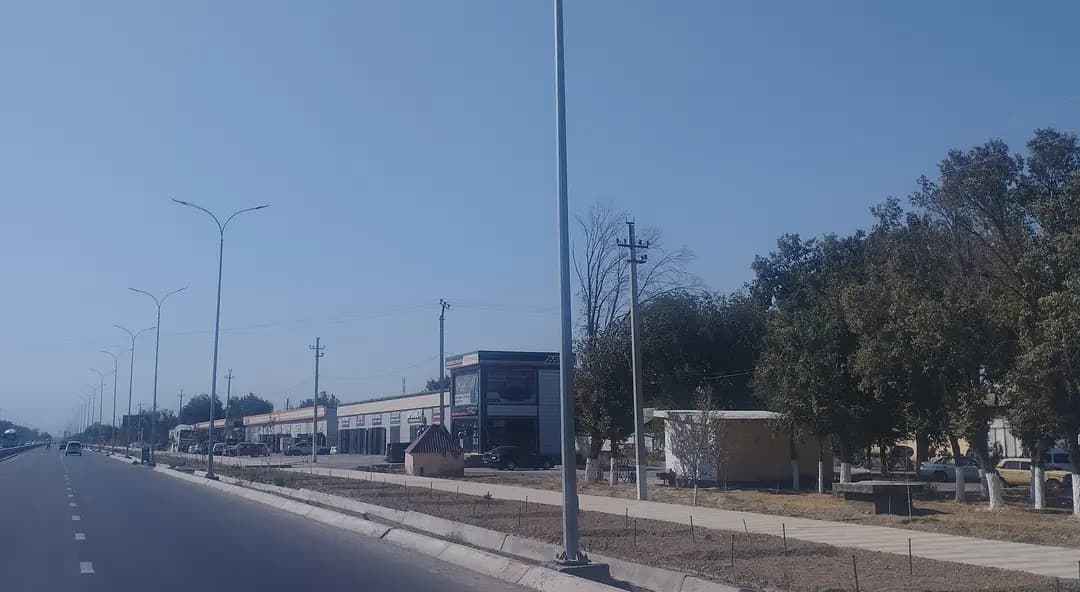
The name Yangiyer means "new land," and it fits: the town appeared on the map in the late 1950s, when thousands of people came to the Hungry Steppe to turn an empty plain into fields and orchards. The construction of canals, state farms and villages was directed from here, and engineers, land reclamation specialists and machine operators arrived from across the Soviet Union. Today Yangiyer is a quiet, green town in the south of Syrdarya Province, right at the foot of the mountains. Few tourists come, but those who enjoy history and unhurried travel may well like it.
How Yangiyer came to be
The Hungry Steppe (Mirzachul) is a huge plain between the Syr Darya and the mountains. Fertile soil and no water: that is its central contradiction. Attempts to irrigate the steppe began in the late 19th century, but large-scale development started after the Second World War.
In 1957 a center for managing the development was founded on the site of the future town. It was built to a plan, with wide streets, residential blocks, administrative buildings, parks and schools. Many residents are descendants of those pioneers who came from different republics. That is why you still hear different languages in Yangiyer, and family stories weave together people from Uzbekistan, Russia, Ukraine, Kazakhstan and elsewhere.
What to see in town
Yangiyer is compact, and you can walk around it in a couple of hours.
- The main street and square. Typical 1950s–60s town planning with shady alleys.
- The park. Old trees planted by the first residents, a living monument to the taming of the steppe.
- Mosaics and murals. Some buildings still bear Soviet mosaics on themes of labor and land development.
- The bazaar. Small but colorful, with fruit, vegetables, dairy products from nearby farms and flatbread.
- The railway station. The town lies on the railway, and the station is part of its story.
If you are interested in the history of the development, ask locals about memorial sites dedicated to the first builders; they are well remembered here.
The foothills nearby
Yangiyer's main natural advantage is how close it is to the mountains. South of town begin the foothills of the Turkestan Range. In spring the slopes turn green and fill with flowers, and in summer the river valleys are cooler than the steppe.
Important: the state border with Tajikistan runs further south. Before walking in the hills, ask locals where it is allowed to go, keep away from the border zone and carry your documents. It is best to head into the foothills with a local who knows the paths.
For proper mountain hiking, many people go further, to Zaamin National Park, which can be reached from Yangiyer via Jizzakh Province.
How Yangiyer connects to other towns
Yangiyer is well placed: close to the main roads but away from the busy highway.
| Route | Distance | Travel time |
|---|---|---|
| Tashkent — Yangiyer | about 150–160 km | 2.5 hours |
| Gulistan — Yangiyer | about 35 km | 40 minutes |
Many residents work or study in the capital and in Gulistan, so cars run regularly. The Tashkent — Yangiyer route is convenient from the capital, while the Gulistan — Yangiyer route suits a half-day trip if you are staying in Gulistan.
Where to eat
Yangiyer has simple teahouses and cafes serving plov, shashlik, lagman and samsa. In summer the bazaar sells melons and watermelons; Hungry Steppe melons are famous for their sweetness. Prices are low but change, so check on the spot.
Where to stay
There are few hotels in town and the choice is modest. If you plan to stay overnight, book ahead, or stay in Gulistan, which has more options, and visit Yangiyer for the day.
Half-day plan
- Morning: leave Gulistan and arrive in Yangiyer 40 minutes later.
- Walk: the center, the park, the mosaics and the bazaar.
- Lunch: plov at a teahouse.
- Afternoon: a short trip to the foothills with a local driver.
- Evening: return to Gulistan or Tashkent.
Tips
- Season. Spring (April–May) is best: the steppe is green and the foothills bloom. Autumn is good too.
- Heat. Summer days are very hot, so plan walks for the morning and evening.
- Border. Do not approach or photograph border facilities.
- Cash. Small shops and the bazaar do not always accept cards.
Why go
Yangiyer is a small but honest story of how people turned the steppe into a garden. There are no grand monuments, but there is the feeling of a place built from scratch, with mountains on the horizon. Chat with older residents at a teahouse: many will happily tell you how their parents lived in tents and trailers, planted the first trees and waited for water from the new canal.
The road
If you want to see the pioneers' town for yourself, choose a ride on Yo'ldosh on the Tashkent — Yangiyer or Gulistan — Yangiyer routes. Drivers are verified, seats are booked in the app, and you can time your departure to fit your plans. Other directions are on the routes page.
Cover photo: Mirzoulugʻbek, CC BY-SA 4.0, Wikimedia Commons.
