Driving an EV in Uzbekistan: Highway Charging and Long Trips
Where to charge between cities, which routes your range can handle, how the Kamchik pass and summer heat affect the battery, and why the desert needs its own plan.
The number of electric cars on Tashkent's streets has grown noticeably in recent years, and more and more owners are now taking them on trips between cities. The charging network is expanding, but it is uneven: on the busy highways in the centre of the country it is easier to charge, while in the desert regions it is much harder. Here is how to plan a long journey in an EV and which routes you can drive with confidence.
How the charging network works
Charging stations in Uzbekistan are installed by various companies: at fuel stations, next to shopping centres and hotels, and in residential car parks. Tashkent and the large regional capitals already have plenty of points, and on the main highways fast chargers can be found at the bigger fuel station complexes. The situation changes quickly, so before you set off:
- install several apps with charging station maps, since there is no single network yet;
- check reviews of each specific station: is it working, what is its real power output, is there a queue;
- confirm the connector type. Many Chinese models are sold here, so several standards are in use and a station may not fit your car.
Always plan a backup charging point in case the main one is occupied or out of order.
What affects your range
The manufacturer's stated range and the real one are two different things. In Uzbekistan consumption is affected most by:
- Heat. In summer at +40 °C the air conditioning runs constantly and the battery needs cooling. Real range drops noticeably.
- Cold. In winter nights can be below freezing, especially in the mountains. Cabin heating and a cold battery also eat up kilometres.
- Speed. At high motorway speeds consumption rises faster than you might expect. Calm driving brings real savings.
- Mountain passes. Climbing takes a lot of energy, though some of it comes back through regenerative braking on the way down.
- Load. A full car of passengers and a boot packed with luggage increase consumption.
A practical rule: count on about 70 to 80 percent of the stated range, and do not plan to arrive at the next charger with less than 15 to 20 percent left.
Tashkent to Samarkand: the easiest route
The Tashkent — Samarkand highway is about 300 km across flat land and one of the busiest roads in the country. Along the way are Syrdarya region, Gulistan and Jizzakh, sizeable towns with fuel station complexes. Many modern EVs with a large battery cover this distance with one intermediate charge, or even without one in mild weather. In summer it is still wise to plan a stop around Jizzakh, which also lets you rest and sit out the heat.
Tashkent to Fergana: the Kamchik pass
The Tashkent — Fergana route is about 310 km, but the main factor here is not distance but the Kamchik pass, which rises above 2,200 metres. The climb from Angren is long and drawn out, and energy consumption on it jumps sharply. Tips:
- leave Tashkent with a full battery, or top up in Angren or on the approach to it;
- do not count on chargers on the pass itself;
- on the descent into the Fergana Valley regenerative braking recovers part of the charge, but not all of it;
- in winter, remember that the pass can close or traffic may be restricted because of snow and ice. Follow the road condition updates.
In the valley the towns of Kokand, Fergana, Margilan, Namangan and Andijan are close to one another, and charging there is easier.
Desert routes need a separate plan
The routes to the west, such as Bukhara to Khiva, Bukhara to Nukus and the road across the Kyzylkum, are still the hardest for an electric car. Distances between settlements are long, infrastructure is sparse and summers are extremely hot. If you decide to go:
- check every station on the route in advance and call ahead if there is a contact;
- keep a reserve of at least a third of the battery on each leg;
- bring a portable charger and adapters for a regular socket, so that in a pinch you can charge slowly at a roadside cafe or guesthouse after asking the owners;
- leave early in the morning so the main stretch falls in the cooler hours;
- always carry water and tell someone your route.
To be honest, for desert routes many EV owners still choose the train for now.
EVs and shared rides
An electric car is well suited to shared rides: a quiet cabin and energy that is cheap compared with petrol. If you are a driver publishing a trip on Yo'ldosh, mention in the description that the car is electric and let passengers know about the planned charging stop, which takes 30 to 40 minutes at a fast charger. Passengers usually see it as an ordinary tea and lunch break. And a passenger who sees an EV in the description should leave a little extra time in their plans.
Checklist before a long trip
- Battery charged to 90 to 100 percent.
- Route planned with main and backup charging points.
- Connectors and payment methods at the stations checked.
- Portable charger and adapters in the car.
- Tyres inflated to the correct pressure, which also affects consumption.
- Water, mobile signal and offline maps.
In short
You can already drive an electric car between the major cities of Uzbekistan, especially in the centre of the country and into the Fergana Valley. Desert routes require serious preparation. Look at trips on the Tashkent — Samarkand and Tashkent — Fergana routes, and if you want to take passengers along, see the for drivers page.
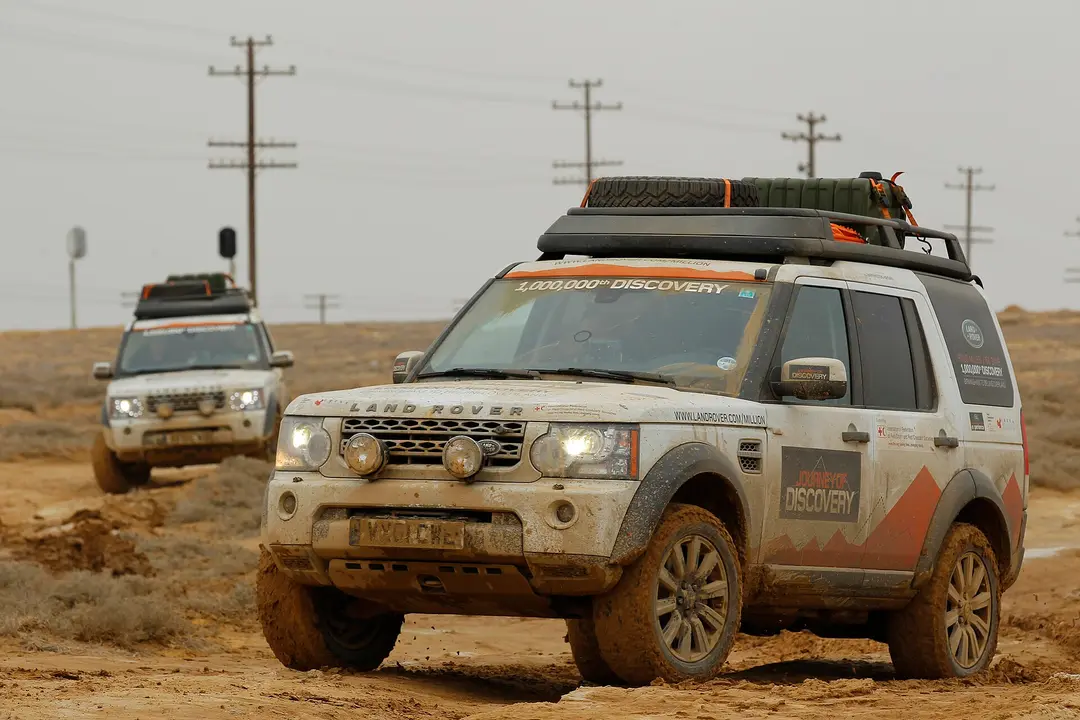
Cover photo: Land Rover MENA, CC BY 2.0, Wikimedia Commons.
