Pahlavan Mahmud Mausoleum: The Patron Saint of Khiva
The story of a poet, wrestler and furrier who became a saint, the legend of a bout he chose to lose, and why his tomb is among Khorezm's most visited places.
Above the rooftops of Itchan Kala rises Khiva's largest dome, turquoise with a gilded finial. Beneath it lies the man the people of Khorezm regard as their city's heavenly protector. Pahlavan Mahmud was a poet, a famous wrestler and a humble furrier. The combination seems unusual, but it is exactly what made him one of the region's best-loved saints. Today his mausoleum draws pilgrims, newlyweds and tourists alike.
Who Pahlavan Mahmud was
Pahlavan Mahmud lived in the 13th and 14th centuries and died around 1325. The word "pahlavan" means a hero or a wrestler. According to tradition he never lost a bout, and his strength was famous far beyond Khorezm.
Yet he earned his living by a craft: he made sheepskin coats, which is why he is also called Puryoyvali or Pustindoz, "the furrier". He also wrote poetry: short Persian quatrains, or rubai, about the meaning of life, humility, strength of spirit and love. Many have survived, and some lines are inscribed on the tiles inside the mausoleum.
After his death Pahlavan Mahmud came to be venerated as a saint. He is considered the patron of Khiva and of wrestlers, and many athletes still come here before important competitions.
The legend of the lost bout
The most famous story about Pahlavan Mahmud concerns a bout in India. He is said to have travelled there to fight a local champion who had never been beaten. As a reward for victory, the ruler promised to free Khorezmian captives.
On the eve of the fight, Pahlavan Mahmud saw his opponent's mother praying fervently for her son's victory, because defeat would bring the family shame and ruin. Moved by this, the hero deliberately gave way the next day. When the ruler learned the truth, he was so impressed by his nobility that he freed the captives anyway. This legend, that true strength lies in mercy, made Pahlavan Mahmud a hero for generations.
How the mausoleum grew
At first a modest mausoleum stood over the saint's grave, with a cemetery beside it. Over time a khanaka, a mosque and other buildings appeared around it. In the early 19th century Muhammad Rahim Khan I of Khiva greatly enlarged and rebuilt the complex, and it was then that the large dome with its gilded finial was added.
The khans of the Qongrat dynasty wished to be buried near the saint, and their tombs were placed in the mausoleum. So the shrine of a craftsman also became a dynastic burial place.
What to see inside
- Tiles. The interior of the tomb chamber is one of the richest in Khiva. Walls and vaults are covered in blue and white majolica with floral patterns. Look for bands of inscription among the ornament; these are lines of poetry.
- The saint's tomb. It lies in the main hall under the dome, behind a carved screen. People pray and make wishes here.
- The khans' tombs. The rulers' burials are in an adjoining room.
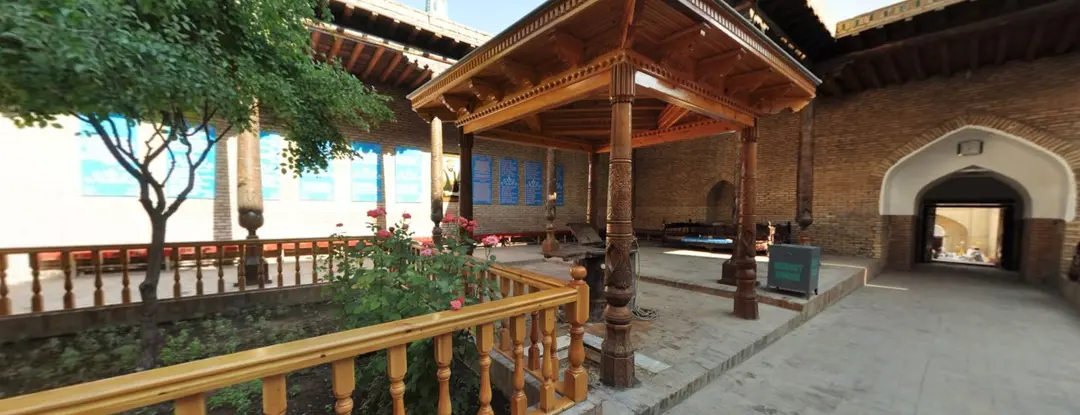
- The courtyard. A cosy little courtyard with trees and an old well. Its water is considered holy: it is said that whoever drinks it grows stronger, and young couples will have strong children.
- Carved doors. Wooden doors with fine carving, a showcase of Khivan craftsmanship.
Why it is always busy
The Pahlavan Mahmud Mausoleum is not just a tourist site but a living shrine. Visitors include:
- Newlyweds. On their wedding day many Khorezm couples come for a blessing. If you are here at the weekend, you will probably see wedding parties.
- Pilgrims from different regions of the country.
- Athletes before competitions.
- Tourists drawn by the architecture.
As a result it can be noisy and crowded, especially at weekends and in the wedding seasons of spring and autumn. For a quiet visit, come early in the morning.
Visiting rules
- Dress modestly: shoulders and knees covered; a headscarf is advisable for women.
- Speak quietly inside and do not disturb people praying.
- Photograph people only with permission. Photography may be restricted in the main hall.
- Entry may be covered by the Itchan Kala combined ticket or charged separately; check on site.
- Allow 30-40 minutes.
The mausoleum is in the southern part of Itchan Kala, next to the Islam Khodja Minaret, so it combines easily with climbing the minaret and visiting Tash-Hauli.
From Khiva to Bukhara
After Khorezm many travellers continue to Bukhara, about 450 km across the Kyzylkum Desert and along the Amu Darya, six to seven hours by car. The road is long but interesting: dunes, saxaul shrubs and the occasional village. A convenient way to cover it is a shared ride via Yo'ldosh: you book one seat with a verified driver, and the cost is noticeably lower than a private taxi. Leave early in the morning to reach Bukhara in daylight, and bring water and snacks.
See trips on the Khiva - Bukhara route page and other directions in the routes section.
Cover photo: Jamolbek Kalandarov, CC BY-SA 4.0, Wikimedia Commons.
