Po-i-Kalyan: The Minaret That Genghis Khan Spared
The ensemble around Bukhara's great minaret: the Kalyan Mosque, Mir-i-Arab Madrasa, the evening lighting and the best spots to see Po-i-Kalyan from.
If Bukhara has one postcard image, it is Po-i-Kalyan: a tall round minaret flanked by the portals of a mosque and a madrasa with blue domes. The name translates as "foot of the great one", meaning the space at the foot of the Great Minaret. This is the heart of old Bukhara, and almost any walk around the city passes through this square sooner or later.
The Kalyan Minaret: almost nine centuries old
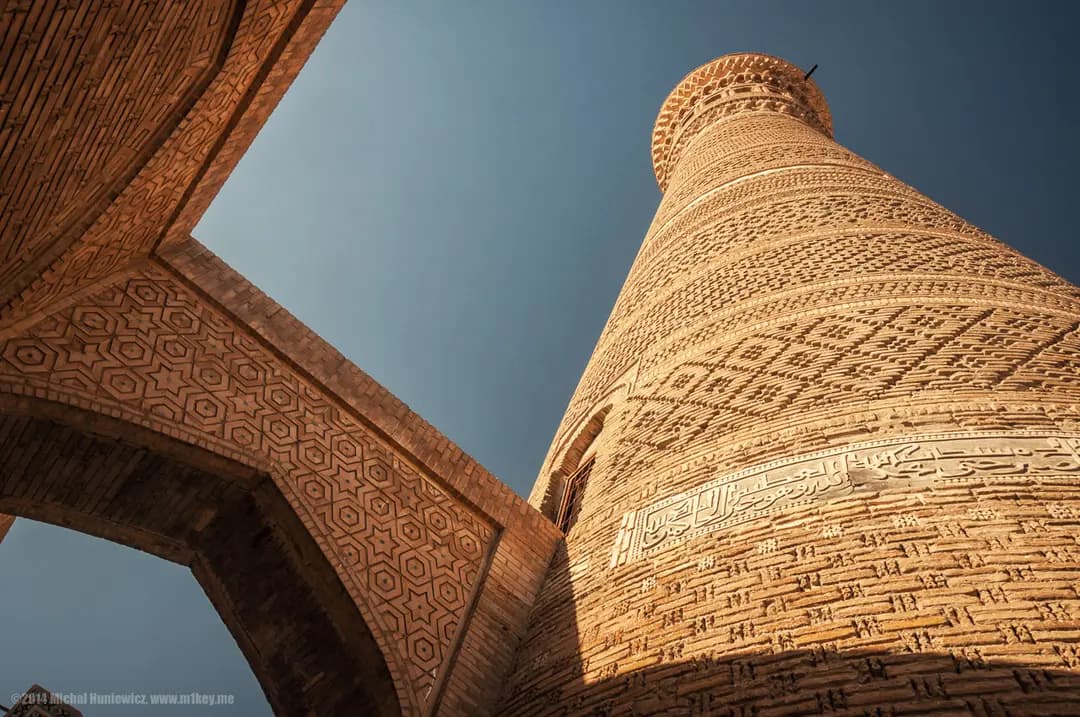
The minaret was built in 1127 under the Karakhanid ruler Arslan Khan. It is about 46 metres tall and for centuries was the highest point in the city. It was used not only for the call to prayer: the minaret served as a landmark for caravans approaching Bukhara across the desert, and as a watchtower.
The most famous legend dates from 1220. Genghis Khan's armies took Bukhara and destroyed much of the city, including the congregational mosque. According to the story, the khan rode up to the minaret and tipped his head back to see the top, and his hat fell off. As he bent to pick it up, he supposedly said that this minaret deserved a bow and ordered that it be left untouched. Whether this is true nobody knows, but the minaret did survive the Mongol invasion.
Take a close look at the brickwork. The shaft is wrapped in bands of fired brick in different patterns, each ribbon with its own ornament. Just below the top runs a narrow strip of blue glaze, one of the earliest in Central Asia. At the summit is a rotunda with sixteen arched openings.
Tourists are usually not allowed to climb the minaret. You may hear stories of exceptions, but do not count on it.
The Kalyan Mosque
West of the minaret stands the Kalyan Mosque, one of the largest in Central Asia. The present building dates from the early 16th century and replaced the ancient congregational mosque. Its vast courtyard held thousands of worshippers and is surrounded by domed galleries, more than two hundred domes in all. At the far end is the main building with a turquoise dome.
In the courtyard stands a small octagonal pavilion. It served acoustics, allowing the person repeating the imam's words to be heard across the whole courtyard. The mosque is active: tourist access may be limited at prayer times, and it is best not to plan a visit for Friday midday. Clothing should cover shoulders and knees.
The Mir-i-Arab Madrasa
Opposite the mosque is the Mir-i-Arab Madrasa with its two blue domes. It was built in the 1530s and named after a sheikh from Yemen who was spiritual mentor to the rulers of Bukhara. Mir-i-Arab is a working religious school, one of the few madrasas that operated even in Soviet times, so tourists are not admitted to the inner courtyard. You can step into the vestibule and look at the courtyard through the grille.
Evening lighting and the square at night
In the evening the ensemble is illuminated and the square changes. The heat eases, people come out for a stroll, and the minaret glows golden against the dark sky. Many people think Po-i-Kalyan is even more beautiful at night than by day. Arrive half an hour before sunset to catch both the setting sun on the brick and the moment the lights come on.
Best viewpoints
- The square between the mosque and the madrasa - the classic shot: the minaret in the centre, portals on either side.
- From the Toki Zargaron side - the minaret rises above the roofs of the trading domes.
- Rooftop cafe terraces around the square - several places offer a view of the minaret. Coffee costs more there, but the view is worth it. The name does not matter; just look for open rooftops.
- From the Ark side - the minaret stands above the old city, especially lovely at sunset.
- Early morning - the square is almost empty and you can take photos without people.
Practical tips
- The square is free to enter. The Kalyan Mosque usually charges an inexpensive ticket; prices are approximate and change.
- Allow 1-1.5 hours for the ensemble, then walk on to the trading domes and Lyabi-Hauz, all close by.
- In summer it is very hot here by day with almost no shade; the best times are before 10 a.m. and after 5 p.m.
- Five minutes away, just past the Toki Zargaron trading dome, the Ulugbek Madrasa (1417) and the Abdulaziz Khan Madrasa face each other. It is a rare chance to compare the restrained 15th-century style with lavish 17th-century decoration.
- Consider a guide: they will point out details that are easy to miss, such as inscriptions in the brickwork.
Getting to Bukhara
From Tashkent to Bukhara is about 560 km by road, roughly seven to eight hours by car. From Samarkand it is about 270 km and three and a half to four hours. Besides the trains, a shared ride is convenient: on Yo'ldosh drivers publish trips and you book a single seat in the app. It costs less than a whole taxi, drivers are verified, and you can choose a departure that gets you to Bukhara in time for the evening lights at Po-i-Kalyan.
Routes: Tashkent - Bukhara and Samarkand - Bukhara. Other directions are in the routes section.
Cover photo: Michał Huniewicz, CC BY 2.0, Wikimedia Commons.
