Bukhara: a guide to a living medieval city
How to find your way around Bukhara: the old city and new districts, the trading domes, mahallas and bazaars — and where to start on your very first evening.
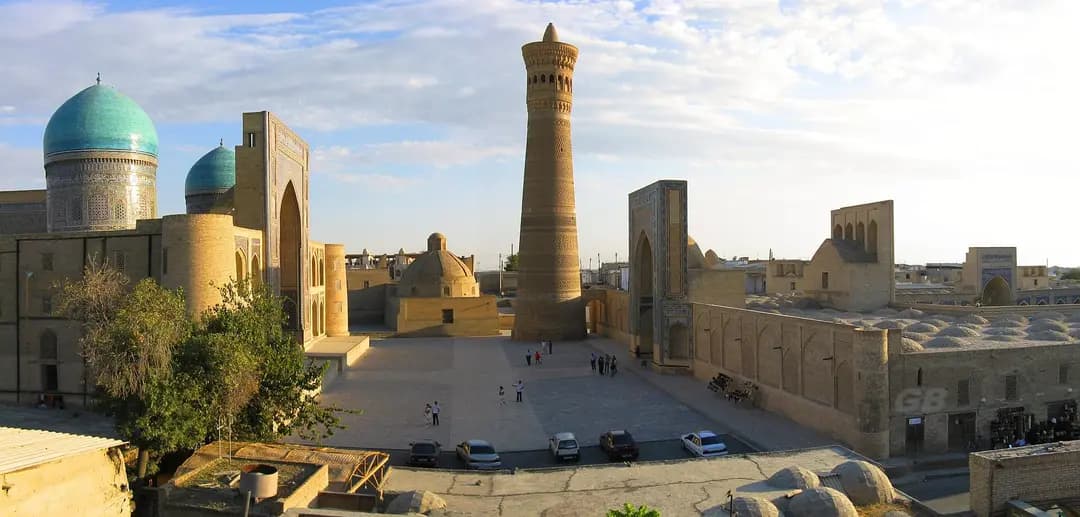
Bukhara is often called a museum city, but that is not quite right. Nobody lives in a museum, yet people very much live in old Bukhara: behind madrasa walls coppersmiths' hammers ring out, laundry dries in courtyards and bicycles rattle down the lanes. The historic centre has survived almost intact, which makes Bukhara wonderfully easy to explore on foot. The key is understanding how the city is laid out and planning your time well.
How Bukhara is laid out
The city roughly divides into two parts:
- The old city — the historic centre, once enclosed by walls of which fragments and a few gates remain. Almost all the monuments, guesthouses, craft shops and mahallas are here. It is modest in size: you can cross it on foot in 30–40 minutes.
- The new city — the Soviet-era and modern districts around it: government buildings, residential areas, markets, large hotels and the roads out of town.
An important detail: the railway station is not in Bukhara itself but in the neighbouring town of Kagan, about 12–15 km away. From the station to the old city it is 20–30 minutes by taxi.
Key landmarks in the old city
The old city is easy to navigate using a few reference points:
- Lyabi-Hauz — a square around an old pool shaded by mulberry trees and framed by a madrasa and a khanqah. It is the heart of tourist Bukhara and the best landmark.
- The trading domes — covered crossroads where jewellers, money changers and hat makers traded for centuries. Today they sell souvenirs, carpets, knives and textiles.
- Poi-Kalyan — the ensemble of the Kalyan Minaret, mosque and Mir-i-Arab Madrasa. The 12th-century minaret is visible from almost everywhere, so it is easy to find your way by it.
- The Ark — the ancient fortress of the emirs on the western side; opposite it stands the Bolo-Hauz Mosque with its carved wooden columns.
- Samanid Park — home to the Samanid Mausoleum, one of the oldest surviving monuments in Central Asia, with Chashma-Ayub nearby.
They all lie along one axis, and the walk from Lyabi-Hauz through the domes to Poi-Kalyan and the Ark is the classic first-day route.
The mahallas
Turn off the main street and you are in residential neighbourhoods. Narrow lanes, mud-brick walls, carved doors. The mahallas hide small mosques, madrasas and the former Jewish quarter with its working synagogue. This is also where you will find Chor-Minor, a small and very photogenic building with four blue domes.
Walk quietly and respectfully: these are people's homes, not stage sets.
Markets
- The central market — in the new city, not far from Samanid Park. This is where Bukharans themselves shop: vegetables, fruit, spices, dried fruit and bread.
- The trading domes and craft workshops — more for souvenirs. Look for forged knives, engraved metalwork, carpets, suzani embroidery and Bukhara's famous stork-shaped scissors.
Prices at the market are lower and bargaining is normal. In craft workshops prices depend on quality and handwork, so ask and compare.
Your first evening in Bukhara
If you arrive during the day, here is a simple plan for the evening:
- Check in and rest — Bukhara is hot during the day for most of the year.
- Towards sunset head to Lyabi-Hauz: the square comes alive, with people dining and strolling by the water.
- Walk through the trading domes to Poi-Kalyan — the minaret looks its best at sunset and under the evening lights.
- Return through the mahallas, where the lanes are quiet and cool.
This takes 2–3 hours, and by the end you will already understand how the centre fits together.
How many days you need
| Time | What you can fit in |
|---|---|
| 1 day | Lyabi-Hauz, the domes, Poi-Kalyan, the Ark |
| 2 days | plus the Samanid Mausoleum, Chor-Minor, mahallas and the market |
| 3 days | plus sights outside the city: the Sitorai Mohi-Khosa summer palace and the Bahauddin Naqshband complex |
When to go
The best times are April–May and September–October. In summer daytime temperatures exceed 40 °C, and walking is only comfortable in the morning and evening. Winter is chilly, but there are few tourists and prices are lower.
Getting there and moving on
Bukhara sits on the country's main tourist route:
- From Samarkand — about 270 km, 4 hours by car, faster by train. Shared rides on Bukhara — Samarkand are handy if you want to leave at your own time or stop along the way.
- To Khiva — about 450 km across the Kyzylkum desert, 6–7 hours. Trips on Bukhara — Khiva save you hunting for a taxi for the whole long journey; leave early in the morning to cross the desert before the heat.
- To Tashkent — about 600 km. Besides trains and flights, there are Bukhara — Tashkent trips.
On Yo'ldosh you book a seat in the app and can agree on the pick-up point with the driver — sometimes right at the edge of the old city.
The bottom line
Bukhara is a city to take slowly. Start at Lyabi-Hauz, navigate by the Kalyan Minaret and leave time for the mahallas. For the next leg of your journey, check the routes page.
Cover photo: Euyasik, CC BY-SA 3.0, Wikimedia Commons.
