Chatkal Nature Reserve: wild mountains next door to Tashkent
One of Uzbekistan's oldest nature reserves lies a couple of hours from Tashkent. What it protects, which parts you can visit and how to get there via Parkent or Angren.
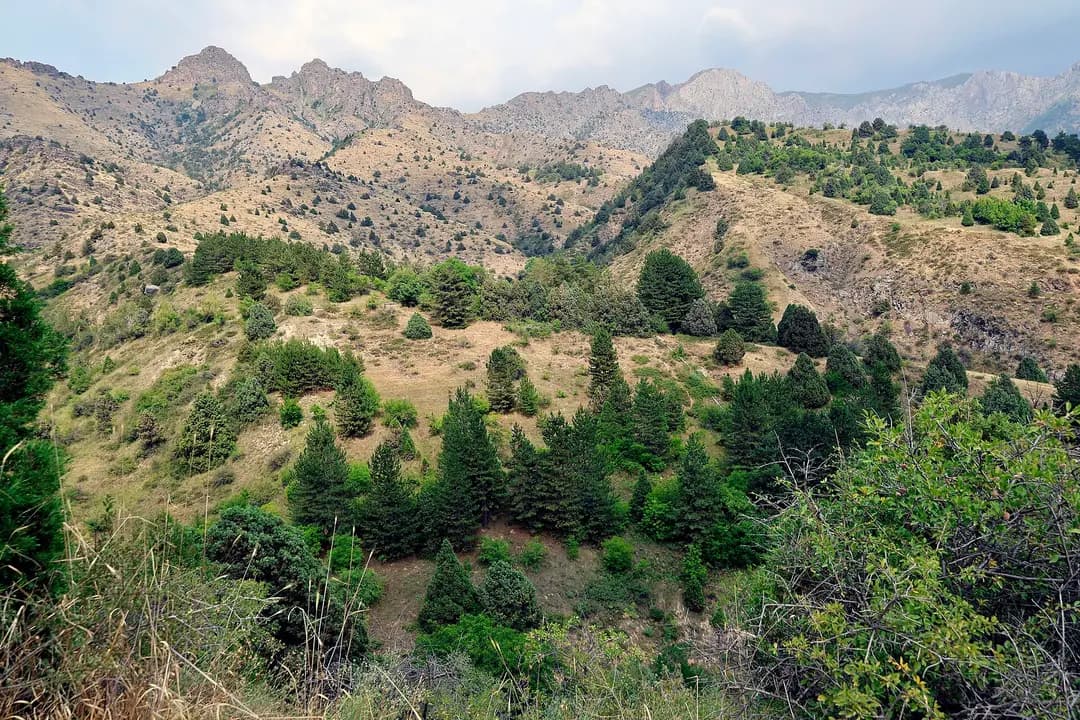
On a clear day you can see the Chatkal range from Tashkent: white-capped in winter, a blue line on the horizon in summer. In 1947 one of Uzbekistan's first nature reserves was set up on its slopes, and it later became a UNESCO biosphere reserve. It is not a park for casual strolls but a strictly protected area, yet you can get to know it if you go about it the right way.
How a reserve differs from a national park
A zapovednik, or strict nature reserve, is the highest level of protection. Economic activity is banned, free entry is closed, and visits are possible only with permission from the administration and usually with a member of staff. This is what sets the Chatkal reserve apart from the neighbouring Ugam-Chatkal National Park, which has villages, holiday camps and open hiking trails.
The two sections
The reserve consists of two separate parts.
Bashkyzylsay lies on the southern slopes of the Chatkal range, on the side of the Akhangaran valley. It is mid-mountain country with juniper woods and thickets of walnut, wild apple, hawthorn and maple. Guided visits and nature trails are based here, so most visitors get to know the reserve through Bashkyzylsay.
Maidantal is the high-altitude section in the upper Pskem, inside the border zone: alpine meadows, rock faces, snowfields and marmot colonies. It is much harder to reach. The road is long, and the border regime requires separate paperwork.
What the reserve protects
Its value lies in packing almost every altitude zone of the western Tian Shan into a small area, from foothill steppe to alpine meadow.
- Plants. Several species of juniper, walnut, and Sievers' apple, the wild ancestor of the domestic apple, along with wild rose and barberry. In spring wild tulips flower on the slopes.
- Mammals. Tian Shan brown bear, Siberian ibex, wild boar, roe deer, porcupine and, higher up, Menzbier's marmot. Snow leopards live here too, although seeing one is almost impossible.
- Birds. Bearded vulture, Himalayan griffon, golden eagle and many small mountain birds.
To see wildlife you need early starts and plenty of walking. Ibex and marmots are the most common sightings, bears only occasionally and usually at a distance.
How to arrange a visit
You cannot simply walk into the reserve. The usual process:
- Contact the reserve administration or a tour operator that runs eco-tours and ask which routes are currently open.
- Agree the date, group size and format: a day trip or an overnight hike.
- Bring your passport, which may be requested when you register and at the ranger post.
- On arrival, take the safety briefing and stay on the agreed trail.
Visiting rules and fees change, so check everything in advance rather than on the day.
Getting there
There are two convenient approaches.
- Via Angren. Angren is about 110 km from Tashkent, roughly one and a half to two hours along the Kamchik highway, and it is the closest town to the Bashkyzylsay section. You can get there as a shared ride on Tashkent — Angren.
- Via Parkent. Parkent sits in the foothills of the Chatkal range, about 50 km from Tashkent. It is a good base for exploring the local countryside, and on the way you can stop at the Solar Furnace complex, a well-known research site in the Parkent district. Look for trips on Tashkent — Parkent.
The last stretch to the ranger post is a mountain road with no public transport. It is usually covered in the organiser's vehicle or with a local driver.
When to go
| Season | What you will see |
|---|---|
| April to May | Tulips and fruit trees in bloom, full streams |
| June to July | Green slopes, a good time for higher ground |
| September to October | Autumn colours, ripe walnuts, mild weather |
| November to March | Snow in the mountains, many trails closed |
Rules to follow
- Stay on the trail and keep up with your guide.
- Do not pick plants, mushrooms or nuts, and do not take stones.
- Keep noise down and do not play music: animals move away from noise.
- Do not light fires where it is not permitted.
- Carry out everything you carry in.
- Do not approach or feed animals, even if they seem tame.
Practical tips
Wear comfortable footwear with good grip, as the trails are rocky. Even in summer the mountains are hot by day and cool in the evening, so bring a warm layer. Carry your own water. There are springs along the routes, but do not drink from them without boiling or filtering. Mobile coverage is patchy.
If you want nature without paperwork, start with the open trails around Parkent and Angren, and book the reserve itself in advance. You can reach your starting point in a shared car via Yo'ldosh: choose Tashkent — Angren or Tashkent — Parkent and book a seat with a verified driver.
Cover photo: 26D, CC BY-SA 4.0, Wikimedia Commons.
