Gijduvan Ceramics: Deep Colours and Family Workshops
How Gijduvan pottery differs from Rishtan ware, how potter dynasties work and how to visit the workshops from Bukhara in half a day.
Uzbek ceramics are famous far beyond the country, and each centre has its own hand. If Rishtan ware is associated with turquoise-blue shades, Gijduvan pottery gives an impression of restrained depth: dark green, brown and rich blue tones, dense patterns and a heavy, tangibly authentic form. Gijduvan lies not far from Bukhara, and its workshops are easy to fit into a day of sightseeing. Here is what makes this centre interesting and how to visit via the Bukhara — Gijduvan route.
Where Gijduvan is
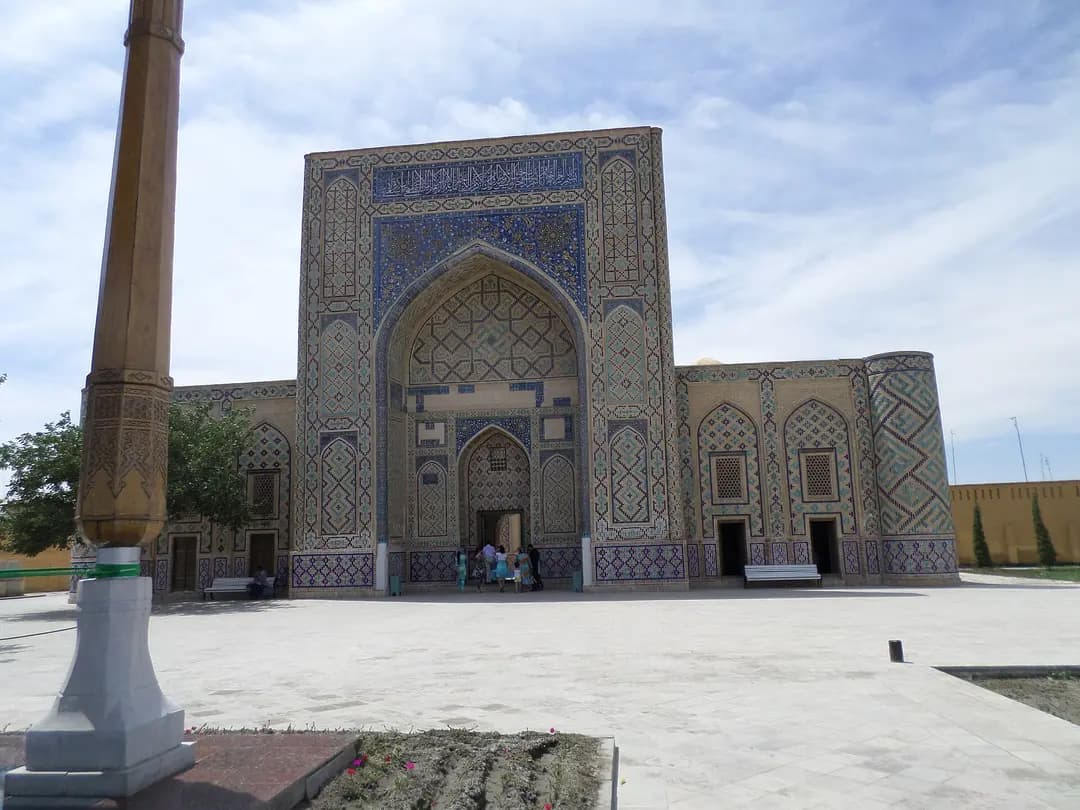
The town of Gijduvan is in Bukhara region, roughly 40-45 kilometres from Bukhara. The drive takes about an hour. It is a small town with a long history: the Sufi sheikh Abdulkhaliq Gijduvani was born here, and a madrasa built under Ulugh Beg in the fifteenth century survives in the town. But for many travelers the main reason to come is the pottery workshops.
How Gijduvan ceramics differ from Rishtan
You can compare the two main centres of Uzbek ceramics to feel the difference.
- Rishtan ceramics from the Fergana Valley are famed for a turquoise and sky-blue glaze made with plant ash (ishkor). The pattern is often light and airy, with floral motifs.
- Gijduvan ceramics are darker and heavier in mood. Green, brown and deep blue colours dominate, and the painting is denser. Patterns are often geometric and floral, laid down with a confident hand.
Both traditions are distinctive, and the point of comparing them is not "better or worse" but the pleasure of seeing two schools. If you have seen both, you can easily tell them apart in any market afterward.
Family dynasties of potters
Gijduvan ceramics rest on family workshops where the craft passes from father to son over many generations. In one family a grandfather, father and grandsons work together: one prepares the clay, another shapes, a third paints. Whole potter dynasties are known, including the Narzullayev family. Apprentices sometimes begin with simple tasks, such as preparing clay or firing, and only later are allowed to paint.
This is not just a business but a way of life and a family's pride. Masters willingly explain how things work and show the stages.
How the ware is made
- Preparing the clay. It is cleaned and kneaded to remove air and achieve uniformity.
- Shaping on the potter's wheel. The master draws up the form: a bowl, a dish, a jug.
- Drying. Pieces are dried for several days.
- Painting and glazing. The pattern is painted by hand with mineral pigments, then covered in glaze.
- Firing in a kiln. After firing the colours emerge in full force.
The fruits of this labour are bowls, lyagans (large plov dishes), jugs, and plates with ornament.
What you can bring home
- Lyagans and dishes. The most recognisable piece of Uzbek ceramics, good for serving and for decoration.
- Bowls and tea sets. A practical souvenir.
- Jugs and vases. Easier to carry home if packed carefully.
- Patterned tiles. Light and compact.
Ask for fragile items to be wrapped in thick paper and boxed. Do not hesitate to bargain politely, but remember that handwork deserves its price. Prices change, so focus on what you like and compare at several workshops.
How to organise the trip
Half a day is enough to see the workshops and have lunch. Use this plan:
- leave Bukhara in the morning, before the hottest part of the day;
- visit one or two workshops, watch the process, and try sitting at the wheel yourself if the master allows;
- look around the madrasa and the town centre;
- have lunch in a local teahouse and return to Bukhara by evening.
You can go by taxi, bus or shared ride: on Bukhara — Gijduvan via Yo'ldosh you book a seat in advance and know the departure time and price. If carrying fragile ware, warn the driver in advance. All directions are collected on the all routes page.
Tips
- The best time to visit is spring and autumn: summers are hot.
- Check workshop hours in advance: they may depend on the day of the week.
- Bring cash: not everywhere has card terminals.
- Ask permission before photographing the masters.
- Support the craft: buy from the potters themselves rather than resellers.
Cover photo: Bobyrr, CC BY-SA 4.0, Wikimedia Commons.
