Kampyr Tepa, Zurmala and Kirk Kiz: Ancient Sites Around Termez
An ancient fortress at a crossing of the Amu Darya, a Kushan-era brick stupa and the mysterious "Castle of Forty Maidens" — a ready-made half-day route around Termez.
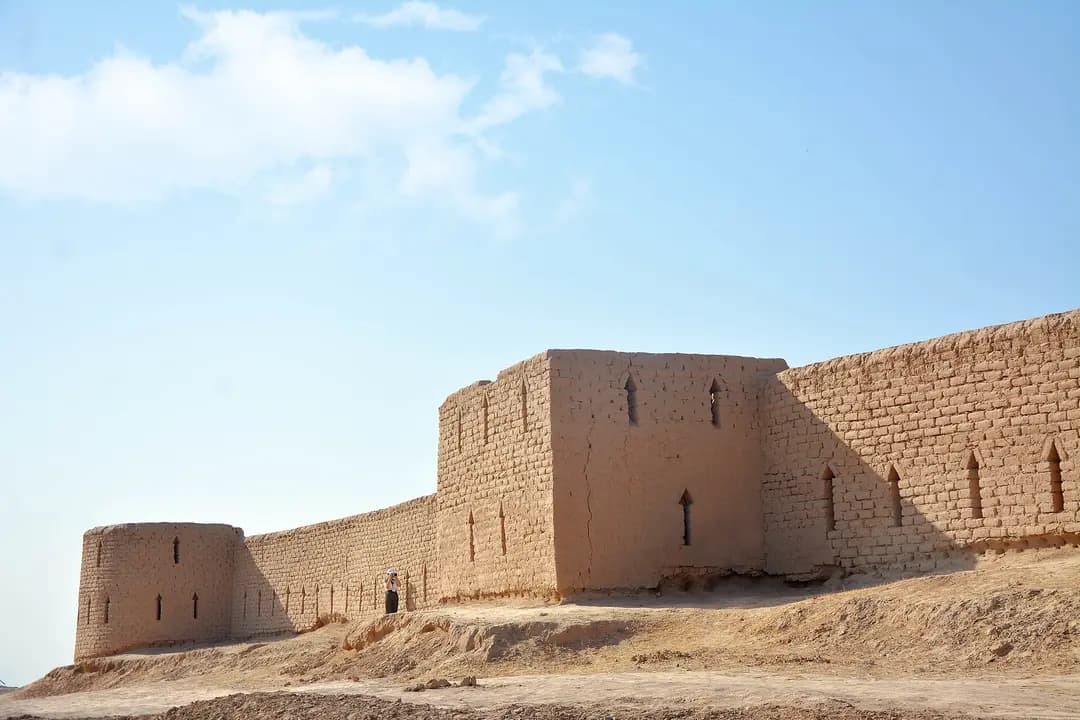
The main sights of Termez — Fayaz Tepa, Sultan Saodat and the mausoleum of al-Hakim al-Termezi — appear in almost every itinerary. But there are several other sites around the city that visitors often skip, even though they say just as much about the region. The ancient fortress of Kampyr Tepa, the brick stupa of Zurmala and the square "castle" of Kirk Kiz span nearly fifteen hundred years of history and together make a convenient half-day route.
Kampyr Tepa: a fortress at the river crossing
Kampyr Tepa is an ancient town site on the right bank of the Amu Darya, about 30 km west of Termez. The town existed from the late 4th century BC to the first centuries AD, which means it lived through the age of Alexander the Great, the Greco-Bactrian kings and the early Kushans.
Why it matters:
- The crossing. The town controlled a crossing point on the Amu Darya and served as a small river port. Some researchers link it to the landing places on the Oxus mentioned in classical sources — Oxus was the Greek name for the Amu Darya.
- A well-preserved layout. You can make out the citadel on a rise, the defensive walls, and the streets and quarters of the lower town. Excavations have been going on here since the 1970s, so the structure is easy to understand even for non-specialists.
- The river view. From the citadel there is a wide panorama over the Amu Darya and its desert banks.
How to visit
Kampyr Tepa lies in the border zone. You need a permit to visit, which is usually arranged in advance through a travel agency, the museum or an official request. The procedure changes from time to time, so:
- Check the current rules at the Termez Archaeological Museum or with local guides.
- Bring your passport.
- Do not photograph border installations, and follow your escorts' instructions.
If you do not have a permit, do not plan to go on your own; it is simpler to focus on the other two sites.
The Zurmala stupa: a Kushan brick tower
Zurmala is one of the oldest surviving structures in Uzbekistan. It is a Kushan-era stupa (roughly 1st–2nd century AD), of which a massive cylindrical tower of mud brick about 13 metres high remains. It was once faced with cladding and probably crowned with a dome and parasols, like the stupas of Gandhara.
Good to know:
- It stands in an open field on the outskirts of Termez and is visible from a distance.
- You can walk up to the base, but climbing the stupa is not allowed: the brick is fragile, and every footstep speeds up its decay.
- The best time for photos is morning or sunset, when the low sun brings out the texture of the brickwork.
Zurmala was part of a larger Buddhist landscape around Old Termez, together with the monasteries of Fayaz Tepa and Kara Tepa. After the museum and Fayaz Tepa its significance becomes especially clear.
Kirk Kiz: the "Castle of Forty Maidens"
Kirk Kiz is an early medieval building (around the 9th–10th century), square in plan with sides of roughly 50 metres, corner towers and an entrance on each side. Inside is a system of corridors, rooms and a central hall.
Its purpose is still debated: it may have been a country palace, a caravanserai, a Sufi khanaqah or a fortified estate. Folk tradition links the name to a legend about forty warrior maidens. Which version is closest to the truth is for you to decide, but the place certainly has a special atmosphere.
Tips:
- You can go inside, but watch your step: the mud-brick walls and floors are uneven.
- Do not lean on the walls or break off pieces of clay.
- There is almost no shade in summer, so come early.
A half-day route
| Time | Stop | How long to allow |
|---|---|---|
| 7:30–8:00 | Leave Termez | — |
| 8:00–10:00 | Kampyr Tepa (with a permit) | 1.5–2 hours |
| 10:30–11:15 | Zurmala stupa | 30–40 minutes |
| 11:30–12:30 | Kirk Kiz | 40–60 minutes |
| 13:00 | Lunch and a break from the heat in town | — |
Without a permit for Kampyr Tepa, the route shrinks to two or three hours and combines easily with the Termez Archaeological Museum. The most practical way to move between the sites is to hire a taxi for a few hours, as public transport does not serve the monuments.
When to go
- March–May and October–November — ideal weather for walking around the ruins.
- Summer — temperatures often exceed 40 °C and there is no shade at the sites. If you come in July or August, stick to the morning hours.
- Winter — mild, but it can be windy and rainy, and the dirt access roads turn muddy.
What to bring
- your passport (essential in a border region);
- 1.5–2 litres of water per person;
- a hat and sunscreen;
- comfortable closed shoes;
- snacks, as there are no cafes at the sites.
Where next: Denau
After Termez many travellers head to the north of Surkhandarya, to Denau. It is about 130 km and roughly 2 hours along the valley, past cotton fields and orchards. On the way and around Denau there are several more well-known archaeological sites, Dalverzintepa and Khalchayan, and the town itself is known for its green gardens and its bazaar.
A shared ride is a convenient way to make the move: on the Termez — Denau route drivers post trips on Yo'ldosh, so you can book a single seat and leave at a time that suits you instead of waiting at the bus station.
Why it is worth seeing
Kampyr Tepa, Zurmala and Kirk Kiz show three different faces of Termez: an ancient town at a river crossing, a Buddhist shrine and an early medieval estate. These are places without crowds, where you can stand in silence and imagine the caravans and pilgrims who once passed this way.
If you are planning a trip around Surkhandarya, take a look at the Termez — Denau route and at all routes to put together a convenient chain of journeys.
Cover photo: Jonibek Qo'zimurodov, CC BY-SA 4.0, Wikimedia Commons.
