Marhamat: Mingtepa and the ancient capital of Dayuan
A quiet district town south of Andijan with the earthen walls of an ancient city nearby. What is known about Mingtepa, what to see and how to get there.
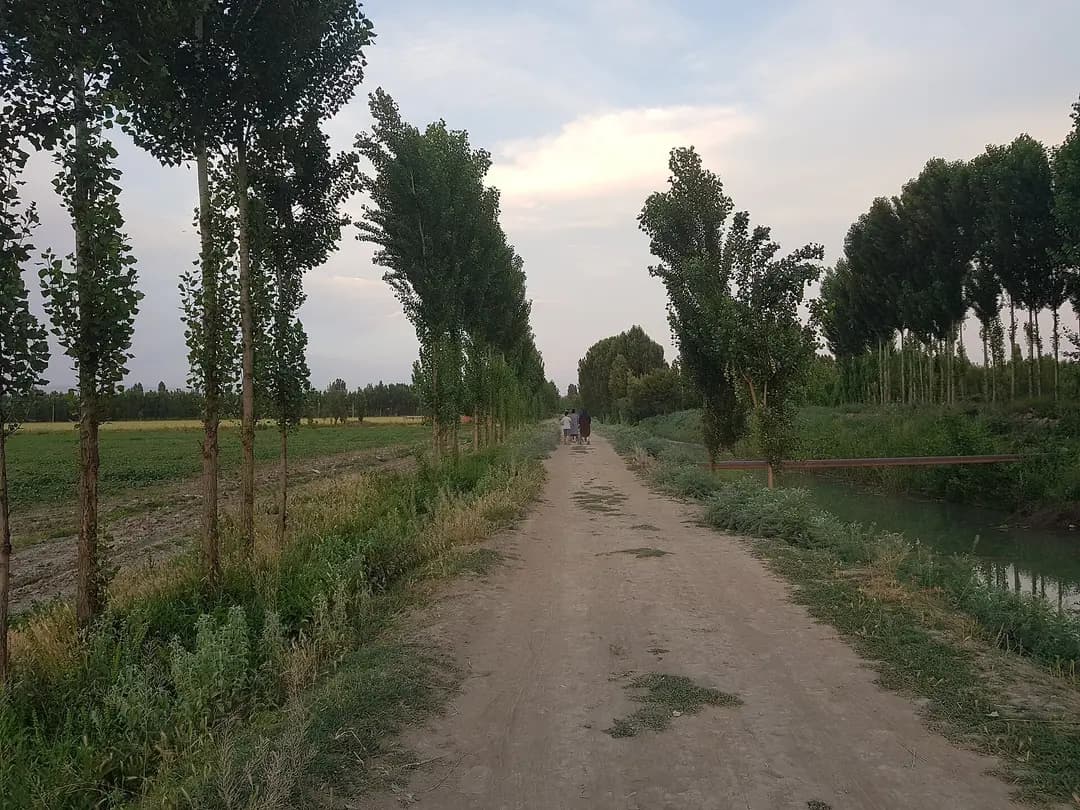
Two thousand years ago the Fergana Valley was known far beyond its borders. Chinese chronicles describe a rich state here called Dayuan, with walled cities, vineyards and the famous "heavenly horses" for which a Han emperor sent his armies across the mountains. Exactly where the capital of Dayuan stood is still debated, and one of the leading theories points to Mingtepa, an ancient site next to the modern town of Marhamat. Coming here is a way to see with your own eyes a place that ancient historians wrote about.
Where Marhamat is
Marhamat is a district town in the southern part of the Andijan region, about 25–30 km from Andijan. The drive takes around 40 minutes. To the south the foothills begin, and beyond them lies the border with Kyrgyzstan. The town is surrounded by orchards, cotton fields and villages, and hills on the edge of the plain make a pretty mountain backdrop on clear days.
Marhamat itself is calm and green, with none of the bustle of tourist towns. A main street with shops and teahouses, a bazaar and a park: a typical valley district centre where everyone knows everyone.
What Mingtepa is
Mingtepa, which means roughly "a thousand hills", is a large ancient settlement close to Marhamat. Archaeologists have studied it since the middle of the twentieth century. They have found the remains of massive defensive walls of mud brick and rammed earth, traces of inner quarters, pottery and other objects dated to the last centuries BC and the first centuries AD.
Many researchers link Mingtepa with the city of Ershi, the capital of Dayuan, which a Chinese army besieged at the end of the second century BC. According to the chronicles, Dayuan was famous for its fine horses, and China launched its military expeditions precisely to obtain them. There are other theories about where Ershi was, so it is fairer to call Mingtepa one of the main candidates rather than a proven fact.
What a visitor will see
It is important to set your expectations: Mingtepa is not a museum complex with display cases and audio guides. It is an archaeological site in the countryside:
- Earthen ramparts. The remains of the fortress walls look like high, weathered ridges, especially visible in spring when the hills turn green.
- The outline of the ancient city. From the top of the ramparts you can see how the walls enclosed a large area, now covered by fields and villages.
- Excavations. If an expedition is working during the season you may see open trenches, but do not approach them without permission.
Without some preparation it is easy to mistake the site for ordinary hills, so read about it beforehand or ask locals to show you the most impressive sections of wall.
Visiting Mingtepa respectfully
- Do not pick up or take away pottery shards, coins or other finds: they are part of the monument, and removing them is prohibited.
- Do not climb into open trenches or walk along the edges of steep banks; the clay walls crumble.
- Part of the area is private land and farmland, so ask before crossing it.
- Bring water and a hat: there is almost no shade on the ramparts.
What else to see nearby
- Andijan. The Jami madrasa, the Babur literary museum and Babur Park on Bogishamol hill are a good complement to the ancient history, taking you forward to the Timurid era.
- Asaka. The car-plant town half an hour away offers a striking contrast between antiquity and modern industry.
- The southern foothills. In summer people from Andijan head towards the mountains to escape the heat; the roads pass through orchards and small villages.
When to go
The best months are April to May and September to October. In spring the hills are green, the orchards are in bloom and the ramparts stand out clearly against the grass. Summer afternoons are very hot, so if you come in July or August, set out early in the morning. In winter the valley roads are usually passable, but after rain the dirt tracks to the site can be muddy.
How to get there
Marhamat is easiest to reach from Andijan. Minibuses and taxis run, and on the Andijan – Marhamat route drivers also post shared rides on Yo'ldosh. This is handy if you want to leave at a specific time instead of waiting for a minibus to fill up. From Marhamat itself the site is a few kilometres away along local roads; that last stretch is easiest by local taxi.
How much time to allow
Half a day is enough for Marhamat and Mingtepa. Add Andijan with its museums and park and you have a full day spanning twenty centuries of history, from Dayuan to Babur.
If you are travelling with children, Mingtepa can be a good open-air history lesson: tell them about the heavenly horses and the siege, then ask them to find the spot on the ramparts where a gate might have stood. For photographers the best time is early morning or the hour before sunset, when the low sun brings out the relief of the walls and the shadows give shape to the weathered ramparts. At midday the site looks flat and washed out.
Marhamat is not on the standard tourist circuit, and that is its charm: here you will be almost alone with history. When planning your trip, check the Andijan – Marhamat route, and find other connections around the valley under all routes.
Cover photo: Ella's page, CC BY-SA 4.0, Wikimedia Commons.
