Odina Mosque and Kok Gumbaz: A Walk Through Old Qarshi
Qarshi rarely makes it onto tourist itineraries, which is a pity: its centre keeps 16th-century mosques and an old brick bridge over the Kashkadarya, all easy to see in a couple of hours.
Most people pass through Qarshi on their way to Shahrisabz, Termez or Bukhara. Yet it is one of the oldest cities in the country: over the centuries it was known as Nakhshab and Nasaf, and in the Middle Ages it was an important stop on the caravan routes between Samarkand, Bukhara and Balkh. Today Qarshi is a modern regional capital, but a small historic quarter survives at its heart, and you can walk around it in a couple of hours. That makes it worth a proper stop rather than just a lunch break on the road.
A little history
The city grew up in the Kashkadarya oasis, on fertile land that has been irrigated since ancient times. According to a widely held view, Qarshi got its present name in the Mongol period, from a word associated with a palace or fortified residence. The great age of new building came in the 16th century under the Shaybanids, when mosques, madrasas and a bridge over the river were built.
The Kok Gumbaz mosque
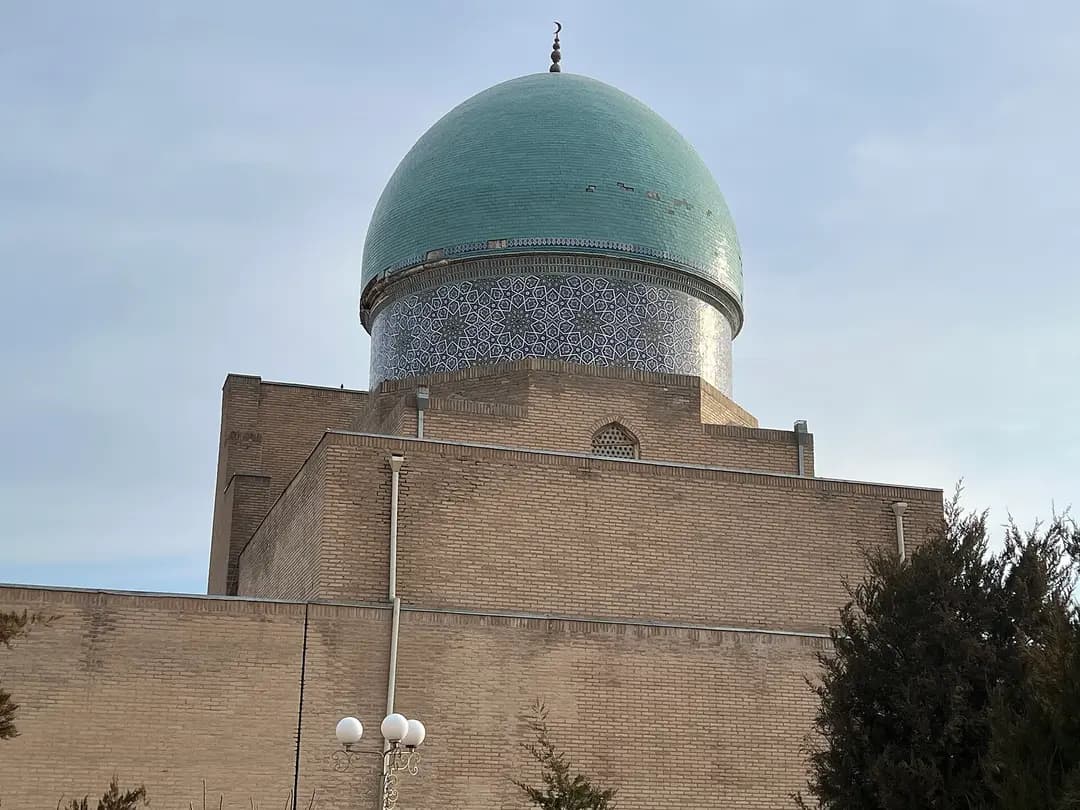
Qarshi's main Friday mosque is Kok Gumbaz, the "Blue Dome". It was built in the 16th century and is still one of the most prominent buildings in the old centre.
What to see:
- The dome. Large and set on a tall drum, it was once covered with blue tiles, hence the name. Even with much of its facing gone, it stands out clearly against the sky.
- The portal. Austere brick, with remnants of decoration.
- The interior. The spacious hall under the dome gives a real sense of scale, especially if you visit at a quiet time.
This is an active mosque, so plan your clothing and timing in advance: during prayer times and on Fridays visitors are asked not to disturb worshippers.
The Odina mosque
The Odina mosque is a small but very elegant 16th-century building. According to one version, it was originally built as a mausoleum and only later became a mosque, which would explain its compact proportions and centralised plan.
What to notice:
- the tiled facing of the portal with geometric and floral ornament;
- the careful brickwork of the walls;
- the contrast between the small volume and the tall portal, a typical device of architects of that era.
Odina looks especially lovely in soft evening light, when the tiles begin to glow.
The old bridge over the Kashkadarya
The Qarshi bridge is one of the city's most unusual structures. It is a 16th-century arched brick bridge, built under the Shaybanids, and it still stands in its original place. It connected the city to the roads to Bukhara and Samarkand, and caravans crossed it for centuries.
Why it is worth a visit:
- It is a rare surviving example of medieval engineering in Uzbekistan.
- The bridge and the riverbank offer views of the river and the city.
- In the evening local people stroll here, and the atmosphere is very relaxed.
Remember that it is a historic monument: do not climb on the parapets or pick at the bricks.
What else is nearby
The historic centre has other buildings you can see along the way:
- The Bekmir madrasa, a 16th-century madrasa near Kok Gumbaz;
- The Kilichbay and Khoja Abdulaziz madrasas, later buildings that are interesting examples of local architecture;
- The central bazaar, where you can try local flatbread and dried fruit and buy Kashkadarya carpets and embroidery.
A 2–3 hour walk
| Step | Stop | Time |
|---|---|---|
| 1 | Kok Gumbaz mosque | 30 min |
| 2 | Bekmir madrasa and surroundings | 20 min |
| 3 | Odina mosque | 20–30 min |
| 4 | Old bridge over the Kashkadarya | 30 min |
| 5 | Bazaar, lunch or tea | 40–60 min |
All the stops are fairly close together, but in summer it is better to take a taxi between them or set out early in the morning.
How to get there
From Samarkand
The distance is about 150 to 160 km, roughly 2.5 to 3 hours on the road. The route crosses steppe and foothills and combines well with a trip to Shahrisabz. A shared ride on the Qarshi — Samarkand route on Yo'ldosh lets you leave at a convenient time instead of waiting for a minibus to fill up at the bus station.
From Tashkent
Roughly 470 to 520 km depending on the road, about 6 to 8 hours of travel. There are trains, but many people prefer to drive, with stops in Samarkand or Jizzakh. The Tashkent — Qarshi route works well for such a long journey: drivers list their departure time and number of seats, and you book one seat and share the fuel costs.
When to go
- Spring is the best time: poppies bloom across the Kashkadarya steppes and temperatures are comfortable.
- Autumn is warm and dry, and the bazaar is full of fruit.
- Summer is very hot in Qarshi, sometimes above 40 °C. Walk in the morning and evening.
- Winter is mild, but often grey and rainy.
Practical tips
- In mosques, cover your shoulders and knees; women should wear a headscarf.
- Ask before photographing people.
- Carry cash, as cards are not accepted everywhere in small cafes and at the bazaar.
- Qarshi is a good base for trips around Kashkadarya, including Shahrisabz and Kitab.
Why it is worth lingering
Qarshi cannot compete with Bukhara in the number of monuments, but it shows how southern Uzbekistan lives without a tourist facade. A couple of hours in the old centre, an evening by the bridge and dinner in a local cafe are a good way to break the long drive south.
To plan your trip, see the Qarshi — Samarkand and Tashkent — Qarshi routes and other destinations under all routes.
Cover photo: MirfayzbekAbdullayev, CC0, Wikimedia Commons.
