The Muhammad Amin Khan Madrasa and the Other Madrasas of Khiva
How Khiva's madrasas are laid out, which ones are now a hotel and which are museums, and which are worth visiting in Itchan Kala if you only have one day.
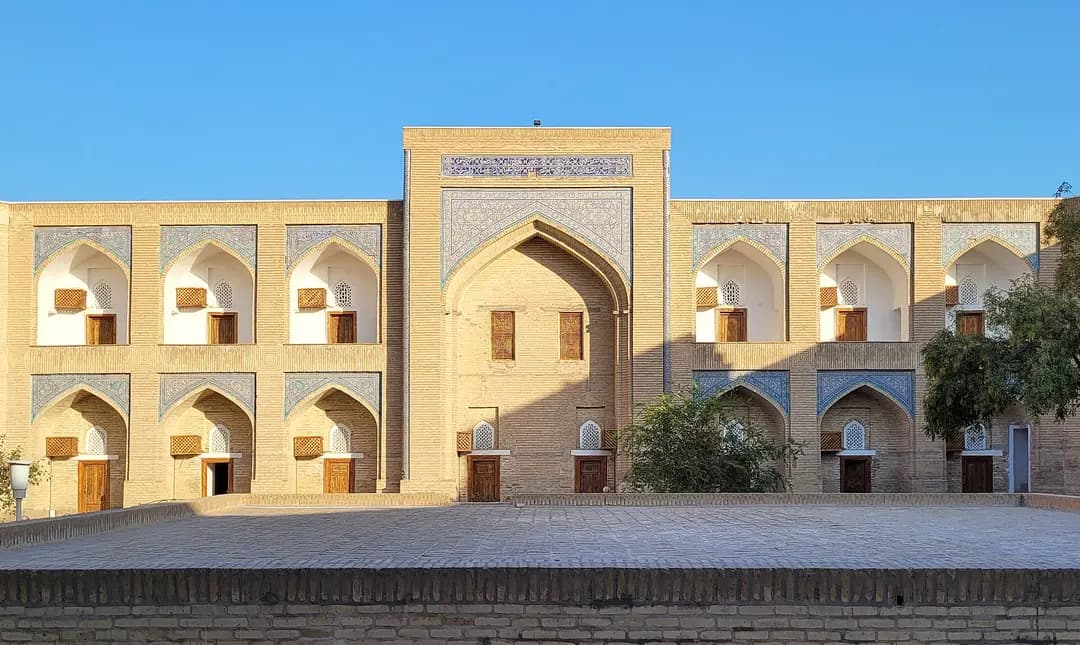
Within the walls of Itchan Kala, Khiva's old town, stand dozens of madrasas. They were once theological schools where students lived for years, studying the Quran, law, logic and poetry. Today some house museums, others craft workshops, and the largest has become a hotel. Here is how a Khiva madrasa is laid out and which ones to see first.
How a madrasa is laid out
Almost all of Khiva's madrasas follow the same plan, and once you understand it you can easily "read" any of them:
- The portal (peshtak), a tall entrance arch and the main decorative feature of the facade. In Khiva portals are often faced with tiles in blue and turquoise.
- Corner turrets (guldasta), small decorative towers at the corners of the facade.
- The vestibule, usually flanked by a mosque and a darskhana, the lecture hall.
- The inner courtyard, rectangular and surrounded by cells.
- Hujras, the students' cells, on one or two floors. Each housed one or two students: a small room with niches for books and belongings.
Students studied here for many years, supported by the waqf, the land and shops donated to the madrasa. The larger the waqf, the richer the school.
The Muhammad Amin Khan Madrasa
Khiva's largest madrasa was built in the early 1850s under Muhammad Amin Khan. It stands by the west gate of Itchan Kala, next to the Kalta Minor minaret. It has more than a hundred hujras on two floors, and its portal is one of the tallest in the city.
In its day it was not only a school but also the seat of the khanate's highest court. In Soviet times the building was converted, and today it operates as a hotel, with guest rooms in the former student cells. Even if you are not staying, you can step into the courtyard to appreciate its scale.
Next to it stands Kalta Minor, an unfinished minaret entirely covered in glazed tiles. It was meant to become the tallest in Central Asia, but construction stopped after the khan's death in 1855. Today it is probably the most recognisable symbol of Khiva.
Other madrasas worth seeing
The Muhammad Rakhim Khan Madrasa (second half of the 19th century), opposite the Kunya Ark citadel. Inside is a museum on the history of the Khiva Khanate and the khan himself, also known as the poet Feruz.
The Allakuli Khan Madrasa (1830s), by the eastern Palvan Darvaza gate. It is one of the most richly decorated, with a portal covered in finely patterned tiles. It once had a library.
The Islam Khoja Madrasa (early 20th century), small but famous for its minaret, the tallest in Khiva. Inside is a museum of applied arts: woodcarving, ceramics, textiles and jewellery. You can climb the minaret for a separate fee, and the view over the city is the best in Khiva.
The Shergazi Khan Madrasa (early 18th century), one of the oldest surviving. Legend says it was built by captives who were promised freedom once the work was done. The Turkmen poet Magtymguly studied here.
The Kutlug Murad Inak Madrasa (early 19th century), interesting for the water cistern built beneath its courtyard and for showing the classic two-storey madrasa plan very clearly.
Museums and workshops
In many of Itchan Kala's madrasas, craftspeople work in the former hujras: woodcarvers, embroiderers and carpet makers. It is a good chance to watch them at work and buy a souvenir directly from the maker. Bargaining is normal, but keep it polite.
Tickets and practical tips
- Itchan Kala has a combined entry ticket that covers most of the museums. Climbing the minarets and some exhibitions cost extra. Prices change, so check at the ticket office by the west gate.
- The best times to walk are morning and evening. Summer afternoons in Khiva are very hot, and there is no breeze in the enclosed madrasa courtyards.
- Allow a full, unhurried day to see the main madrasas.
- In the evening Itchan Kala is beautifully lit, the best time to photograph Kalta Minor.
- Wear comfortable shoes, as the old town's streets are paved with stone.
Getting there
The nearest major transport hub is Urgench, the regional capital of Khorezm, with an airport and a railway station. From Urgench to Khiva is about 30 to 35 km, a 40-minute drive.
Yo'ldosh shared rides between Khiva and Urgench run frequently in both directions, including mornings and evenings, which is handy if you fly into or leave by train from Urgench. You can book a seat in advance in the app and arrange with the driver to be dropped at the gates of Itchan Kala. It is usually cheaper than a taxi from the airport.
Khiva's madrasas are more than beautiful facades. Behind each portal lies the story of a whole community of students, teachers and craftsmen, and after walking through a few courtyards you begin to understand how this city lived behind its walls. Other destinations are on the routes page.
Cover photo: Bgag, CC0, Wikimedia Commons.
