The Pskem valley: border mountains and the permit regime
The wildest valley near Tashkent starts just past Charvak, but not everyone can enter, and not on any day they like. What to see there, whether you need a permit and how to organise a trip.
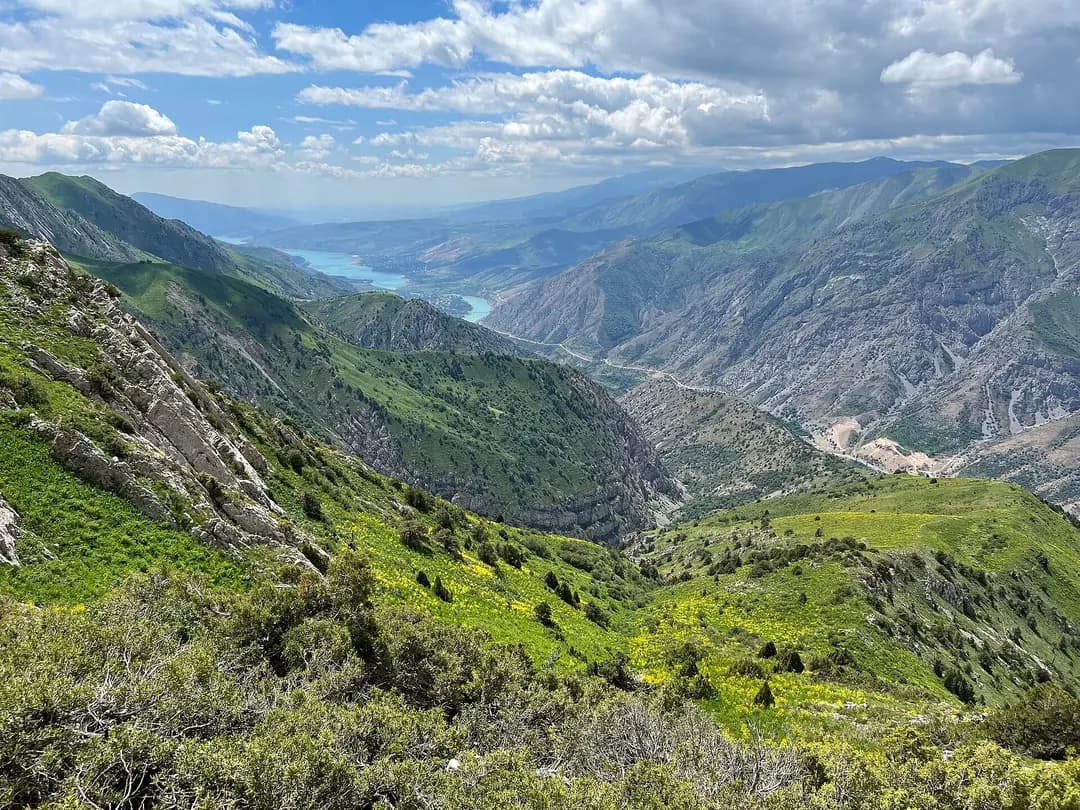
If Chimgan is a mountain resort for everyone, the Pskem is for those prepared for a long road and some paperwork. The valley of the Pskem river runs north-east from the Charvak reservoir all the way to the borders with Kyrgyzstan and Kazakhstan. There are no ski lifts and no noisy holiday camps, but there are the highest peaks of the Tashkent region, walnut forests and mountain lakes that few people ever reach.
What the Pskem is
The Pskem river rises in the high mountains where several ranges meet and flows into Charvak by the village of Bogustan. The valley is squeezed between the Pskem and Ugam ranges, and the further you get from the reservoir, the narrower and higher it becomes. Above it rises Beshtor, the highest point of the Tashkent region at around 4,300 metres. The high-altitude section of the Chatkal Nature Reserve lies at the head of the valley.
The lower valley has orchards and villages such as Nanay, the middle section has slopes of walnut and juniper, and the upper valley is alpine meadow, glaciers and snowfields.
What to see
- The road itself. A narrow mountain road along the river with views of rock walls is reason enough to go.
- Pskem village. The last sizeable village in the valley, rarely reached by tourists. Multi-day routes start here.
- The Ikhnach lakes. Mountain lakes in a side valley, a goal for well-prepared hikers with an overnight stay.
- The Urungach lakes. Two lakes in the lower valley and a comparatively easy route.
- Walnut forests and flower meadows. In summer flocks graze on the slopes and locals sell honey.
The permit regime: how it works
The valley lies in a border zone, and the road into it passes a checkpoint. The rules change from time to time, so treat what follows as a general picture and check the current procedure before you leave.
Citizens of Uzbekistan usually pass with a passport or ID card, sometimes registering at the checkpoint. At certain times entry for non-residents of the area may be restricted.
Foreign nationals must obtain a border zone permit in advance. It is usually arranged through a tour operator and takes anywhere from a few days to a couple of weeks. Without a permit, foreigners are turned back at the checkpoint.
Whatever your situation:
- keep your passport on you, not at the bottom of a bag in the boot;
- do not photograph the checkpoint or the border guards;
- do not head towards the border line or try to take shortcuts over the mountains;
- if you travel with a local driver, ask whether he has passed the checkpoint recently.
Getting there
The first leg is from Tashkent to Chirchik, about 35 km. It is easy to do as a shared ride, with trips on Tashkent — Chirchik leaving throughout the day. From Chirchik the road leads to Charvak, then along the northern shore of the reservoir to Bogustan and on up the valley.
The lower Pskem is about 100–120 km from Tashkent, and the upper valley takes much longer because of the road. The lower part is paved, higher up it turns to gravel in places. In spring, rain brings landslides and rockfall, so you need a car with good ground clearance and a driver used to mountain roads.
How to organise the trip
There are three workable options.
- With a tour operator. The easiest way for foreigners: the operator arranges the permit, transport and a guide. Best for multi-day hikes to the lakes.
- With a local driver. Suits Uzbek citizens who want to drive the valley in a day. Arrange it in Chirchik or at Charvak.
- On your own in your own car. Possible, but only if you trust your car and your mountain driving. Fill up beforehand, as fuel is hard to find in the valley.
When to go
| Period | What to expect |
|---|---|
| May | Green slopes and a full river, but landslides are possible |
| June to August | The best time for high ground and the lakes |
| September to October | Golden autumn, walnut harvest, settled weather |
| November to April | Snow higher up, parts of the road may be closed |
What to bring
- Your passport or ID card and, for foreigners, the permit.
- Warm clothes: nights are cold higher up even in summer.
- Water and food for one day more than you plan.
- A first-aid kit and sun protection, as the sun is very strong at altitude.
- Cash: village shops rarely take cards.
What not to do
Do not swim in the Pskem: the water is ice-cold and the current knocks you over even in the shallows. Do not light fires in the dry season or leave litter, as the valley is part of the national park. And if you are a foreigner, do not plan the trip at the last minute: without a permit arranged in advance, it will not happen.
If you would rather start with something easier, visit Charvak and Chimgan first and save the Pskem for a separate trip. Either way, the first leg is easiest with fellow travellers via Yo'ldosh on Tashkent — Chirchik, and from there you head on into the mountains.
Cover photo: Carpodacus, CC BY-SA 4.0, Wikimedia Commons.
