Shah-i-Zinda: the street of mausoleums in Samarkand
How to walk the necropolis from entrance to summit, which tiles to look at and how to behave in a living shrine so your visit is calm and respectful.
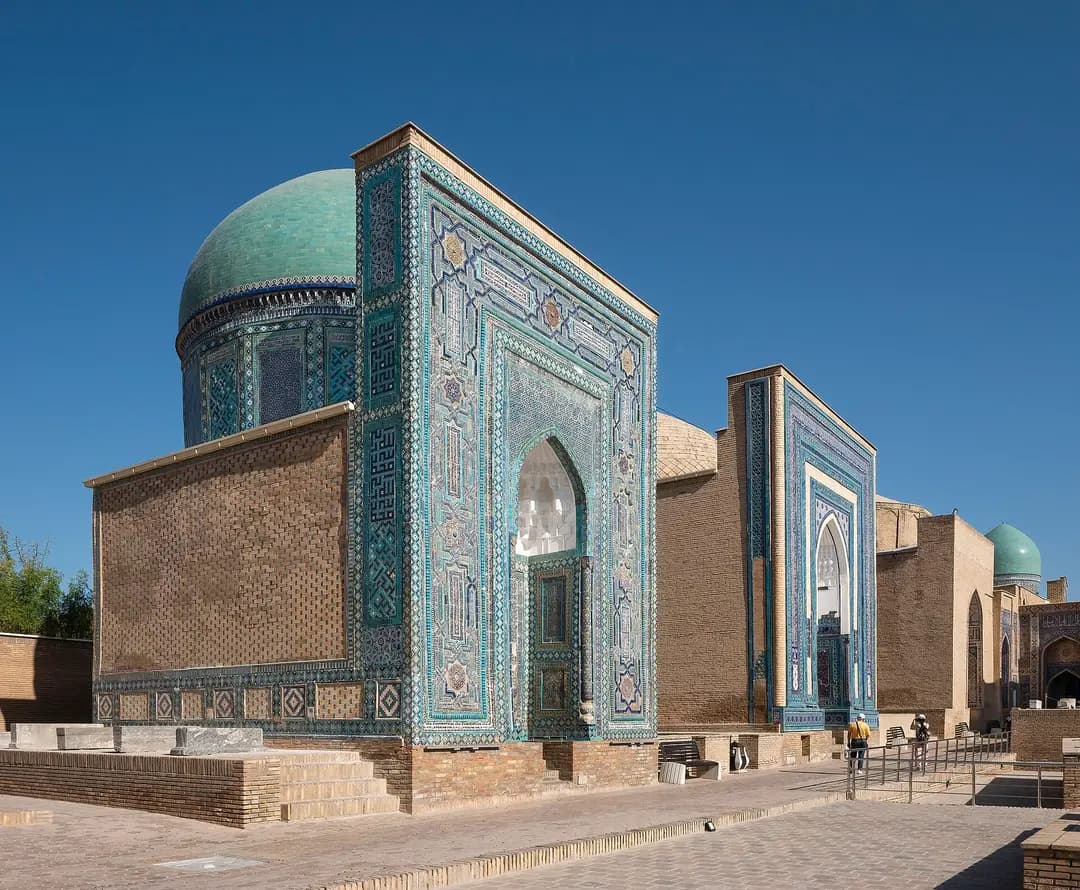
Shah-i-Zinda is an ensemble of mausoleums and mosques on a hillside in the north-east of Samarkand. The name means the living king and is tied to the legend of Qusam ibn Abbas, a cousin of the Prophet Muhammad, regarded as the man who brought Islam to this land. According to the story he was beheaded but took his head and went down into a well, where he continues to live. The shrine attracts pilgrims, and for the beauty of its tiles it is considered one of the finest in the world.
What Shah-i-Zinda is
The necropolis took shape from the eleventh to the nineteenth century, but most of the mausoleums were built in the fourteenth and fifteenth centuries under Timur and the Timurids. Members of the ruling family, nobles and commanders are buried here. The narrow lane between the mausoleums gives the impression of walking down a passage whose walls bloom with blue, turquoise, white and gold patterns.
The complex is divided into three groups:
- The lower group. Begins right after the entrance portal and the staircase. Early buildings of the fourteenth and fifteenth centuries stand here, along with portals.
- The middle group. Located on the rise, this is where most of the finest Timurid mausoleums are concentrated.
- The upper group. The most sacred part, including the tomb of Qusam ibn Abbas himself. It is the place most visited by pilgrims.
How to walk from entrance to summit
The entrance and staircase
The complex is reached by a staircase traditionally called the stairs of wishes: according to the tradition you must count the steps going up and going down, and the totals must match. If they match, your wish will come true. Is it hard? You have to count carefully.
The first mausoleums
Past the stairs a narrow passage begins. Stop by the first mausoleums and look at the fine carving in terracotta: the facades are covered in plant patterns and inscriptions made by hand.
The middle section
Here the ensemble opens up fully. Mausoleums stand on both sides of the lane, each with its own character: turquoise domes, portals with mosaic, painting and niches inside. Especially famous are the mausoleums linked with Timur's wives and relatives and with courtiers. The facades are made of majolica, terracotta and glazed brick.
The upper section
Climbing higher, you reach the most revered buildings, including the complex that holds the tomb of Qusam ibn Abbas. It is a living shrine, so it is especially important to be quiet here.
What to look at
- The tiles. Compare techniques: terracotta, majolica, mosaic. They show changes in taste and skill over several centuries.
- The portals. They are decorated with pointed arches and inscriptions.
- The domes. Inside some mausoleums you can see painting and niches.
- The details. Look closely at inscriptions and geometric patterns. They encode quotations and names.
How to behave in a living shrine
Shah-i-Zinda remains a place of pilgrimage. For a respectful visit:
- Dress modestly: shoulders and knees covered, and a scarf for women is advisable.
- Speak quietly, and do not run or make noise.
- Do not touch the tombstones unnecessarily.
- Ask permission before photographing people, especially those praying.
- Follow the instructions of attendants and locals.
When to come
The best time is early morning or late evening: fewer people and softer light. In the middle of the day, especially in summer, it is hot in the sun, and the mausoleums are tight and crowded. In winter the weather is cool but visitors are few. A visit usually takes about an hour, but you can stay longer if you want to study the details.
Tickets and hours
Entry is paid. Ticket prices and hours may change, so check current information on the spot or from official sources. For foreigners prices are usually higher than for residents.
Getting to Samarkand and back
From Tashkent you can reach Samarkand by high-speed train, bus or car. Returning from Samarkand to Tashkent is convenient by a shared ride leaving after the sights close: see trips on the Samarkand to Tashkent page. In the Yo'ldosh app you book a seat and see the departure time and the driver's profile.
Practical tips
- Wear comfortable shoes: the steps and stones are uneven.
- Bring water, especially in summer.
- Do not rush: the ensemble is best seen slowly.
- Combine Shah-i-Zinda with the Registan and Gur-Emir in one day.
Plan your trip
To return from Samarkand, open the Samarkand to Tashkent page. Other directions are in all routes. Drivers travelling between Samarkand and the capital will find the for drivers page useful.
Cover photo: Petar Milošević, CC BY-SA 4.0, Wikimedia Commons.
