Sitorai Mohi-Hosa: The Country Palace of Bukhara's Last Emir
East and West under one roof: the White Hall, peacocks in the garden, a suzani collection, and how to combine the palace with other Bukhara suburbs in a day.
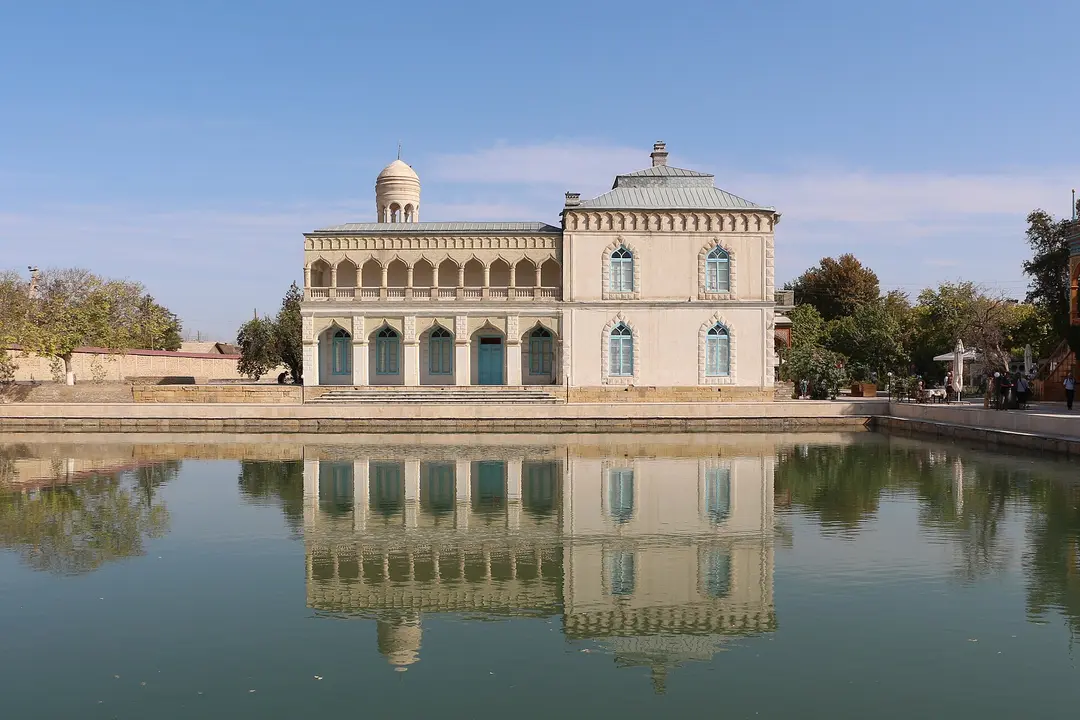
Most of Bukhara's monuments tell the story of the Middle Ages. Sitorai Mohi-Hosa tells a very different one: the final decades of the emirate, when Bukhara was already linked to Russia by rail and the emir travelled to St Petersburg and Yalta. This country palace north of the city is a blend of oriental ornament and European furniture, mirrors and stoves. It is a little eclectic and naive in places, and that is exactly what makes it interesting.
The palace's history
The name is usually translated as "palace like the stars and the moon". A country residence appeared here under Emir Abdulahad Khan, while most of the surviving buildings date from the early 20th century and the reign of his son Alim Khan, the last emir of Bukhara. According to legend, the site was chosen like this: carcasses of sheep were placed at different spots around the city, and wherever the meat stayed fresh the longest was judged to have the healthiest air. It sounds like a fable, but every guide tells it.
Both local craftsmen and architects familiar with European building styles worked on the palace. In 1920 the emir fled Bukhara and never returned, and the palace eventually became a museum.
What to see
The main palace and the White Hall
The central building combines oriental portals with European windows. Its jewel is the White Hall. The walls are covered with delicate carved ganch plaster backed with mirrors, and under the chandeliers the hall seems to glow from within. The work is attributed to the renowned Bukhara master Shirin Muradov. Receptions were held here, and this hall is the best place to understand the taste of the early 20th-century court.
Neighbouring rooms display Chinese and Japanese porcelain, European furniture, vases, gifts from foreign governments and large tiled stoves. Carved ceilings alongside bentwood chairs look odd, but they are an accurate portrait of the era.
The harem building and the suzani museum
The separate harem building now houses an exhibition of applied arts. The collection of suzani, embroidered bedspreads and wall hangings from different regions, is particularly fine: Bukhara, Nurata and Shahrisabz styles side by side. It is an easy place to compare styles and see how they differ. National costumes, jewellery and household objects are also on display.
The pond and the garden
In front of the harem is a small pond with a pavilion. Another legend goes with it: the emir supposedly watched his wives from here and tossed an apple to the one he chose. Guides tell it with a smile. Peacocks roam the garden freely, one of the most photogenic details of the visit.
Why it is all so eclectic
Do not expect the coherence of a medieval ensemble at Sitorai Mohi-Hosa. The palace was built at a time when Bukhara's nobility was eagerly discovering European fashion: furniture, chandeliers, mirrors, clocks and stoves were brought in from Russia, while local craftsmen kept working in traditional techniques. As a result, one room may combine carved ganch with wallpaper, or a painted ceiling with parquet. See it as a document of an era of change rather than a lapse of taste, and the palace becomes genuinely fascinating.
Practical information
- Location: about 4-6 km north of central Bukhara, 10-15 minutes by taxi.
- Time: 1.5-2 hours for the palace, the harem and the garden.
- Tickets: sold at the entrance; a separate photo fee may apply. Prices are approximate, so check on site.
- Season: the garden blooms in spring and the light is soft in autumn; in summer come in the morning.
Some halls close periodically for restoration, so the exhibitions open on the day may differ from descriptions.
Combining it with other suburbs
Several interesting places around Bukhara are easy to combine in one day by taxi or with a driver:
- Morning - Bahauddin Naqshband. The complex of Bukhara's foremost Sufi saint, about 12 km north-east of the city.
- Before lunch - Sitorai Mohi-Hosa. The palace lies on the way back to town.
- After lunch - the Chor-Bakr necropolis. A quiet "city of the dead" west of Bukhara.
- Evening - the old city. Lyabi-Hauz or Po-i-Kalyan at sunset.
The whole loop takes 6-7 hours with stops. Agree a price with your driver in advance for the full route including waiting time; it is easier than finding a car at each site.
Kogon and the railway station
If you arrive in Bukhara by train, you will most likely get off in Kogon: Bukhara's main railway station is located there, about 12-15 km from the old city. From Kogon to central Bukhara takes around 20-30 minutes by car. Some travellers arrive on a morning train, head straight out to the suburbs and check into town in the evening.
Before and after trains people often look for an inexpensive car for a short hop. A shared ride through Yo'ldosh works for short legs like this too: drivers publish trips between Bukhara and Kogon, you book a seat in the app and avoid paying for a whole car.
See trips on the Bukhara - Kogon route page. How rides and booking work is explained in the for passengers section.
Cover photo: Bernard Gagnon, CC0, Wikimedia Commons.
