Tashkent to Fergana over the Kamchik pass: road, timing, restrictions
The country's main mountain highway: hairpins, tunnels, checkpoints and winter restrictions. How long the drive to Fergana takes and how to prepare for the pass.
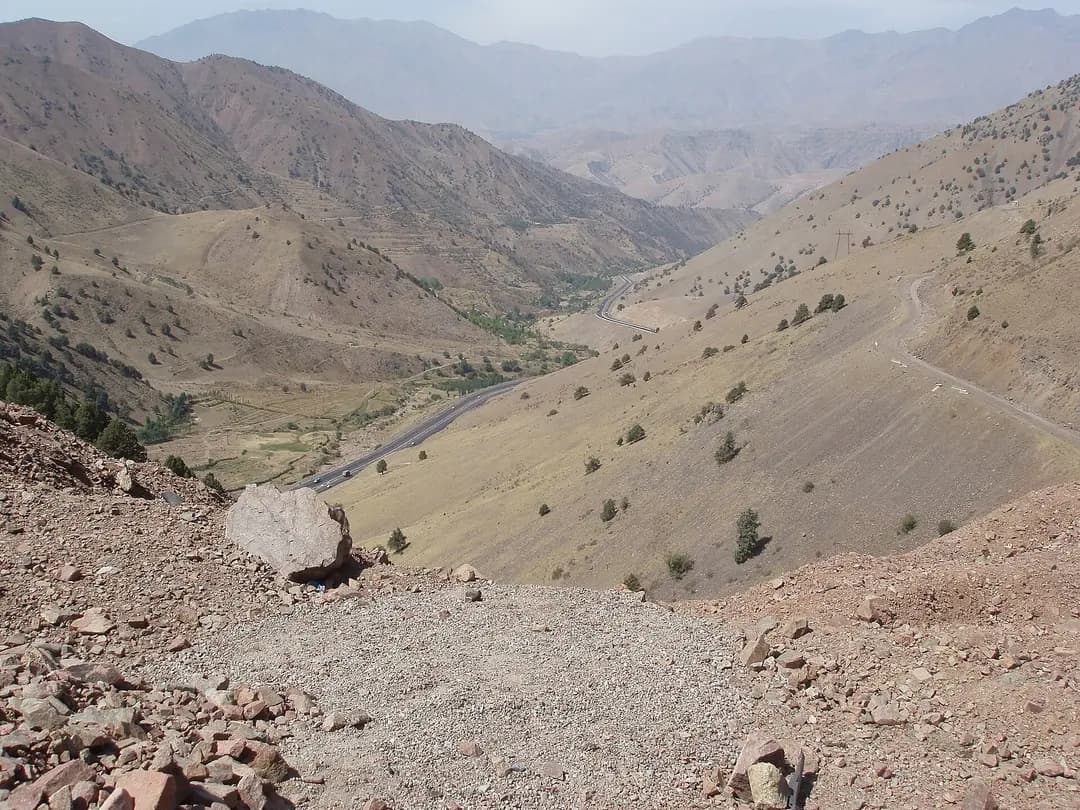
The Fergana Valley is separated from Tashkent by the Kurama mountains, and the only road between them crosses the Kamchik pass. It is Uzbekistan's main mountain highway: thousands of cars, buses and lorries use it every day. The road is scenic and generally in good shape, but it has quirks worth knowing about in advance, especially if it is your first time or you are travelling in winter.
Key figures
- Tashkent to Fergana: about 310–320 km.
- Driving time: 4.5–5.5 hours in normal conditions.
- Height of the Kamchik pass: about 2,200 m above sea level.
- Mountain section: roughly 2–2.5 hours from Angren to the descent into the valley.
The route
From Tashkent the highway heads south-east through Almalyk or along the Akhangaran valley to Angren, a mining town at the foot of the mountains. This is where the climb begins. The hairpins gradually gain height, opening up views of gorges and slopes, green and dotted with poppies in spring and covered in golden grass in autumn.
Near the top of the pass the road goes through tunnels. After them comes the descent into the Fergana Valley, a long one with bends and steep gradients. At the bottom the highway reaches the Pap and Kokand area, from where it is roughly another hour and a half across the plain to Fergana.
Checkpoints and documents
There are police checkpoints on the approach to the pass and in the valley. A check usually takes a couple of minutes, but keep these to hand:
- a passport or ID card for every passenger;
- the driver's licence and vehicle documents;
- for foreigners, a passport with entry stamps.
There can be queues at the checkpoints, especially on Friday evenings and Sundays, when many cars head into the valley and back. Allow 15–30 minutes for this.
Winter restrictions
Winter is the main thing to consider on the Kamchik. From November to March the pass sees snowfall, fog and ice. On such days:
- traffic may be restricted for lorries and buses, and in severe weather the road may be temporarily closed to everyone;
- queues build up on the climb and journey times can increase by half or even double;
- winter tyres are needed, and in heavy snow you may need chains.
Before setting off in winter, check the weather forecast and news about road conditions. If the pass is closed, the alternative is the electric train through the Kamchik railway tunnel, which runs regardless of snow on the road.
Safety on the hairpins
- Do not overtake on bends. Lorries are slow, but overtaking on a blind mountain bend is the main cause of accidents.
- Use engine braking on the way down. The long descent into the valley overheats brakes.
- Do not rush at night. Visibility on the mountain section is worse in the dark, and drivers tire faster.
- Take a break. At the top and on the descent there are places to stop, have tea and rest.
If you get carsick
The Kamchik hairpins go on for a long time, and passengers with a sensitive stomach often feel queasy here. A few simple rules help you get through the mountain section calmly:
- sit in the front and watch the road rather than your phone;
- do not eat a heavy breakfast before leaving, but do not travel on an empty stomach either;
- keep water, mints and a bag handy just in case;
- ask the driver to open a window a little and make a short stop at the top of the pass.
When booking a shared ride, you can let the driver know in advance that you need the front seat.
The best time to leave
In summer and autumn the ideal departure is early morning, at 6 or 7 am. You cross the pass ahead of the main traffic and the heat, and reach Fergana by lunchtime. In spring the summit can be cool and foggy early on, but the fog usually lifts by 9 or 10 am. In winter, do not leave late: the pass is slippery at dusk, and if the road closes you risk getting stuck.
Transport options
| Option | Time | Pros | Cons |
|---|---|---|---|
| Your own car | 4.5–5.5 h | freedom and stops | hairpins, tricky in winter |
| Seat in a car | 4.5–5.5 h | experienced driver, cheaper than a taxi | needs booking |
| Private taxi | 4.5–5.5 h | door-to-door | expensive for one person |
| Train through the tunnel | about 5–6 h | unaffected by snow | you need to get to the station |
Sharing a ride over the pass
If you would rather not drive the hairpins yourself, a seat with a driver who travels to the valley regularly is the answer. These drivers know every bend on the Kamchik and understand how the road behaves in different weather. On Yo'ldosh you can find a trip on the Tashkent — Fergana route and see the departure time, price per seat and driver's profile. You book in the app and sort out details in the chat.
What to see on the way and on arrival
On the way you can stop at viewpoints on the climb to the pass and in Kokand, where the palace of Khudoyar Khan still stands. In and around Fergana itself, highlights include:
- Margilan with the Yodgorlik silk factory, where atlas and adras fabrics are woven;
- Rishtan, the centre of ceramics with a distinctive blue-green glaze;
- the valley's markets, piled high with fruit and famous flatbreads.
Find a seat on the Tashkent — Fergana route on Yo'ldosh, and other directions into the valley on the routes page. If you regularly drive over the Kamchik yourself, take a look at the for drivers section.
Cover photo: Man77, CC BY 3.0, Wikimedia Commons.
