Ak-Saray in Shahrisabz: What Remains of Timur's Palace
The "White Palace" took nearly a quarter of a century to build, and today two giant pylons of its portal remain. What it was like, what you can see and how the square around it has changed.
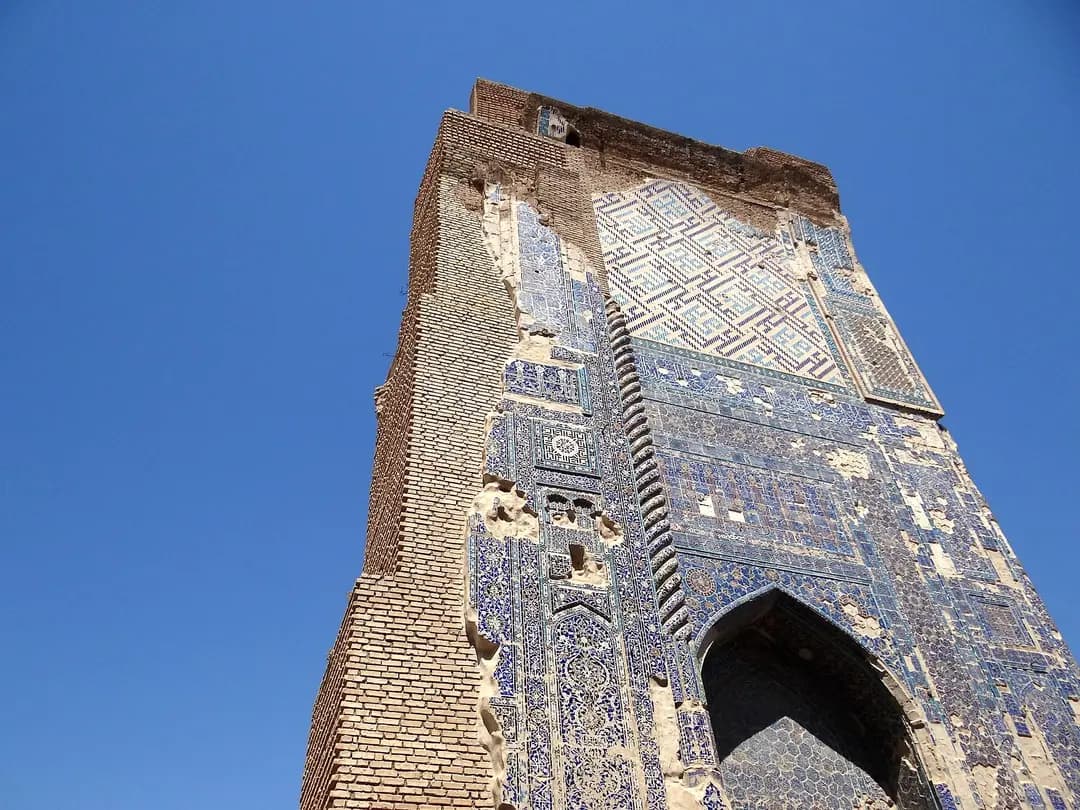
Shahrisabz is Timur's home town, and it was here that he planned a residence meant to outshine anything travellers of his time had ever seen. Ak-Saray, the "White Palace", took almost 25 years to build. Only fragments of its portal survive, yet even they are deeply impressive: two colossal towers covered in mosaic rise above the town and can be seen from far away.
History: a palace described by ambassadors
Construction began in 1380, after Timur's campaign in Khorezm. Craftsmen famous for their skill with brick and tile were brought from there to Shahrisabz. The work continued for more than two decades and was completed in the early 15th century.
In 1404 the palace was seen by the Spanish envoy Ruy González de Clavijo on his way to Timur's court. His account describes Ak-Saray as a grand building with enormous halls and walls decorated with gold and lapis blue. It is one of the few eyewitness descriptions of the palace at its height.
A famous phrase often attributed to Timur is associated with the portal of Ak-Saray: "If you doubt our power, look at our buildings." Whether or not the conqueror ever said it himself, it captures the idea behind the building perfectly.
The palace did not survive the following centuries. Wars, earthquakes and time took their toll, and according to a widely told version it was badly damaged in the 16th century under the Bukharan ruler Abdullah Khan.
What survives
All that remains of the complex are the two pylons of the entrance portal. Even in their present state they reach almost 40 metres in height, and researchers estimate that the arch between them was one of the widest in Central Asia. When the arch was intact, the portal was probably taller than any other structure of its time in the region.
What to look at:
- The mosaic. Blue, white and gold patterns, geometric ornament and inscriptions in Kufic script. Step closer: near the bottom you can see how finely the tile pieces were fitted together.
- The scale. Stand at the foot of a pylon and look up — that is the best way to grasp how vast the palace was.
- The inscriptions. The calligraphy on the pylons is part of the decoration, not just text. Notice how the letters are woven into the pattern.
- The brickwork. Where the facing has been lost, you can see how the wall was built and the techniques of 14th-century builders.
The square around it: before and after reconstruction
The historic centre of Shahrisabz is a UNESCO World Heritage Site. In the mid-2010s the area between Ak-Saray and the Dorut Tilovat complex was heavily redeveloped: part of the old residential neighbourhood was demolished, a large park with avenues, fountains and lawns was laid out, and facades were renovated.
What this means for travellers:
- The upside: you can now walk comfortably from Ak-Saray to Kok Gumbaz and Dor us-Saodat along a wide pedestrian zone.
- The downside: part of the traditional mahalla has disappeared, and the centre now feels more like a ceremonial park than an old town. The reconstruction raised concerns at UNESCO.
- Tip: to see the living Shahrisabz, wander into the side streets beyond the park and visit the local bazaar.
A statue of Amir Timur stands in front of Ak-Saray — a favourite photo spot, especially for newlyweds.
Seeing Shahrisabz in a day
| Time | Sight |
|---|---|
| Morning | Ak-Saray and the Amir Timur statue |
| Late morning | Walk through the park, Dor us-Saodat and Timur's crypt |
| Lunch | A local cafe or the bazaar |
| Afternoon | Dorut Tilovat: Kok Gumbaz and the mausoleums |
| Evening | Return to Samarkand |
Four to five hours is enough for the main sights, so a trip from Samarkand fits comfortably into one day.
Getting there from Samarkand
Samarkand and Shahrisabz are only about 90 km apart, but the road crosses the Takhtakaracha Pass, one of the most scenic drives in the country. The road climbs in hairpin bends through the mountains of the Zarafshan range, with viewpoints along the way and roadside stalls selling fruit and bread. Expect the journey to take roughly 1.5 to 2 hours.
Things to keep in mind:
- In winter the pass is sometimes closed because of snow, and then you have to take a detour, which makes the journey considerably longer.
- If you get carsick, sit in the front and take precautions in advance.
- Going one way over the pass and returning by the other road is a good way to see more.
A shared ride is a convenient way to travel: on the Samarkand — Shahrisabz route drivers post trips on Yo'ldosh. You can leave early in the morning to catch Ak-Saray in soft light and be back by evening.
When to go
- April–May — green mountains on the pass and comfortable temperatures.
- September–October — dry and warm, with fruit harvest stalls along the road.
- Summer — Shahrisabz gets hot, so head out to the sights early.
- Winter — few tourists, but the pass can be a problem.
Practical tips
- Morning light is best for photographing the pylons: the portal is oriented so that part of the mosaic falls into shadow later in the day.
- Wear comfortable shoes, as you will walk a couple of kilometres between the sights.
- Cash is useful at the bazaar and in small cafes.
- Observe the dress code in mosques and mausoleums: covered shoulders and knees.
Why Ak-Saray is worth the trip
Even in ruins, Ak-Saray explains Timur's imperial ambition better than any book. Standing at the foot of the pylons, it is easy to believe that the most magnificent palace in Central Asia once stood here.
If you are planning a day trip, check the rides on the Samarkand — Shahrisabz route and other destinations under all routes.
Cover photo: Adam Jones from Kelowna, BC, Canada, CC BY-SA 2.0, Wikimedia Commons.
