The Ark of Bukhara: Fortress of the Emirs and What to See Inside
What survived inside the citadel after 1920, which museums are there, how much time to allow and where to look out over Bukhara from the fortress mound.
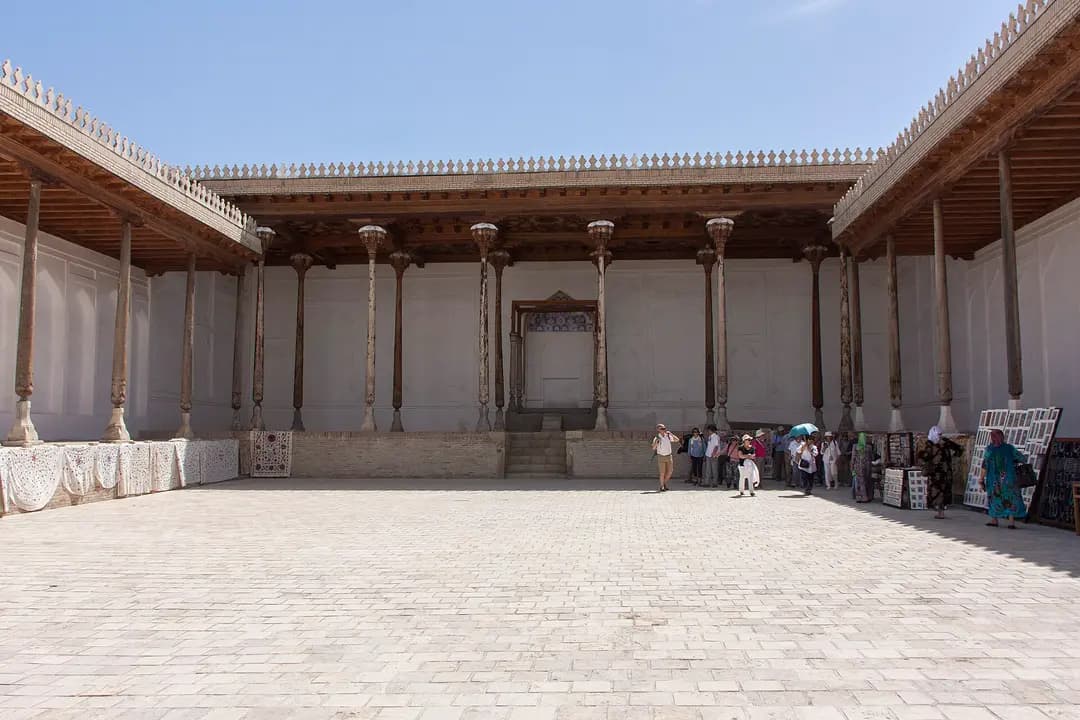
The Ark is Bukhara's oldest structure and perhaps its most imposing. A huge man-made mound with sloping walls up to twenty metres high rises above Registan Square on the western side of the old city. For more than a thousand years this was the seat of rulers, and until 1920 the emirs of Bukhara lived and governed here. Getting in is easy, but to make sure your visit is more than a quick lap of empty courtyards, it helps to know exactly what you will see.
A little history
The Ark mound grew over the centuries: each new fortress was built on the ruins of the previous one. A legend credits its founding to the hero Siyavush. Archaeologists confirm that a fortification stood on this spot in ancient times, long before the arrival of Islam.
Inside the walls was a true city within a city: the emir's palace, a mosque, a chancery, the treasury, a mint, an arsenal, stables, courtiers' quarters and even a prison. Several thousand people lived on an area of about four hectares. In 1920, during the Red Army's assault on Bukhara, the fortress was badly damaged by shelling and fire. By a commonly cited estimate, only a small part of the buildings survived, and today much of the interior consists of open ground and ruins.
The main gate and the ramp
You enter the Ark through a monumental gateway framed by two towers on the Registan Square side. Above the gate is a gallery from which the emir could watch the square. A long covered ramp, once used by horsemen, leads up inside. Along it are niches that used to be cells and guardrooms. Climbing through the dim passage towards the light is part of the experience in itself.
What survives inside
At the top you reach the area where several museum exhibitions now operate. The highlights:
- The Ark's Friday Mosque - with carved wooden columns and a painted iwan ceiling. Inside there is usually an exhibition of manuscripts and calligraphy.
- Kurinishkhana - the throne courtyard where receptions and coronations took place. At the far end is a marble platform for the throne. The courtyard is empty and austere, and this is where it is easiest to imagine the ceremonies of the emirate.
- Salomkhana and former state rooms - housing exhibitions on the history of Bukhara.
- Museum halls with archaeology, coins, weapons, clothing, objects from the emir's court and early 20th-century photographs. The pictures of Bukhara before 1920 are especially interesting, showing the fortress and the city before the destruction.
- Former living and service quarters - some survive as walls and foundations.
A practical note: some exhibitions may be closed for repairs or require a separate ticket. This is normal at the Ark, so check at the ticket desk.
Is it worth climbing the walls?
The top of the fortress wall is generally not open for walking, and the edge is not safe. But the Ark itself stands on a high mound, so the inner terraces and open platforms already give good views of the city: Registan Square, the Bolo-Hauz Mosque with its wooden columns, the rooftops of old Bukhara and the Kalyan Minaret in the distance. If you find an open viewpoint, go in, but never climb over railings.
It is also well worth walking around the Ark from outside, especially towards sunset. The sloping walls, buttresses and gate look very photogenic in low sun, and the square in front comes alive in the evening.
How much time to allow
- A quick look - about an hour: the ramp, the mosque, the throne courtyard and the view from the terraces.
- A detailed visit with the museums - an hour and a half to two hours.
- With a guide - about the same, but you will understand far more: a guide will explain the ceremonies, court life and the events of 1920.
Tickets are usually sold at the gate. Prices are approximate and change from time to time, and a separate photo fee may apply - check on site.
What is nearby
- Bolo-Hauz Mosque - directly opposite the Ark, with twenty carved columns reflected in its pond.
- The Zindan - the emirate's former prison behind the Ark, now a small museum. It is tied to dark chapters of history, including the fate of two British officers in the 1840s.
- A Soviet-era water tower by the square - it once had a viewing platform, but access is often closed.
- Po-i-Kalyan - a 5-10 minute walk through the old city.
Visiting tips
- Arrive at opening time: mornings are cooler and there are fewer groups.
- In summer the Ark's courtyards bake in the sun with little shade. Bring water and a hat.
- The ramp is paved with uneven stone, so comfortable shoes are essential.
- Combine the Ark with Bolo-Hauz and the Zindan, all in one block.
Heading back to Tashkent
Many travellers leave the Ark for their last morning in Bukhara and set off back after lunch. Tashkent is about 560 km away, roughly seven to eight hours by car via Navoi, Samarkand and Jizzakh. One convenient option is a shared ride through Yo'ldosh: you book a seat with a verified driver, pay less than for a private taxi, and choose a departure time that lets you see the Ark and still reach the capital before night.
See trips on the Bukhara - Tashkent route page and passenger tips in the for passengers section.
Cover photo: Davide Mauro, CC BY-SA 4.0, Wikimedia Commons.
