Itchan Kala in One Day: A Walking Plan for Khiva's Inner City
A step-by-step route through the fortress: the combined ticket and what it excludes, where to climb walls and minarets, where to watch sunset and how to reach Khiva.
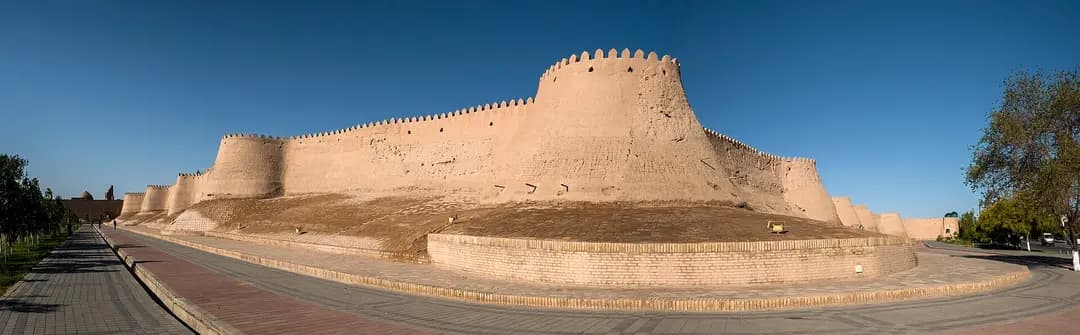
Itchan Kala is the inner city of Khiva, enclosed by a mud-brick wall. It is a rare case of an entire historic quarter surviving almost intact within its walls: madrasas, mosques, minarets, palaces and houses packed tightly together on about 26 hectares. In 1990 Itchan Kala became the first site in Uzbekistan to be inscribed on the UNESCO World Heritage List. The good news is that everything is compact and can be covered on foot in a day. The bad news is that without a plan it is easy to waste time running between ticket desks and miss the highlights.
The gates and the general layout
The wall, about 2.2 km long, has four gates:
- Ota-Darvoza - the western, main gate. The main ticket office is here and most visitors start from it.
- Bogcha-Darvoza - the northern gate, leading to Dishan Kala and the Nurullah-Bai Palace.
- Palvan-Darvoza - the eastern gate, next to the former slave market.
- Tosh-Darvoza - the southern gate.
The main street runs from the west gate to the east gate and splits the town in two. Almost all the major monuments are on it or a couple of minutes away.
The combined ticket: what is in and what is not
The ticket office at the west gate sells a combined ticket that gives access to most of Itchan Kala's museums and monuments. It is usually valid for a couple of days, so you can spread out your sightseeing. Several things, however, are generally paid for separately:
- climbing the Islam Khodja Minaret;
- climbing the Ak-Sheikh-Bobo watchtower in the Kunya-Ark fortress;
- climbing the Juma Mosque minaret;
- sometimes a walk along the walls and certain special exhibitions.
What the ticket covers and how much it costs change from time to time, so check at the ticket office. Simply walking the streets of Itchan Kala and looking at the facades needs no ticket; it is required to go inside the museums.
A one-day route
Morning (8:00-11:00). Start at the west gate. Just inside is Kalta Minor, the unfinished minaret covered in turquoise glaze, with the Muhammad Amin Khan Madrasa beside it. Then go into Kunya-Ark, the khans' old fortress with its summer mosque, throne hall and mint. Climb Ak-Sheikh-Bobo before the sun gets high; the whole of Itchan Kala is spread out below.
Late morning (11:00-13:00). Walk along the main street to the Juma Mosque with its forest of 213 wooden columns. In the midday heat it is cool and dim inside. Next comes the Islam Khodja madrasa and its minaret, the tallest in Khiva. If you have the energy, climb to the top.
Lunch. There are plenty of cafes in and around Itchan Kala. Try Khorezm dishes: shivit oshi, green noodles made with dill, and tukhum barak, dumplings filled with egg.
Afternoon (14:30-17:00). The Pahlavan Mahmud Mausoleum, the city's shrine, with sumptuous tiles. Then Tash-Hauli, Allakuli Khan's palace with its harem and reception courtyards. On the way, look into the small madrasas where woodcarving and embroidery workshops operate.
Sunset. Head to the north gate: next to it you can usually climb onto the wall and walk along it. The wall at sunset offers one of the best views in Khiva, with minarets and domes turning gold. The alternative is Ak-Sheikh-Bobo again, if you make it before closing.
Evening. Itchan Kala is lit up, the streets empty and the town looks like a set for an Eastern fairy tale. This is the time to simply wander.
If you have a second day
The combined ticket is usually valid for more than one day, so a second day can go on whatever did not fit: the museums inside the madrasas, carpet-weaving and woodcarving workshops, and an unhurried walk around the outside of the wall. It is also well worth stepping out through the north gate into Dishan Kala, the outer town, to the Nurullah-Bai Palace. It is far less crowded, and its early 20th-century interiors complement medieval Itchan Kala nicely.
Where to watch sunset: a short list
- The wall by the northern Bogcha-Darvoza gate.
- The Ak-Sheikh-Bobo tower in Kunya-Ark.
- Rooftop cafe terraces along the main street.
- Outside, by the western wall, for the silhouette of the town.
Practical tips
- Footwear. The streets are paved and the minarets have many steps, so wear comfortable shoes.
- Heat. Summer temperatures in Khiva can exceed forty degrees. See open areas in the morning and evening, and shelter in the Juma Mosque and museums at midday.
- Minarets. Staircases are narrow, dark and steep. If you dislike heights or tight spaces, stick to Ak-Sheikh-Bobo.
- Overnight. If you can, stay inside the walls or nearby: dawn and evening are the most beautiful times in Itchan Kala.
- Money. Keep some cash; not every shop and ticket desk accepts cards.
Getting to Khiva
The nearest large city and airport is Urgench, about 30-35 km from Khiva, roughly 40 minutes by car. From Bukhara to Khiva it is about 450 km across the Kyzylkum Desert along the Amu Darya, six to seven hours on the road.
On both legs a shared ride via Yo'ldosh is convenient: you book a seat in the app, drivers are verified and the price is lower than a private taxi. That makes a real difference on the long drive from Bukhara, and the short hop from Urgench can be timed to match your flight.
Routes: Urgench - Khiva and Bukhara - Khiva. Travel tips are in the for passengers section.
Cover photo: Petar Milošević, CC BY-SA 4.0, Wikimedia Commons.
