Bread in Uzbek Culture: Flatbread Types by Region
Obi non, patir, shirmoy non and other flatbreads: how to tell regional breads apart, how they differ and where to taste them on a trip.
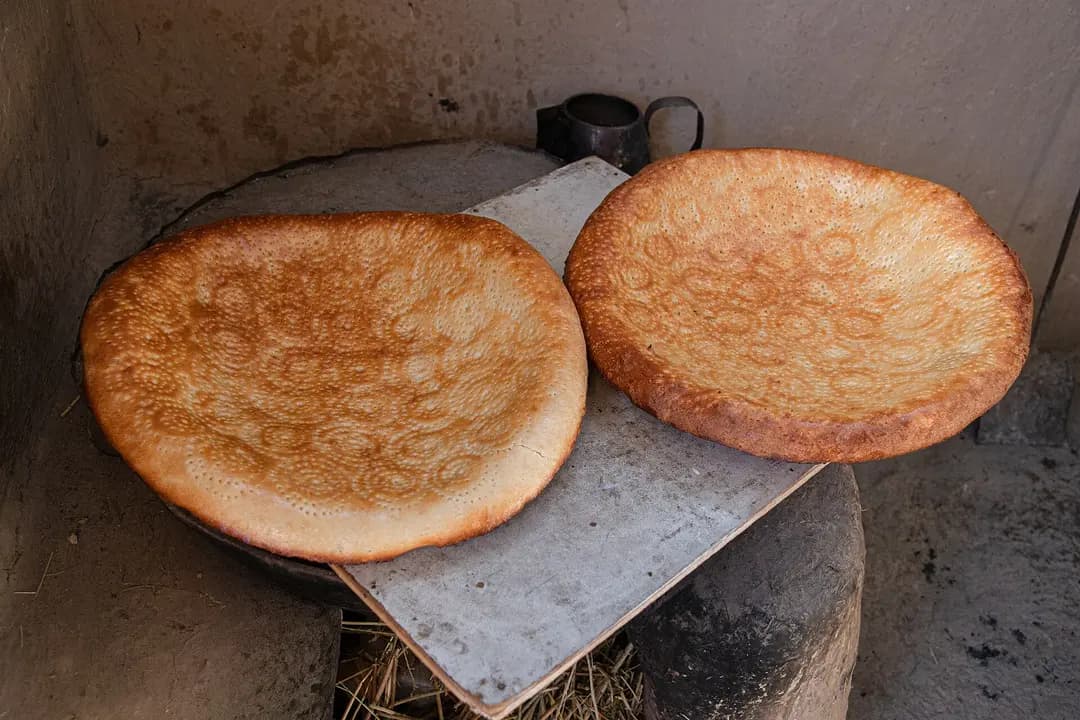
Bread in Uzbekistan is more than food. A flatbread must not be placed upside down, dropped on the ground or thrown out with the rubbish: it is treated with respect as a symbol of well-being. It is brought to guests, shared at family celebrations and taken along on the road. And Uzbek bread differs from region to region, so a traveller can collect a "set" of flavours along the way.
General features of Uzbek flatbread
Most flatbreads in the country are baked in a tandoor, a clay oven. The dough is pressed to the hot inner wall, and in a few minutes the bread is ready. The classic composition is flour, water, salt and a starter or yeast, sometimes with milk, butter, onion, sesame or cumin. The shape is round and flat, with a thickened rim and a stamped pattern in the centre. The pattern is made with a special stamp (chekich), and it not only decorates but also keeps the dough from puffing up.
Obi non: the Samarkand classic
Obi non (or Samarkand bread) is perhaps the most famous. It is tall and dense, with a shiny crust sprinkled with sesame. The bread is soft inside and crisp outside. It keeps for several days without going stale too quickly. In Samarkand it is sold near Siab Bazaar and in small bakeries across the city.
Patir: layered and filling
Patir is made with butter or fat, so the dough turns out layered and richer. It is eaten with tea or as the basis of a light lunch. The recipe differs between regions: in some places patir is thin and crisp, in others fluffy and soft. It is best tried hot, straight from the tandoor.
Shirmoy non: the sweet flatbread
Shirmoy non is made with milk, butter and sometimes sugar. The dough is soft, delicate and slightly sweet. Such breads are often served with tea, at breakfast and on holidays. The flavour is reminiscent of pastry, so both children and adults like it.
Katlama and lochira
- Katlama: a layered flatbread, often fried in oil or baked. It is eaten hot with qatiq, sour cream or honey.
- Lochira: a small soft flatbread popular in a number of districts. It is less dense than obi non and good for light snacks.
Names and recipes differ slightly between towns, so it is worth asking bakers what a particular kind is called.
Gijduvan bread
Near Bukhara the town of Gijduvan is known for beautiful flatbreads with rich patterns. They look like works of art: the ornament is made by the baker on the dough before baking. Such breads are bought as a treat and as a souvenir.
Breads by region: a guide
| Region | What to try |
|---|---|
| Samarkand | Obi non with sesame |
| Bukhara | Patterned, layered flatbreads |
| Tashkent | Soft flatbreads, lochira |
| Fergana Valley | Patir, katlama, shirmoy non |
| Khorezm | Flatbreads with fat and onion |
This is only a general guide. The real traditions are richer, and every baker adds his own details.
How to behave with bread
- Do not place bread upside down or put things on it.
- Do not cut it with a knife: break it by hand.
- Do not throw away leftovers. If you do not finish, leave them neatly or take them with you.
- Do not drop it on the floor: if it falls, pick it up, kiss it and set it somewhere high, as locals do.
- Take bread with your right hand.
If you are a guest in a home, the host will break the bread himself and hand you the first piece. It is a sign of respect.
Where to try it
- At markets. Flatbreads are sold from the morning, hot and fresh.
- In bakeries. Small points where bread is baked in front of you are best.
- In guesthouses and teahouses. Morning tea is usually served with flatbread.
- On the highway. Roadside stalls sell bread to travellers.
How to choose and store
- Choose a warm flatbread: it is tastiest in the first hours.
- Look at the crust: it should be golden.
- Better to store it in cloth or a paper bag, not in plastic.
- Warm it slightly in a pan or oven to restore freshness.
- For travel take loaves with a firm crust: they bruise less.
Bread along the way
A good idea: try the local flatbread at every stage of the route. The road from Tashkent to Namangan crosses the Kamchik Pass, and in the Fergana Valley you will meet patir and katlama; on the Tashkent — Namangan page drivers post trips. Then, in the south of the country, in Samarkand and Bukhara, the famous obi non and Bukhara breads await: you can travel between the cities on the Samarkand — Bukhara route. You book a seat in the Yo'ldosh app, drivers are verified, and the price is usually lower than a taxi. Other directions are collected on the all routes page.
The takeaway
The flatbread is Uzbekistan's main bread and the key to its cuisine. Taste obi non, patir and shirmoy non, talk to the bakers and bring home at least one fresh loaf. It will remind you of the warmth of the tandoor and of the people who share bread with a guest.
Cover photo: Sinchalak Musulmon, CC BY-SA 4.0, Wikimedia Commons.
