Kukeldash Madrasa and the Juma Mosque: Old Tashkent by Chorsu
A 16th-century madrasa on a hill above the bazaar, a mosque founded by the Sufi sheikh Khoja Ahrar and quiet mahallas all around — a walk through Tashkent's historic quarter.
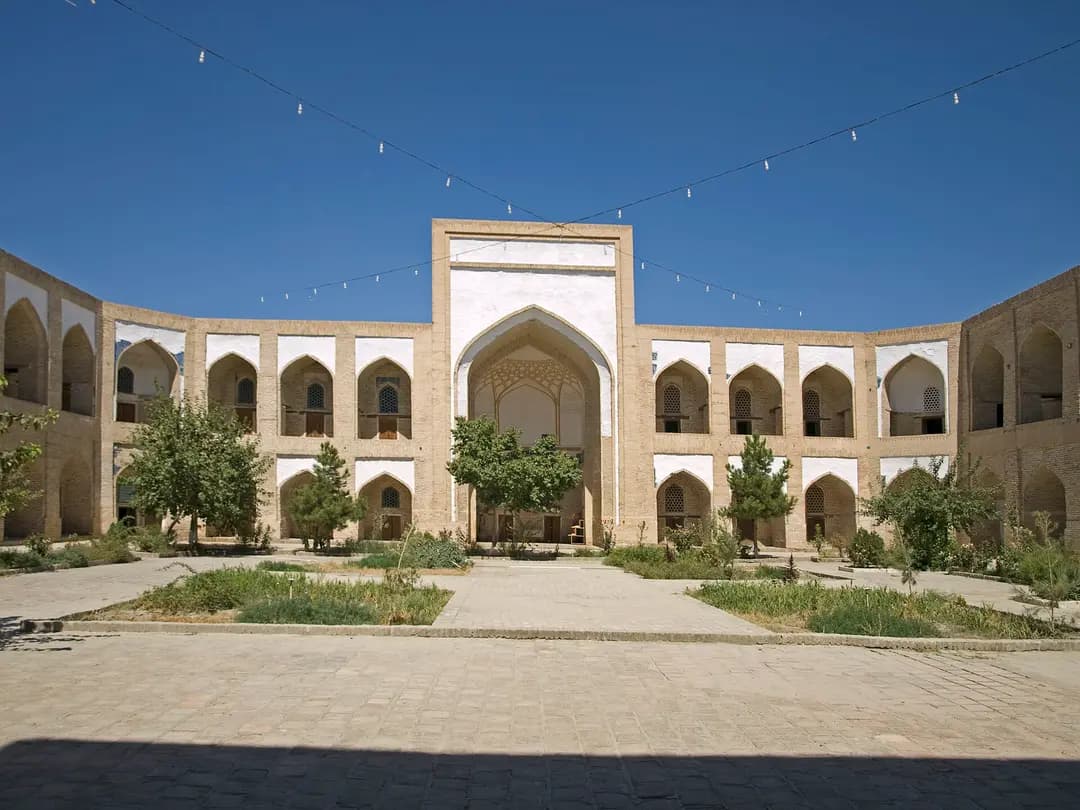
It is hard to find a street in Tashkent that looks the way it did two hundred years ago: the city has been rebuilt many times, and the 1966 earthquake wiped out most of the old quarters. But by Chorsu, on a hill above the main bazaar, the historic heart of the old town has survived. Here stand the Kukeldash madrasa and the Juma mosque of Khoja Ahrar, surrounded by mahallas where life moves at its own pace. It is the best place to sense what Tashkent was like before the age of wide avenues.
The Kukeldash madrasa
The madrasa was built in the 16th century, in the Shaybanid era. It was commissioned by Kulbobo Kukeldash, a vizier of high rank at court. "Kukeldash" was the title of the ruler's foster brother, which underlines how close the vizier was to the throne.
Good to know:
- One of the largest madrasas in Central Asia in its day. Its huge portal is visible from afar, especially from the square by Chorsu.
- A turbulent history. Over the centuries the building served not only as a school but also as a caravanserai and even a fortress. The portal was badly damaged by earthquakes and has been restored.
- A working madrasa. Students study here again today, so visitors are usually allowed into the courtyard but not into the cells.
What to look at
- The portal. Massive, with tile inserts and inscriptions. The best angle is from below, on the square.
- The courtyard. Surrounded by two-storey galleries of hujras, the students' cells. The atmosphere is calm and focused.
- The view of Chorsu. From the hill by the madrasa you can see the bazaar's blue dome and the busy streets around it.
The Juma mosque of Khoja Ahrar
Opposite the madrasa stands the main Friday mosque of old Tashkent. Its foundation is linked to the name of Khoja Ahrar, an influential 15th-century Sufi sheikh of the Naqshbandi order who was born in the Tashkent oasis. He was one of the best-known spiritual leaders of his time and enjoyed great authority among the Timurid rulers.
The mosque has been rebuilt many times over the centuries, and in the late 20th and early 21st century it was restored in a traditional style. Today it is a spacious building with a dome, iwans and carved wooden columns. On Fridays thousands of people gather here.
Etiquette:
- cover your shoulders and knees; women should wear a headscarf;
- remove your shoes before entering the prayer hall;
- do not come during Friday prayers unless you are there to pray;
- take photos outside, and inside only with permission.
The mahallas around
The most rewarding part is wandering the lanes behind the madrasa and mosque. Here you will still find:
- blank courtyard walls with carved wooden gates;
- narrow alleys where children play and neighbours chat at their gates;
- small bakeries with tandoor ovens turning out flatbread and samsa;
- neighbourhood mosques.
The rules of courtesy are simple: do not peer into courtyards, ask before photographing people and say hello. Mahalla residents are usually friendly and curious about visitors.
Chorsu bazaar
It makes sense to end the walk at Chorsu, Tashkent's main bazaar under a huge blue dome. Under the dome you will find spices, dried fruit, nuts and dairy products, and around it rows of fruit, vegetables, bread and crockery.
Bazaar tips:
- the best time is morning, when everything is fresh and it is less crowded;
- bargain politely, as it is part of the culture;
- keep your belongings close, a sensible precaution in any crowd;
- try kurt (dried salty cheese balls), dried apricots and a hot flatbread straight from the tandoor.
A half-day plan
| Time | What to see |
|---|---|
| 9:00 | Kukeldash madrasa |
| 9:45 | Juma mosque of Khoja Ahrar (outside, or inside outside prayer times) |
| 10:15 | A walk through the mahallas |
| 11:30 | Chorsu bazaar |
| 13:00 | Lunch: plov or shashlik at a nearby teahouse |
The nearest metro station is Chorsu. From here you can also walk to the Hast Imam complex if you want to see more of the old town.
From Tashkent to Angren
If the old town leaves you wanting mountains, head south-east to Angren. The town lies about 110 km from Tashkent in the Angren river valley, surrounded by ranges of the Western Tien Shan. The drive takes about 1.5 to 2 hours. This is where the road to the Kamchik Pass and the Fergana Valley begins, and the surrounding foothills are good for walks.
A shared ride is a convenient way to go: on the Tashkent — Angren route drivers post trips on Yo'ldosh, so you can book a seat at a convenient time instead of fitting in with the bus schedule.
When to go
- Spring and autumn — comfortable weather for walking.
- Summer — set out early in the morning; open squares get hot by midday.
- Winter — mild but sometimes rainy; the bazaar is open all year.
- Ramadan — evenings in the mahallas have a special atmosphere.
Why come
The Kukeldash madrasa, the Khoja Ahrar mosque and the mahallas around Chorsu are the Tashkent that generations of locals have known. A few hours here tell you more about the city than a whole day on the central avenues.
To get out of town after your walk, check the Tashkent — Angren route, and find other destinations under all routes.
Cover photo: Ymblanter, CC BY-SA 4.0, Wikimedia Commons.
