The Parkent Solar Furnace: How the Giant Solar Complex Works
A wall of mirrors in the Tian Shan foothills where sunlight melts materials: what you see on a tour, how to get there from Tashkent and what to stop for on the way.
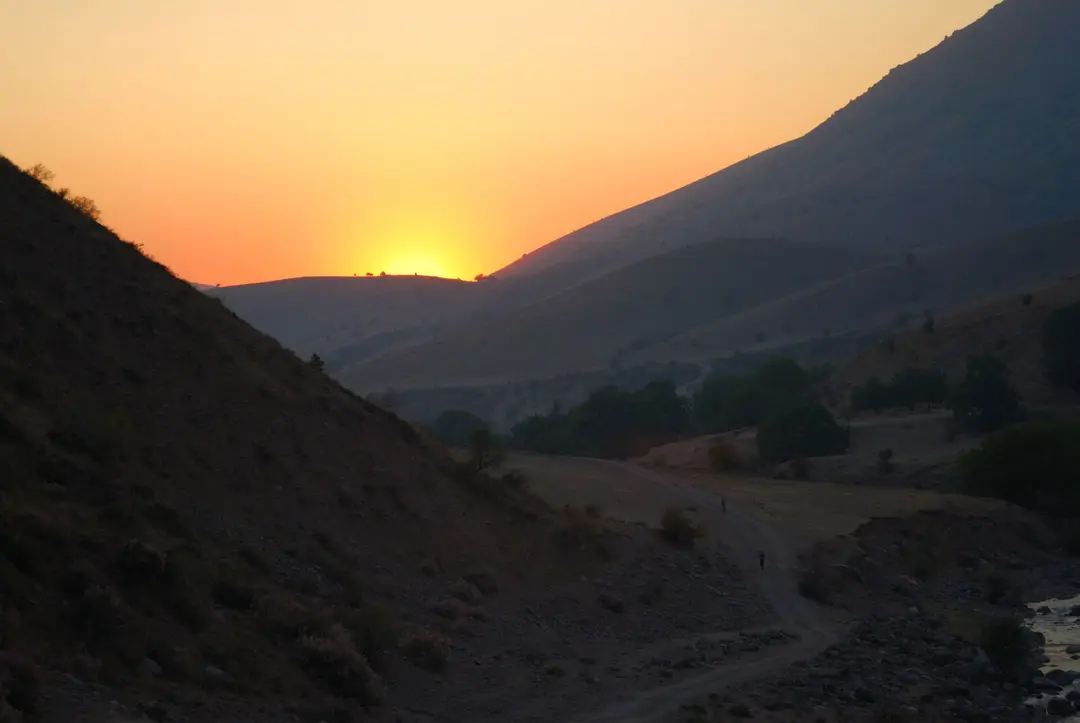
In the foothills east of Tashkent, above the villages and orchards of Parkent district, a huge concave wall of mirrors glitters on a slope. This is the Great Solar Furnace, a research complex built in Soviet times and still working today. There are very few places in the world that concentrate sunlight into a single point with such power, and here you can see one with your own eyes.
What the site is
The complex is known as "Sun" or "Physics-Sun". It was built in the 1980s to test materials at extremely high temperatures, free of the impurities and contamination a conventional furnace introduces. The location was chosen deliberately: there are many clear days a year, the air is clean and the ground is stable, which matters for precision optics.
The complex sits at roughly 1,000 metres above sea level. Today it belongs to the Institute of Materials Science of the Uzbek Academy of Sciences.
How the solar furnace works
The principle is easy to grasp even without a physics background:
- On the slope in front of the main building stand dozens of heliostats, flat mirrored panels that automatically turn to follow the sun.
- The heliostats reflect the light onto a giant parabolic concentrator, the concave mirrored wall as tall as an apartment block. It is assembled from thousands of small mirrors.
- The concentrator focuses the entire flow onto one point in the tower facing it. In that technological zone the temperature can reach several thousand degrees.
At that point ceramics and heat-resistant materials are melted and synthesised, and coatings are tested. Because the heating comes from light alone, the resulting materials are exceptionally pure.
The tour: what visitors see
The complex accepts tourists, but it is first and foremost a research facility, so visits take the form of a guided tour. Usually you are shown:
- the field of heliostats and how they change position;
- the concentrator up close, which is truly impressive in sunshine;
- the tower with its technological zone and an explanation of the experiments;
- a small exhibition on the history of the complex.
On a clear day you may sometimes see a demonstration, such as a piece of wood bursting into flame instantly at the focal point. That depends on the weather and the staff's plans, so it is not guaranteed.
Visiting rules
- There is an entrance fee, and prices for foreigners and Uzbek citizens may differ. Prices change, so check before you go.
- Come in the first half of the day and in clear weather: on a cloudy day half the impression is lost.
- Do not look directly at the reflected light or the focal point, as it can damage your eyes. Sunglasses are a must.
- Follow your guide: there are areas on site that are off limits.
- Photography is allowed in most places, but ask before shooting in the laboratories.
Getting there
It is about 50 km from Tashkent to Parkent, roughly an hour's drive depending on where in the city you start. The complex itself is higher up in the hills, another 15 to 20 minutes from Parkent along a local road.
A convenient option is to get to Parkent by shared ride and take a local taxi from there to the complex. On Yo'ldosh, drivers publish trips on the Tashkent to Parkent route, especially on weekday mornings; you book your seat in the app in advance and can agree a drop-off point with the driver.
What to see on the way
The trip easily becomes a full day out of the city:
- Parkent bazaar. A small but lively market selling fruit from local orchards: cherries, apricots, apples and nuts in season.
- The foothills. The road from Tashkent runs through orchards and villages, and further on you get views of the Western Tian Shan ranges. In spring everything is in blossom.
- Riverside recreation spots. Along the mountain streams of Parkent district there are many places where local families spend summer days. Stick to official recreation areas, as mountain rivers are cold and fast.
In the hot season Parkent is noticeably cooler than the capital, which is another reason to come in July or August.
When to go
The best time is April to October, when clear days are most frequent. The complex may also operate in winter, but foothill weather is unpredictable. Pick a cloudless morning: the light is stronger, the mirrors look more dramatic and you will be back in Tashkent before evening.
The solar furnace is a rare case of a scientific facility that is interesting to everyone, not just specialists. If you have a free day in Tashkent, it is one of the most unusual trips nearby. You can return the same way, with a shared ride from Parkent to Tashkent; all destinations are listed on the routes page.
Cover photo: vit5112, CC BY 3.0, Wikimedia Commons.
