An Archaeology Route: From Afrasiab to Toprak-Kala
Ancient cities, fortresses and museums across the country: Afrasiab, Paykend, the desert castles of ancient Khorezm and the Kushan mounds of Surkhandarya in one route.
Uzbekistan is usually presented through the tilework and domes of the fifteenth to seventeenth centuries, but beneath that layer lie two more millennia of history: Sogdian cities, Khorezmian fortresses and Kushan monasteries. Many of these places look like clay mounds in the middle of fields or desert, which is exactly why large tour groups skip them. If you love antiquity, this route gives you what a standard tour cannot: walls more than two thousand years old and the feeling that the dig has only just finished.
How the route is built
The sites are scattered across the whole country, so it is easiest to assemble the trip from three blocks. You can do them back to back in 7–9 days or separately:
- Sogdiana: Samarkand and Bukhara with their surroundings, 3 days.
- Khorezm: Khiva, Urgench and the desert fortresses of Karakalpakstan, 2–3 days.
- Bactria: Termez and Denau, 2 days as a separate trip south.
Block 1. Samarkand and Bukhara
Afrasiab is the site of ancient Samarkand on the northern edge of the modern city. People lived here long before Timur; in the thirteenth century the city was destroyed by the Mongols and life moved south. Today it is a vast hilly plateau dotted with excavations. The highlight is the Afrasiab Museum, which holds seventh-century Sogdian wall paintings showing embassies arriving at the court of Samarkand's ruler. They are among the most important pre-Mongol paintings in Central Asia.
From Samarkand to Bukhara is about 270 km, or 3.5–4 hours by highway. The Samarkand — Bukhara route is one of the most popular, and shared rides run every day.
Around Bukhara:
- Paykend, an ancient city about an hour's drive southwest. It was one of the oldest trading towns of the oasis, with a citadel, residential quarters and a small on-site museum.
- Varakhsha, a former country residence of Bukhara's rulers on the edge of the desert, famous for wall paintings now kept in museums. The road is long, so go with a driver who knows the way.
- The Ark of Bukhara, a citadel whose layers go far deeper than its visible walls.
Block 2. The fortresses of ancient Khorezm
This is the climax of the route. On the right bank of the Amu Darya, in Karakalpakstan, dozens of fortresses stand in the desert, often called the Golden Ring of Khorezm. Many were built over two thousand years ago from mud brick and still hold their shape.
Khiva or Urgench works as a base. The Urgench — Beruni road crosses the Amu Darya to the right bank in about 1–1.5 hours. From Beruni and the neighbouring Ellikkala district the fortresses are close at hand.
What to see:
- Toprak-Kala, a palace and city complex from the first centuries AD with a tall citadel. Wall paintings and documents were found here, many now in museums. Even in ruins, its regular grid layout is clear.
- Ayaz-Kala, a group of hilltop fortresses; the highest offers a view over the desert and salt lakes. A yurt camp nearby offers overnight stays.
- Kyzyl-Kala, a small but well-restored fortress with red walls.
If you continue to Nukus, be sure to visit the Savitsky Museum: besides its famous avant-garde collection, it has an excellent archaeology section on Khorezm.
Block 3. Bactria: Termez and Denau
The south of the country is a separate trip. In Termez, start with the Archaeological Museum, then see the Buddhist monastery of Fayaz Tepe and the Zurmala stupa. Some sites along the Amu Darya are in the border zone, so check access rules in advance.
Further north along the Termez — Denau route, about 130 km, lies Dalverzin Tepe, a Kushan city where a hoard of gold jewellery was found, and Khalchayan with the remains of a palace.
Distance table
| Leg | Distance | Driving time |
|---|---|---|
| Samarkand to Bukhara | about 270 km | 3.5–4 hours |
| Bukhara to Khiva | about 450 km | 6–7 hours |
| Urgench to Beruni | about 60–70 km | 1–1.5 hours |
| Termez to Denau | about 130 km | 2–2.5 hours |
Figures are approximate.
Tips for visiting ancient sites
- Season. Spring and autumn. In summer the desert fortresses bake, and there is no shade at all.
- Time of day. Early morning and the last hour before sunset, when soft light picks out the relief of the walls and the heat is lower.
- Footwear. The slopes of the mounds crumble underfoot. Wear shoes with good grip.
- Respect for the sites. Do not climb the walls, take pottery shards or dig. These are protected archaeological monuments, and removing finds is illegal.
- Guide. There are almost no signs at the sites. Without a guide, read up in advance and start each region at its local museum.
- Tickets. Some sites charge entry, and prices change, so check locally.
Getting around
Between cities, shared rides are convenient: with Yo'ldosh you can book a seat with a verified driver, choose a time that suits you and save compared with a taxi. For the sites themselves it is better to hire a driver for the day, as no scheduled transport goes into the desert.
Useful routes: Samarkand — Bukhara, Urgench — Beruni and Termez — Denau. Everything else is under all routes.
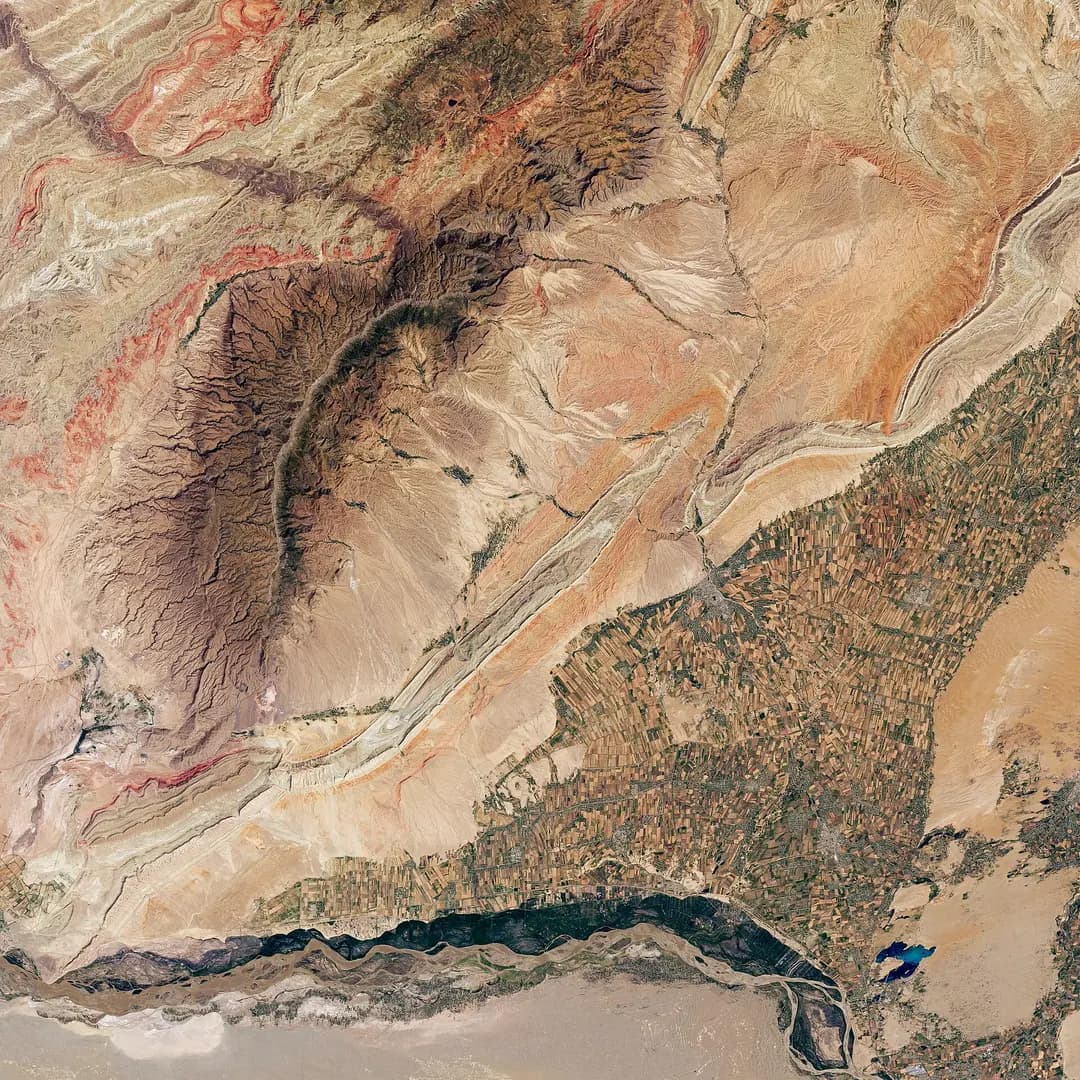
Cover photo: NASA Earth Observatory images by Joshua Stevens, using Landsat data from the U.S. Geological Survey and topographic data from the Shuttle Radar Topography Mission (SRTM). Story by Adam Voiland, with information from Franz T. Fürsich, Petra Tuŝlová, and Ladislav Stančo., Public domain, Wikimedia Commons.
