Rishtan Ceramics: How to Spot Handmade Pieces and What to Buy
Turquoise ishkor glaze, hand-painted platters and bowls: how the Rishtan craft works, how handmade differs from stamped, and how to get your pottery home intact.
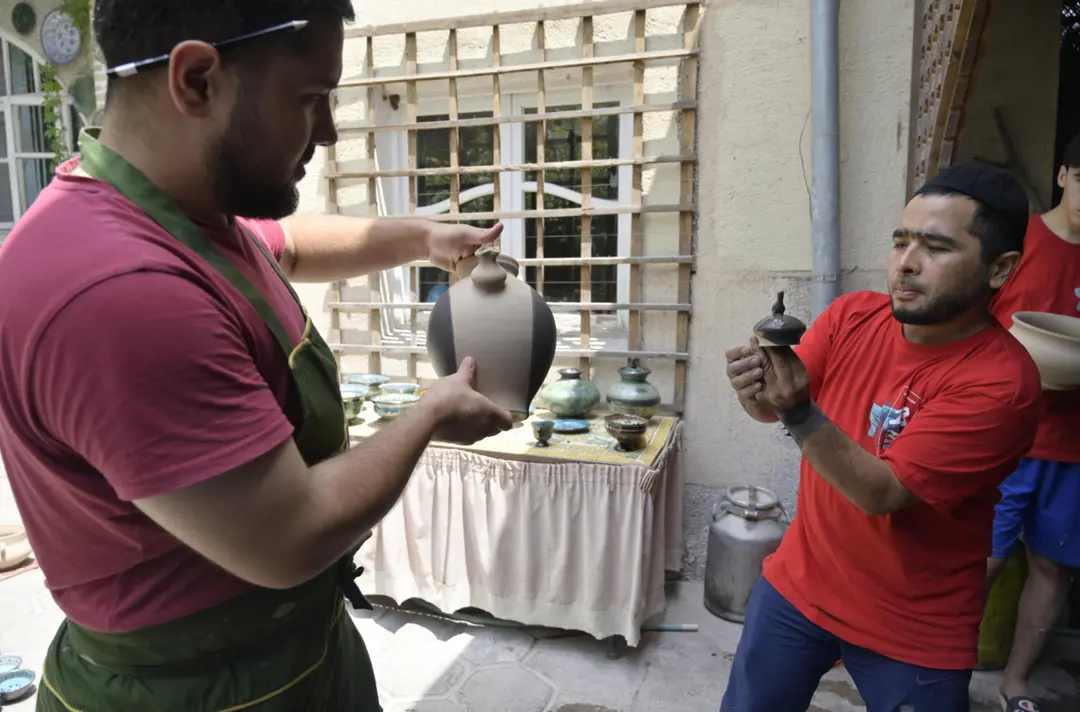
If a large platter with a turquoise and blue pattern hangs on the wall of an Uzbek home, chances are it was made in Rishtan. This small town in the south-west of the Fergana Valley has lived by pottery for centuries, and today dozens of family workshops operate here. A trip to Rishtan is a chance to see how pottery is born and to buy it straight from the maker rather than from a souvenir stall.
Why Rishtan
The town's secret is in the ground. The local red clay is plastic and dense, good for both delicate tea bowls and heavy platters. It is dug nearby, and many masters prepare the clay body themselves using family recipes.
The second feature is the ishkor glaze. It is based on the alkaline ash of steppe plants, mixed with quartz sand and colourants. After firing, ishkor produces the deep turquoise and cobalt blue that make Rishtan ceramics recognisable at a glance. The glaze is slightly translucent, so the painting beneath it seems to glow.
What the workshops make
The main items worth knowing by name:
- Lagan: a large flat platter for plov, from 30 to 60 cm across and sometimes larger.
- Kosa: a deep bowl for shurpa and soups.
- Piyola: a handleless tea bowl.
- Jugs and teapots, vases, sugar bowls and plates of various sizes.
- Decorative platters for the wall, with especially intricate painting.
Traditional motifs include plants, the pomegranate as a symbol of fertility, the chilli pepper as a protective charm, fish, birds and geometric grids. Each workshop has its own recognisable style.
How to tell handmade from stamped
Markets sell plenty of Uzbek-style pottery, and not all of it is handmade. A few signs to look for:
- Imperfect symmetry. In hand painting, pattern elements are similar but not identical: petals vary slightly and lines change thickness. If every flower repeats perfectly, it is most likely a decal or a stencil.
- Brush marks. Hold the piece to the light. Hand painting shows strokes, and the paint lies unevenly, thicker in places.
- The base. Turn the piece over. The unglazed foot of Rishtan pottery usually shows reddish clay. A white factory body is a reason to be cautious. Many masters sign or stamp the base.
- The glaze. Ishkor has depth and slight unevenness, sometimes with a fine network of crackle. Factory glaze is usually flat and glassy.
- Weight and sound. Handmade pottery from local clay is noticeably heavier than thin porcelain and gives a duller sound when tapped lightly.
The best way to avoid mistakes is to buy in a workshop where you can see the wheel, the kilns and the potters at work.
What to buy and what it costs
Prices depend heavily on size, the complexity of the painting and the master's reputation, so treat these as rough ranges and check on the spot:
| Item | Approximate price |
|---|---|
| Tea bowl | from a few tens of thousands of sum |
| Kosa or small plate | from 50,000–100,000 sum |
| Medium lagan (30–40 cm) | from several hundred thousand sum |
| Large decorative lagan | from a million sum upwards |
If you are unsure what to choose, a set of tea bowls is the most practical: they are light, easy to carry and actually get used. A lagan is the classic gift but needs careful packing.
You can bargain in a workshop, but modestly: you are dealing with the maker, not a reseller.
How to pack pottery for the journey
Ceramics survive travel better than you might think if you follow a few rules:
- ask the master to pack your purchase; they usually have paper, bubble wrap and boxes;
- wrap each piece separately and never nest tea bowls without padding;
- stand platters upright rather than flat, and protect the rims;
- on a plane, carry valuable pieces in your hand luggage;
- in a car, keep the bag on your lap or by your feet rather than in the boot under suitcases.
Getting to Rishtan
Rishtan works well as a stop on the way or as a half-day trip:
- from Fergana it is about 50 km, around an hour on the Fergana – Rishtan route;
- from Kokand it is about 45 km, also under an hour: see rides on Kokand – Rishtan.
A good plan is to arrive in Rishtan in the morning, visit two or three workshops, have lunch and either head back or continue through the valley. On weekdays the potters are busy working, but they generally welcome visitors: they will show you the wheel, explain the glaze and sometimes let you have a go yourself.
A shared ride with Yo'ldosh is a simple way to reach Rishtan without renting a car: you book a seat in the app and pick a convenient departure time. Check the rides on Fergana – Rishtan and Kokand – Rishtan and plan a day among the potters.
Cover photo: AIDEPCUL, CC BY 4.0, Wikimedia Commons.
