Samarkand beyond the Registan: a guide to the whole city
How Samarkand works as a whole: the old city and its mahallas, Siab Bazaar and Afrasiab, the European quarter with its boulevards and districts tourists rarely see.
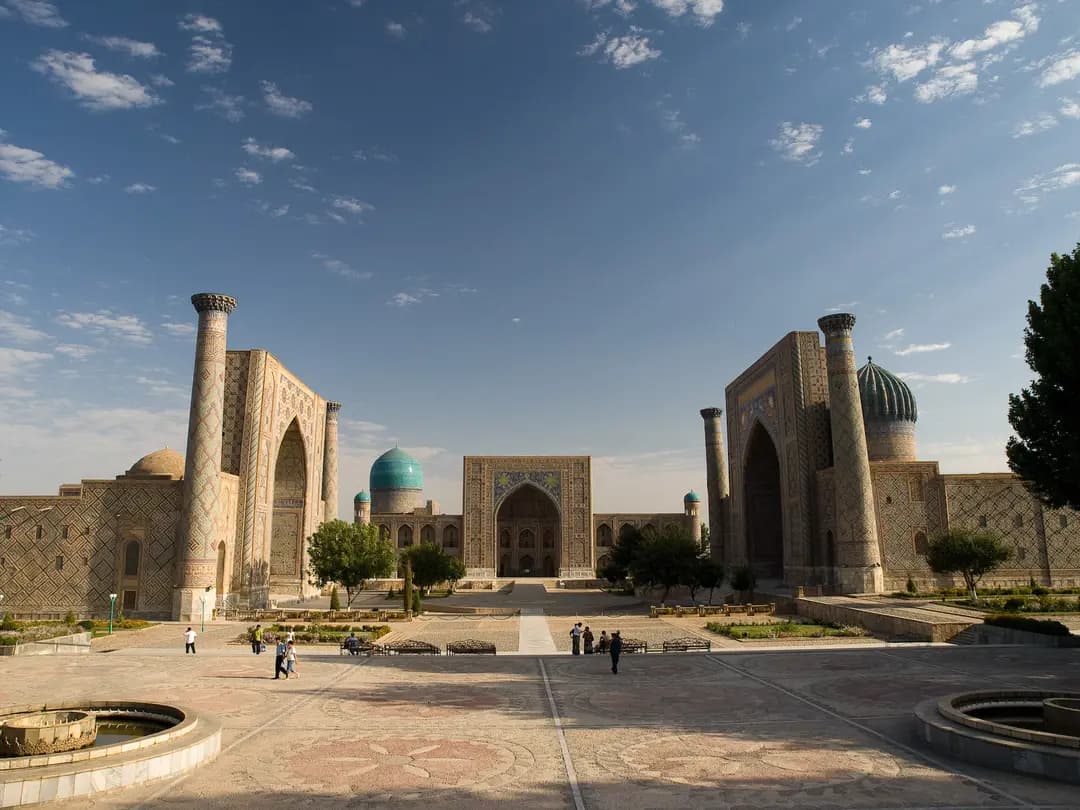
Most visitors see Samarkand as a handful of pins on a map: the Registan, Gur-e-Amir, Shah-i-Zinda, Bibi-Khanym. A taxi between them, a hotel in the evening. But Samarkand is a living city of around half a million people, with its own neighbourhoods, markets, boulevards and rhythm. Stay for at least two or three days and step off the tourist trail, and the city reveals a completely different side.
How the city is laid out
It helps to picture Samarkand as several layers stacked on top of each other:
- Afrasiab — a hilly ancient site in the north-east where old Maracanda stood. Today it is an archaeological zone with a museum.
- The old city — the medieval Samarkand of Timur and his descendants, with its great ensembles and the mahallas around them.
- The European quarter — west of the Registan: a town built from the late 19th century onwards, with straight streets, boulevards and buildings of that era.
- Modern districts — Soviet-era and newer residential areas around the edges.
The boundary between the old and the European city runs roughly around the Registan and the Gur-e-Amir mausoleum.
The old city and its mahallas
Behind the facades of the great ensembles lie the mahallas — traditional neighbourhoods of narrow lanes, blank walls and inner courtyards. Ordinary families live here, small bakeries work away, and in the morning children run to school.
Things worth doing:
- walk from the Registan to Bibi-Khanym Mosque through the side lanes rather than the main pedestrian street;
- visit the former Jewish quarter near the Registan, where an old synagogue survives;
- stop at a tandoor bakery in the morning for hot Samarkand bread — it is denser and heavier than Tashkent bread and keeps well on the road.
Remember these are residential areas: keep your voice down, do not peer into courtyards and ask before photographing people.
Siab Bazaar
Samarkand's main market is right next to Bibi-Khanym Mosque. It sells dried fruit, nuts, spices, sweets, fresh produce and the famous bread. The best time is the morning, when the market is just opening and everything is freshest.
Do not be shy about tasting — traders are happy to offer samples. Bargaining is fine, but keep it friendly: bazaar prices are approximate and depend on the season.
Afrasiab and around
North-east of the bazaar rise the hills of Afrasiab. There is a museum with fragments of ancient murals, and nearby is the Khoja Doniyor mausoleum on the bank of the Siab stream, a revered site with a peaceful garden. A little further along the road is the Ulugh Beg Observatory — or what remains of it: a huge underground sextant and a small museum.
All of this combines easily into one outing, with a taxi for some of the stretches.
The European quarter
This side of Samarkand is almost unknown to tourists, yet it is a lovely place for an evening walk. University Boulevard is a broad avenue with century-old trees, benches and buildings from the early 20th century. Around it are cafes, parks, an Orthodox cathedral and a Catholic church that recall the city's multi-ethnic past.
In the evening, when the heat eases, the boulevard fills with locals — a good way to see everyday Samarkand.
Residential districts and outskirts
Around the edges of the city lie residential districts that tourists hardly ever visit. There is no need to go there specially, but if you are staying in an apartment or with friends, try the local markets and teahouses: prices are lower and the atmosphere simpler. A few kilometres outside the city, in the village of Konigil, a workshop makes Samarkand paper from mulberry bark using a traditional method.
Getting around
- On foot — within the old city and along the boulevards.
- By taxi — between districts, booked through apps, with low fares.
- City buses and minibuses — cheap, but awkward if you do not know the routes.
Where to go from Samarkand
Samarkand is a handy base for trips around the country:
- Back to Tashkent — about 300 km. Besides the train, there are Samarkand — Tashkent shared rides on Yo'ldosh: useful if you need to leave at your own time or tickets have sold out.
- To Bukhara — about 270 km, 4 hours by car. Trips on Samarkand — Bukhara let you stop along the way, for example in Navoi.
- To Shahrisabz — about 90 km over the Takhtakaracha pass, 1.5–2 hours. Drivers travel Samarkand — Shahrisabz every day, and the mountain road itself is a treat.
With a shared ride you book a seat in the app, travel with a verified driver and pay only for yourself.
How many days you need
| Time | Plan |
|---|---|
| 1 day | the main ensembles |
| 2 days | plus the bazaar, mahallas and Afrasiab |
| 3 days | plus the European quarter, Konigil and a trip to Shahrisabz |
The bottom line
The Registan is the heart of Samarkand, but not the whole city. Leave time for the mahallas, the bazaar, the boulevards and the surroundings, and for onward travel check the routes page.
Cover photo: Gustavo Jeronimo from Aranjuez, Spain, CC BY 2.0, Wikimedia Commons.
