Tash-Hauli: Palace of the Khans of Khiva - Harem, Courts and Tiles
How Itchan Kala's main palace works: the harem with five iwans, the court of justice and the festive courtyard with its yurt platform, plus what to look for in the tiles.
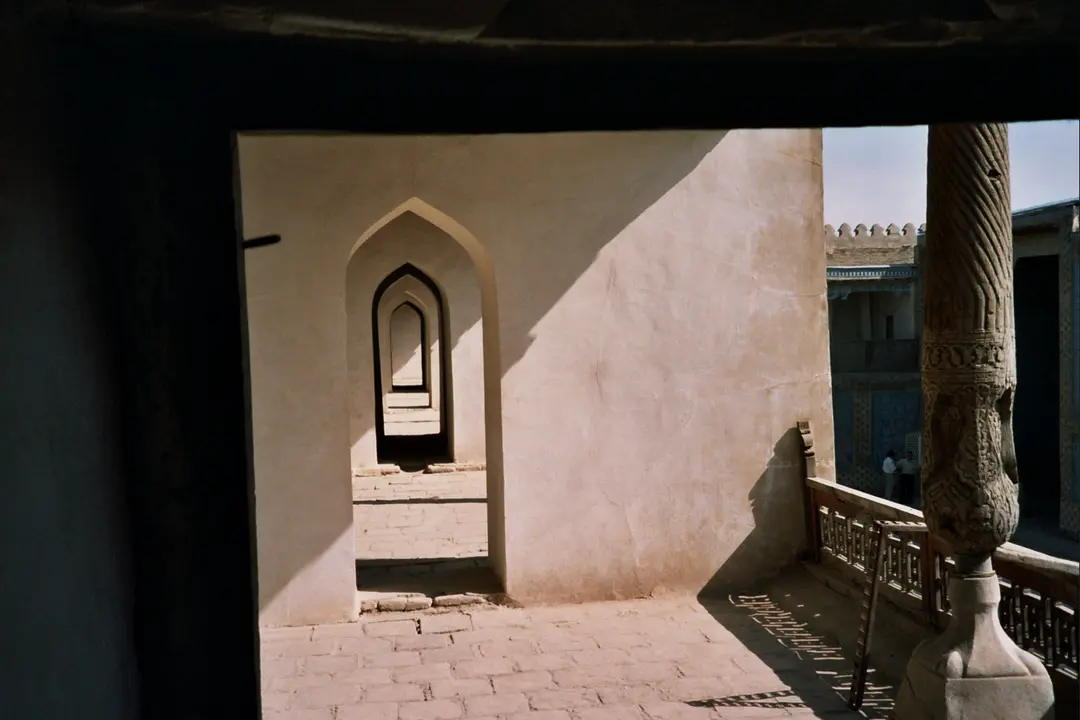
Tash-Hauli is Khiva's most ornate palace. Its name means "stone courtyard" or "stone house", although it is built mainly of brick. From outside it is a massive complex with high walls and crenellated turrets; inside are several enclosed courtyards, each with its own purpose, iwans on carved columns and walls covered entirely in blue and white tiles. To keep the palace from becoming a string of beautiful but baffling rooms, it helps to know how it worked.
How it was built
The palace was built in the 1830s on the orders of Allakuli Khan, one of the most energetic rulers of the Khiva Khanate. The old residence in Kunya-Ark did not seem grand enough to him, so the khan decided to build a new palace in the eastern part of Itchan Kala, near the Palvan-Darvoza gate.
A grim legend is attached to the construction. It is said the khan demanded the harem be finished in two years; the first master builder said this was impossible and paid for it with his life. The next architect met the deadline. Whether this really happened is unknown, but the story reflects the character of the era and the haste with which the palace went up. In total, construction took about eight years.
Allakuli Khan was a prolific builder: in his reign a madrasa, a caravanserai and a covered market, or tim, went up next to the palace by the eastern gate, and they still stand by Palvan-Darvoza today. If you leave Itchan Kala that way, step under the vaults of the tim; it belongs to the same era.
How the palace is laid out
Tash-Hauli consists of three main courtyards linked by narrow corridors. Each had its own function.
The harem
The northern part of the palace is the harem, built first. It is a large rectangular courtyard. On its south side stand five tall iwans on slender carved columns. One was meant for the khan and the other four for his four lawful wives. Behind each iwan are living rooms. The other sides of the courtyard are taken up by two-storey quarters for concubines, female relatives and servants.
The harem iwans are the main reason to visit Tash-Hauli. Tall wooden columns rise from stone bases, the ceilings are painted with vivid ornament, and the walls are clad in majolica from floor to ceiling. Stand in the middle of the courtyard and take in all five iwans at once; it is the palace's most famous view.
Arz-Hauli: the court of justice
Here the khan received petitions, sat in judgement and dealt with affairs of state. The courtyard is more austere than the harem, with a tall iwan where the ruler sat. Notice how the entrances are arranged: petitioners came in and went out through different doors, as part of the ceremony.
Ishrat-Hauli: the festive courtyard
The third courtyard was for receptions, celebrations and meetings with ambassadors. In the centre is a round brick platform. A yurt was set up on it: the khans of Khiva came from nomadic clans and, by tradition, received honoured guests in a yurt even though they had a splendid palace. This detail shows clearly how urban and nomadic cultures blended in Khorezm.
Tiles: what to look for
Tash-Hauli is the best place in Khiva to study Khorezm majolica. A few pointers:
- Colour. Blue, light blue and white dominate. The palette is calmer and cooler than in Samarkand.
- Patterns. Interlacing plant tendrils, stars and geometric grids. Patterns almost never repeat exactly; compare neighbouring panels.
- Handwork. Each tile is hand-painted, and up close you can see brushstrokes and small irregularities.
- The master. The palace tiles are linked to a master named Abdullah, nicknamed "Jinn" for his extraordinary skill.
The wooden columns and doors are just as interesting: Khiva woodcarving is famous across Central Asia, and the palace has plenty of it.
Practical tips
- Ticket. Entry to Tash-Hauli is usually included in the Itchan Kala combined ticket. Check current conditions at the ticket office.
- Time. Allow 40-60 minutes for the palace.
- Light. The harem courtyard looks best in the morning and in the afternoon, when the sun lights the iwans from the side. At noon the contrast is too harsh.
- Finding your way. The passages between courtyards are narrow and confusing, so do not hesitate to ask the attendants.
- Museums. Some palace rooms hold small exhibitions on daily life and applied art.
Tash-Hauli combines easily with the Pahlavan Mahmud Mausoleum and the Islam Khodja Minaret, all in the eastern half of Itchan Kala.
Khiva and Tashkent: getting there
Tashkent and Khiva are about a thousand kilometres apart by road via Bukhara, a full day's drive of around 14-16 hours. That is why most people fly to Khorezm or take the train to Urgench and continue to Khiva from there. If you want to travel overland and see the Kyzylkum Desert for yourself, a shared ride via Yo'ldosh is a good fit: drivers publish long-distance trips, you book one seat in the app, share the road with fellow travellers and pay less than for a car of your own.
See trips on the Khiva - Tashkent route page and tips for long journeys in the for passengers section.
Cover photo: upyernoz from Haverford, USA, CC BY 2.0, Wikimedia Commons.
