Dorut Tilovat and Dor us-Saodat: The Timurid Family Tombs
Where Timur's father and sons are buried, why Ulugbek built the Kok Gumbaz mosque and why the crypt prepared for the conqueror himself has always stayed empty.
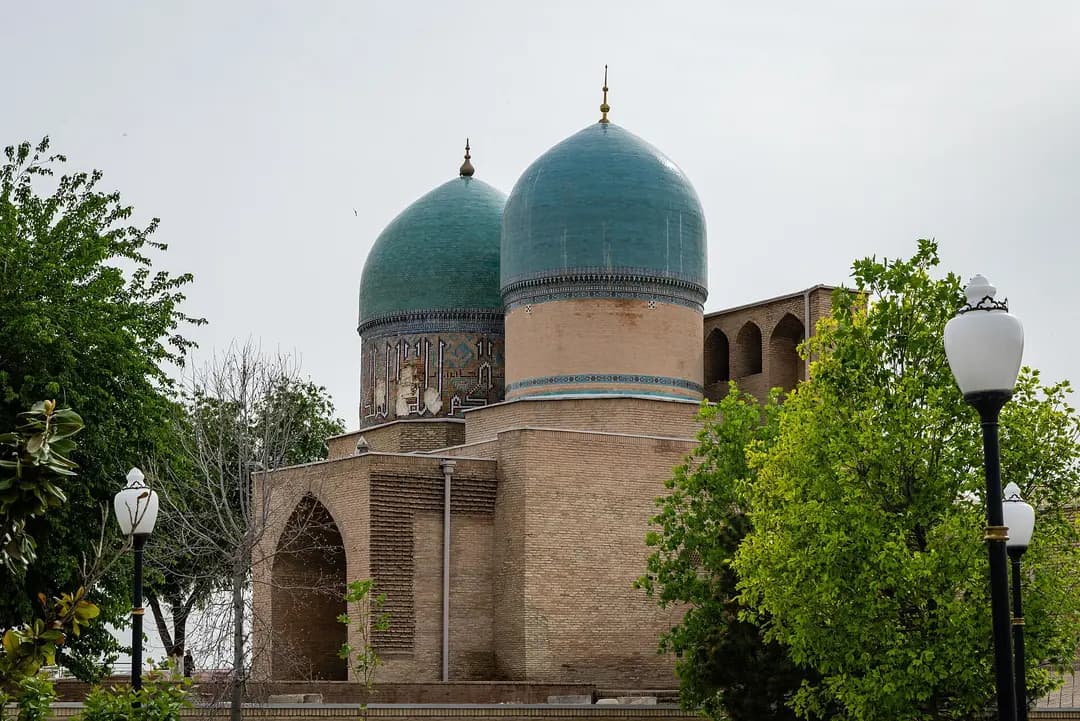
Many people know that Timur is buried in Samarkand, in the Gur-e Amir mausoleum. Far fewer remember that he originally meant to be laid to rest in his home town of Shahrisabz. Two memorial complexes of his dynasty stand here: Dorut Tilovat, where the conqueror's father lies, and Dor us-Saodat, built for Timur's sons and for Timur himself. Together with Ak-Saray they form the main historical axis of the town.
Dorut Tilovat: the "House of Contemplation"
The name of the complex is usually translated as "House of Contemplation" or "House of Recitation". It is an ensemble of several buildings from different periods, grouped around a courtyard.
The mausoleum of Sheikh Shamsiddin Kulal
Shamsiddin Kulal was a Sufi sheikh and the spiritual mentor of Timur and his father, Amir Taragai. His mausoleum was built in the 1370s, and according to tradition Taragai is buried here as well. For Timur this was a deeply personal place: he revered the sheikh and wanted his family to lie beside him.
From the outside the mausoleum looks modest, but the story of Shahrisabz's dynastic necropolis begins here.
The Kok Gumbaz mosque
The most striking building in the complex is the Kok Gumbaz ("Blue Dome") Friday mosque. It was built by Timur's grandson, the scholar and ruler Ulugbek, in the 1430s in memory of his father Shahrukh. The huge turquoise dome on a tall drum can be seen from afar, and the portal is decorated with mosaic and inscriptions.
What to notice:
- the contrast between the austere brick body and the bright dome;
- the geometric ornament on the portal;
- the spacious hall under the dome, one of the largest in Shahrisabz.
Gumbazi Sayyidon
Next to the mosque stands the Gumbazi Sayyidon ("Dome of the Sayyids") mausoleum, also built by Ulugbek. Descendants of noble sayyid families are buried here. Inside, painted decoration and carved tombstones have survived.
Dor us-Saodat: the "Seat of Power"
Dor us-Saodat is the complex Timur built as a dynastic necropolis. Originally it was vast, with a mosque, tombs and service buildings. Only part of it has survived.
The mausoleum of Jahangir
Jahangir, Timur's eldest and favourite son, died young in 1376. His death was a heavy blow to his father, and a tall mausoleum with a distinctive conical dome on a ribbed drum was built in his honour. Later another of Timur's sons, Umar Sheikh, was buried here too.
It is one of the most recognisable buildings in Shahrisabz: cool and quiet inside, with an impressively high dome.
Timur's crypt
A few dozen metres from Jahangir's mausoleum lies the underground crypt Timur prepared for himself. A narrow staircase leads down to a small chamber with a stone sarcophagus decorated with inscriptions.
Why is it empty? Timur died in the winter of 1405 in Otrar, during his campaign against China. The mountain passes on the way to Shahrisabz were blocked by snow, so the conqueror was buried in Samarkand, in Gur-e Amir, where he still rests. The crypt in Shahrisabz was never used.
A few tips:
- The steps are steep, so go down carefully.
- There is little room inside, and on busy days you may need to wait a moment.
- It is a place of remembrance, so keep your voice down.
The Hazrati Imam mosque
Next to Dor us-Saodat stands the active Hazrati Imam mosque, with old plane trees in its courtyard. It is a pleasant place to rest in the shade between sights.
How to explore the complexes
| Order | Sight | Time |
|---|---|---|
| 1 | Ak-Saray | 30–40 min |
| 2 | Dor us-Saodat: Jahangir's mausoleum, Timur's crypt, Hazrati Imam | 45–60 min |
| 3 | Dorut Tilovat: Kok Gumbaz, Shamsiddin Kulal mausoleum, Gumbazi Sayyidon | 1 hour |
A pedestrian zone links all three, and the whole walk is about 2 km.
How to get there
From Samarkand
About 90 km over the Takhtakaracha Pass, roughly 1.5 to 2 hours. The road is very beautiful but winding; in winter the pass is sometimes closed and traffic takes a detour. A shared ride on the Shahrisabz — Samarkand route is a convenient choice — Yo'ldosh drivers travel in both directions regularly, so you can choose a departure time that fits your plans.
From Tashkent
The distance is roughly 380 to 400 km, and the journey takes about 5.5 to 7 hours depending on the route and the weather. The usual way is via Samarkand or via Jizzakh and Guzar. To save money on this long trip, look for rides on the Tashkent — Shahrisabz route: a seat in a car costs much less than a private taxi, and drivers usually know good places to stop.
Visiting etiquette
- Dress: shoulders and knees covered; women should wear a headscarf in mosques.
- Shoes come off at the entrance to prayer rooms.
- Photography is usually allowed; check inside mosques. Do not take photos during prayers.
- Tickets for individual sights may be sold separately; prices are low and change, so check on site.
When to go
- April–May and September–October are the best times.
- In summer, visit the sights before 11 a.m.
- In winter, check the state of the pass if you are coming from Samarkand.
Why go
Dorut Tilovat and Dor us-Saodat show Timur not as a military commander but as a son and a father. There are fewer tourists here than in Samarkand, and a stronger sense of the dynasty's personal story — from the sheikh who guided them to the empty crypt that never received its owner.
To plan your trip, look at the Shahrisabz — Samarkand and Tashkent — Shahrisabz routes, or choose another destination under all routes.
Cover photo: Marat Nadjibaev, CC BY-SA 4.0, Wikimedia Commons.
