Kokand's Juma Mosque and the Narbutabey Madrasa
An iwan with nearly a hundred carved columns, one of the largest madrasas in the Fergana Valley and the necropolis of the Kokand khans — how to see Kokand's main shrines respectfully.
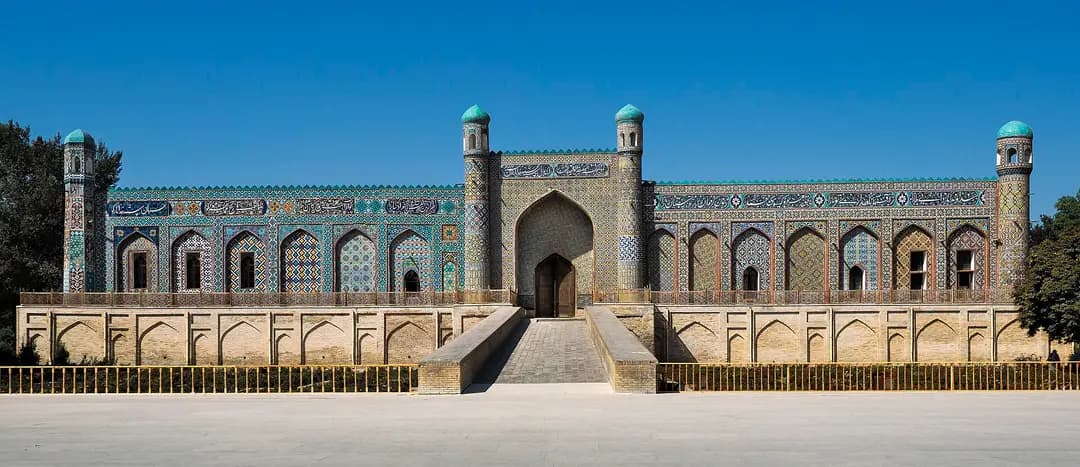
Khudoyar Khan's Palace is Kokand's calling card, but the spiritual life of the city has always been centred elsewhere. The Juma mosque with its famous iwan and the Narbutabey madrasa are the two monuments that best convey Kokand's character as a religious and scholarly centre of the Fergana Valley. Unlike the palace, these are active places of worship, so it is worth preparing a little before you visit.
The Juma mosque: a forest of carved columns
Kokand's main Friday mosque was built in the early 19th century under Umar Khan, one of the best-known rulers of the khanate. It was Kokand's golden age: madrasas were being built, poets gathered at court, and the city was becoming an important centre of Islamic learning.
The iwan
The main reason people come here is the huge iwan, an open covered gallery running along the facade. Its roof rests on 98 wooden columns, making it one of the most impressive wooden structures in Central Asia.
What to look at:
- The columns. Each one stands on a carved base, and the shafts are decorated with fine carving. Walk along the iwan and compare them: the patterns differ.
- The ceiling. Painted with floral ornament in reds and greens, it is especially beautiful in soft morning light.
- The perspective. Stand at one end of the iwan and look down the row of columns — it feels like an almost endless corridor.
The minaret
In the mosque courtyard stands a brick minaret more than 20 metres tall. It is visible from the surrounding streets and makes a handy landmark in the historic centre.
The courtyard
The spacious, tree-lined courtyard brings a sense of calm to the middle of a busy city. On Fridays many people gather here for prayer; on other days it is usually quiet.
The Narbutabey madrasa
The madrasa was built at the end of the 18th century under Narbuta Bey, the ruler who laid the foundations of the Kokand Khanate's power. It is one of the largest madrasas in the valley, with a massive portal, domes and a courtyard surrounded by hujras, the students' cells.
Interestingly, the madrasa is still used for its original purpose, and students study here today. So:
- visitors are usually allowed into the courtyard, but not into every room;
- keep quiet and do not peer into the cells;
- ask the staff whether photography is allowed.
The portal is restrained, with brick decoration and tile inserts. It looks great against the sky, so photograph it from across the street.
What is nearby
If you have another hour or two, visit the other monuments close by:
| Place | What to see |
|---|---|
| Dakhmai Shakhon necropolis | Tomb of the rulers with carved wooden doors |
| Modari Khan mausoleum | Mausoleum of Umar Khan's mother with a tiled portal |
| Khudoyar Khan's Palace | The khan's residence and local history museum |
The Dakhmai Shakhon necropolis is linked to the story of Umar Khan and his wife Nodira, a poet who is still known and revered in Uzbekistan.
When to visit
- The best time is a weekday morning, when the mosque and madrasa are almost empty and the light is soft.
- Friday is the day of congregational prayer. Around midday it gets crowded, so come at another time.
- Ramadan has a special atmosphere, but remember that many people are fasting and be considerate.
Visiting hours for tourists may change, especially on holidays, so check on site.
Etiquette
- Dress: covered shoulders and knees. Women are advised to cover their heads.
- Shoes: remove them before entering the prayer hall.
- Photos: usually fine in the courtyard and iwan; inside the prayer hall, only with permission. Do not photograph people at prayer.
- Behaviour: speak quietly, do not sit on the portal steps and do not touch the carving on the columns.
- Donations: welcome but not required.
Getting there from Tashkent
Kokand is about 230 km from Tashkent. The road over the Kamchik Pass takes roughly 3.5 to 4 hours and is considered one of the most scenic in the country, with mountain slopes, tunnels and views over the valleys.
Things to keep in mind:
- There is usually a checkpoint on the pass, so carry your documents.
- In winter there may be snow and fog, so keep an eye on the weather.
- If mountain roads make you queasy, sit in the front.
A shared ride is a convenient way to travel. On the Kokand — Tashkent route and in the opposite direction, drivers post trips on Yo'ldosh: you book a seat and see the driver's profile and departure time in advance. That way you can arrive in the morning, see the sights and be back in the capital in the evening.
Planning a day in Kokand
- 9:00 — the Juma mosque, while the light is soft.
- 10:30 — the Narbutabey madrasa.
- 11:30 — Dakhmai Shakhon and the Modari Khan mausoleum.
- 13:00 — lunch and Kokand halva at the bazaar.
- 15:00 — Khudoyar Khan's Palace.
- 17:00 — leave for Tashkent or continue through the valley.
Why it is worth seeing
The iwan of the Juma mosque is one of those places where the craft of woodcarving reaches the level of architecture. The Narbutabey madrasa shows that Kokand remains a city of learning and faith to this day. Together they give a much deeper picture of the city than the khan's palace alone.
When heading to Kokand, check the rides on the Kokand — Tashkent route, and find other routes into the valley under all routes.
Cover photo: Petar Milošević, CC BY-SA 4.0, Wikimedia Commons.
