Fayaz Tepa and Kara Tepa: Buddhist Termez
Two thousand years ago Buddhist monasteries of the Kushan Empire stood on the banks of the Amu Darya. Here is what survives, how to enter the border zone and why pilgrims come here.
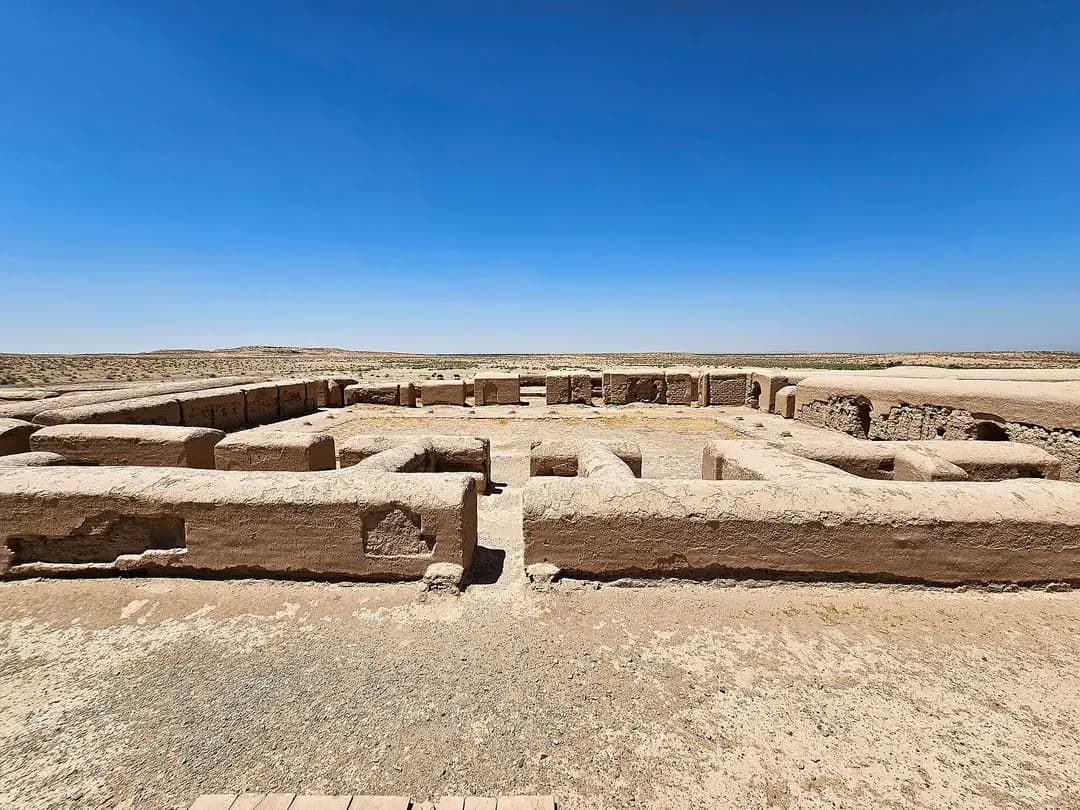
When people talk about the Silk Road in Uzbekistan, they usually picture the domes of Samarkand and Bukhara. But long before those, in the first centuries AD, a very different culture flourished in the south of the country. Termez, an ancient city on the Amu Darya, was one of the centres of Buddhism in the Kushan Empire. Monks and teachers set out from here to the north and east, and monasteries with stupas, cells and assembly halls lined the river. The two best-known monuments of that era are Fayaz Tepa and Kara Tepa.
A little history
In the 1st to 3rd centuries AD the Kushan Empire united the lands of present-day Uzbekistan, Tajikistan, Afghanistan, Pakistan and northern India. Caravan routes crossed these territories, and ideas travelled together with goods. Buddhism reached Bactria from the south and took root here for several centuries.
Termez sat at a convenient crossing of the Amu Darya, and monasteries grew up around the city. Later, with the arrival of Islam, they were abandoned and gradually disappeared under layers of earth. Archaeologists began excavating them systematically in the second half of the 20th century, and finds from Termez are now kept in the country's major museums.
Fayaz Tepa
Fayaz Tepa is a monastery complex a few kilometres from modern Termez, next to the ruins of Old Termez. It was excavated in the late 1960s.
What survives and what to look at:
- The stupa. The main structure of the complex. To protect the ancient brickwork it was covered with a protective shell that repeats the shape of the stupa, and inside you can see part of the original brick construction.
- The monastery courtyard. The layout is easy to read: a central courtyard surrounded by monks' cells, a refectory and service rooms.
- The sanctuary. This is where the famous sculptural group "Buddha with Monks" was found — the Buddha seated beneath a tree with a monk on either side. The original is now in the State Museum of History of Uzbekistan in Tashkent and is one of the most recognisable pieces in the entire collection.
Fayaz Tepa lies outside the strictly closed zone, so it is the easiest site to visit and a good first introduction to Buddhist Termez.
Kara Tepa
Kara Tepa is a larger and more mysterious complex. It spreads over three hills right by the Amu Darya and combines buildings on the surface with cave rooms cut into the slopes. Fragments of wall paintings, sculptures and inscriptions in several languages have been found here, pointing to monks who came from different parts of the Buddhist world.
The main difficulty is its location. Kara Tepa lies in the border strip by the river, and Afghanistan begins on the opposite bank, so there is no free access.
How to visit the border zone
The rules change from time to time, so rely on general principles:
- The permit is arranged in advance. It is usually obtained through tour companies, the museum or an official request. You cannot simply turn up and walk in.
- Bring your passport. It is mandatory for foreigners, and Uzbek citizens should carry ID as well.
- No improvising. Do not photograph border installations, do not leave the route and follow your escorts' instructions.
- Ask locally. Staff at the Termez Archaeological Museum can usually tell you the current procedure.
If you cannot get a permit, do not be disappointed: Fayaz Tepa, Old Termez, the Zurmala stupa and the museum galleries give a very complete picture of the city's Buddhist past.
Why pilgrims come here
For Buddhists from Japan, South Korea, Thailand, Sri Lanka and other countries, Termez is connected with the story of how the teaching spread north. Buddhism travelled through Bactria and Central Asia to China and from there further east. That is why you may meet groups of pilgrims and monks in Termez who come to pray at the ancient stupas. The atmosphere is very calm, and ordinary visitors are welcome too.
How to get to Termez
Termez is the southernmost major city in Uzbekistan.
| From | Distance | Travel time |
|---|---|---|
| Tashkent | ~700 km | 10–12 hours |
| Samarkand | ~370 km | 6–7 hours |
The road from Samarkand runs via Shahrisabz or Kitab and over mountain passes, then across the steppes of Surkhandarya. The scenery is beautiful, but the journey is long, so leave early. A convenient option is a shared ride: on the Tashkent — Termez and Samarkand — Termez routes drivers regularly post trips on Yo'ldosh, and you can book a single seat instead of paying for a whole taxi.
When to go and what to bring
- The best seasons are March to May and October to November. Termez is considered one of the hottest places in the country, and in summer temperatures easily climb above 40 °C.
- In summer, visit the sites early in the morning and spend the middle of the day in the shade or in the museum.
- Bring a hat, water, sunscreen and comfortable shoes, as the ground at the ruins is uneven.
- Respect the site. Do not climb the stupa, do not take pottery shards and do not touch the brickwork.
How to plan your day
A logical order: in the morning, Fayaz Tepa and the ruins of Old Termez; then the Termez Archaeological Museum, where finds from these same monasteries are on display; and in the evening, a walk around the city. If you have a permit, visit Kara Tepa in the first half of the day before the heat sets in.
Buddhist Termez is a rare chance to see Uzbekistan as it was before the age of mosques and madrasas. To get here without hassle, check the trips on the Tashkent — Termez and Samarkand — Termez routes or pick another destination under all routes.
Cover photo: Prof. Mortel, CC BY 2.0, Wikimedia Commons.
