The Muynaq Ship Graveyard and the Aral Sea Museum
Rusting trawlers in the middle of the desert, a cliff where waves once broke and a museum where the Aral is still blue. What to see in Muynaq and how to get there from Nukus.
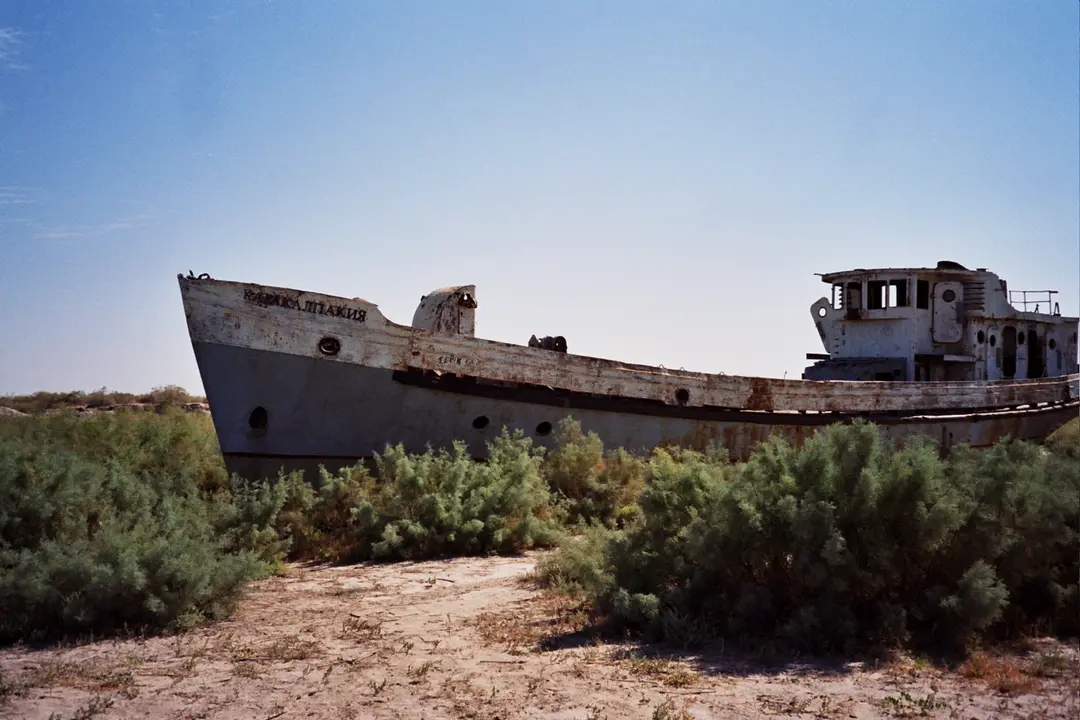
Some places turn textbook numbers into something you can touch. Muynaq is one of them. In the middle of the last century it was a port town on a peninsula, with a fish cannery, a fishing fleet and beaches. Today more than a hundred kilometres of sand and salt flats separate its outskirts from the water, and the rusting hulls of fishing boats stand on the former seabed. A trip here is not about pretty pictures, although you will take plenty. It is about seeing with your own eyes what happened to the Aral Sea.
How to get to Muynaq
Muynaq lies in the north of Karakalpakstan, roughly 200 kilometres from Nukus. The road is paved and runs past cotton fields, canals and small villages, and the landscape grows emptier and more desert-like the closer you get. Expect the drive to take about 3 to 3.5 hours.
Your options:
- Public transport — minibuses and buses run irregularly, so check the schedule at the Nukus bus station the day before.
- A taxi for the whole day — comfortable, but expensive if you travel alone.
- A shared ride — on the Nukus — Muynaq route drivers post their trips on Yo'ldosh, so you can book a seat, split the cost and avoid planning your day around a bus.
Most visitors do it as a day trip: leave Nukus in the morning, see the ship graveyard and the museum during the day, and drive back in the evening. If you want to see the sea itself, you will need a 4x4 and an overnight stay. Dirt tracks across the Ustyurt Plateau lead to the present shoreline, and it is not a place to go on your own without experience and a reliable way to communicate.
The ship graveyard
The main stop is a memorial on a high bluff at the entrance to town. A monument stands at the top, and below, on the old seabed, several old vessels are lined up in a row. They used to be scattered across the desert; later they were gathered in one place so that visitors could see them more easily.
Good to know:
- You can walk down — a path leads to the hulls. Avoid climbing inside: the metal has long since rusted through and there are sharp edges.
- Look at the bluff itself. It is the old shoreline. Standing on top, it is easy to picture where the waves used to break.
- The best light is early in the morning or close to sunset, when the rust turns orange and the shadows stretch out.
- Sand and dust — on windy days dust storms rise, and the dust here is salty. Bring sunglasses and a scarf, and protect your camera and phone.
There are usually information boards on the bluff with maps showing how the water retreated decade by decade. Spend a couple of minutes there: one diagram with several shorelines explains more than any lecture.
The Aral Sea Museum
Many visitors skip the small local history museum in the centre of Muynaq, which is a mistake. This is where you can see what the town looked like before the disaster. The exhibition includes:
- paintings by local artists showing a blue sea, boats and fishermen — a striking contrast to what you have just seen;
- photographs of the fishing fleet, the port and the cannery that once supplied the whole Soviet Union;
- fishermen's everyday objects, nets and ship models;
- maps and diagrams of the shrinking sea: the causes linked to diverting water from the Amu Darya and Syr Darya for irrigation, and the consequences for the climate and people's health.
The museum is modest but very honest. If a guide is available, ask about life in the town: many of the staff are locals whose families remember the sea.
What else Muynaq has to offer
The town is small, but a few things are worth mentioning:
- Muynaq itself, with its quiet streets and old houses from the fishing era — the "end of the road" feeling here is very strong.
- The Stihia festival — an electronic music festival that in recent years has been held next to the ship graveyard and draws young people from around the world. Dates change, so check in advance.
- A starting point for the Aral and Ustyurt — this is where 4x4 tours set off for today's shoreline and the plateau cliffs, with nights in yurts or tents.
When to go
| Season | What to expect |
|---|---|
| April–May | Warm, soft light, the best season |
| June–August | Heat up to 40 °C, dust, set off early |
| September–October | Comfortable, good visibility |
| November–March | Cold and windy, frosts are common |
The climate is sharply continental: hot and dry in summer, with a piercing wind in winter. Carry plenty of water at any time of year.
Practical tips
- Food. There are only a few cafes in Muynaq. Pack snacks in Nukus.
- Cash. There are ATMs, but they do not always work, so carry some cash.
- Phone signal. There is mobile coverage in town, but it is patchy outside it.
- Clothing. A hat, sunscreen and closed shoes for the walk down to the ships.
- Combine it with Nukus. The Savitsky Museum and its famous avant-garde collection is the natural companion to this trip, the day before or the day after Muynaq.
Why it is worth the trip
The ship graveyard is not an attraction. It is a place where one of the largest environmental disasters of the 20th century stops being a chart and becomes a real landscape: a bluff, sand and ships with nowhere left to sail. After the trip many people say they look at water and cotton differently.
If you are heading to Karakalpakstan, set aside at least one full day for Muynaq. You can find travel companions and book a seat for the Nukus — Muynaq trip on Yo'ldosh, and other routes across the country are listed under all routes.
Cover photo: upyernoz from Haverford, USA, CC BY 2.0, Wikimedia Commons.
