Bahauddin Naqshband Complex near Bukhara: History and Etiquette
The holiest site of the Naqshbandi Sufi order: who the sheikh was, what rituals pilgrims perform, how a visitor should behave and how to get there from Bukhara.
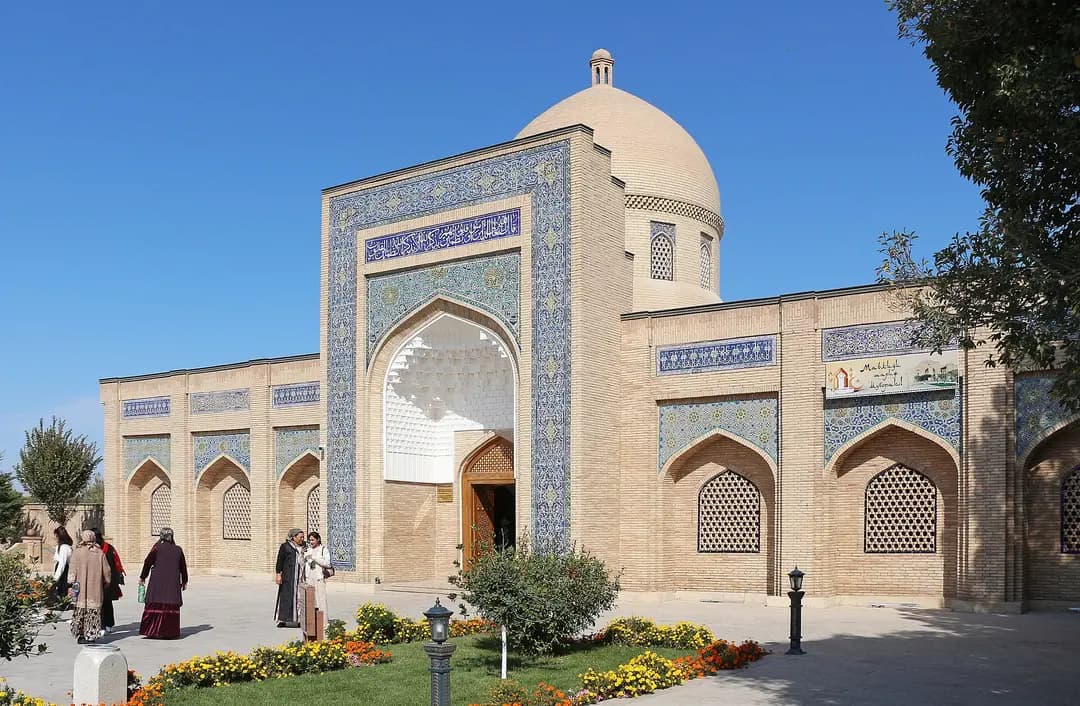
About twelve kilometres north-east of Bukhara, in the village of Kasri Orifon, lies a place many people in Uzbekistan regard as the country's most important shrine. This is the burial place of Bahauddin Naqshband, founder of the Naqshbandi Sufi order, one of the most influential in the Islamic world. For locals it is a place of pilgrimage; for a visitor it is a chance to see living popular faith and to walk through a beautiful memorial complex.
Who Bahauddin Naqshband was
Bahauddin Muhammad was born in 1318 in this very area and died here in 1389. The name Naqshband is linked to his family's craft of stamping or embroidering patterns on cloth, and in a spiritual sense to "imprinting" the name of God on the heart.
The core of his teaching is captured in the famous saying "Dil ba yor, dast ba kor": "The heart with God, the hands at work." Naqshband taught that there is no need to withdraw from the world as a hermit: one can live an ordinary life, work, practise a craft or trade, and keep God inwardly remembered. The order chose silent remembrance over loud rituals. This down-to-earth approach made the Naqshbandiya very popular among craftsmen and merchants, and the order spread from Central Asia to India and the Ottoman Empire.
Popularly, the saint is called Bahauddin Balogardon, "the averter of misfortune". Many people come here before important events: a wedding, a journey or a new venture.
How the complex is laid out
The complex's present appearance largely dates from a major reconstruction in the 1990s, but historic buildings survive as well.
- The sheikh's grave - not a domed mausoleum but an open, stone-clad raised platform called a dakhma. Pilgrims circle it while reciting prayers.
- The 16th-century khanaka - a massive domed building erected for Sufi gatherings.
- Mosques with iwans on wooden columns and painted ceilings, especially lovely in morning light.
- A small minaret and ponds, around which people sit.
- An old dried-out tree - a mulberry trunk that pilgrims walk around or pass beneath while making a wish.
- A well whose water is considered blessed.
- A cemetery with the graves of the sheikh's relatives and followers.
Pilgrims' rituals
You will see several recurring practices:
- Circling the sheikh's grave in prayer.
- Quran recitation: reciters sit by the dakhma, and visitors approach them.
- Walking around the old tree or passing under its trunk.
- Donations and shared food: families often hand out bread and sweets or offer plov.
- Drawing water from the well.
As a visitor you can simply observe. If you are invited to share food, it is a gesture of hospitality, and it is polite to try a little.
Rules for visitors
- Clothing: shoulders and knees covered; women should wear a headscarf. Shorts and revealing tops are inappropriate.
- Behaviour: speak quietly, do not disturb people praying, and never walk directly in front of someone at prayer.
- Photos: architecture is fine; people only with their consent. It is best not to take photos at the dakhma.
- Shoes: remove them in mosques and on carpets.
- Fridays and holidays: these days are very crowded. For a calm visit, choose a weekday.
Entry is usually free, occasionally with a symbolic fee; rules change, so check on site. Allow about an hour.
When to go
The calmest time is a weekday morning, roughly until noon. Spring and autumn are especially pleasant: warm weather, green gardens and shady courtyards where you can sit for a long time. In summer arrive early, before the courtyard stones heat up. During Eid al-Fitr and Eid al-Adha, and at weekends, thousands of people come here; the mood is festive, but for a first visit a quiet day is better.
Getting there from Bukhara
The complex is about 12 km from the old city, 20-25 minutes by taxi. It is easiest to agree a return trip with waiting time. It pairs perfectly with the Sitorai Mohi-Hosa palace and the Chor-Bakr necropolis for a full day in Bukhara's suburbs.
The Seven Saints of Bukhara and Gijduvan
The Bukhara region has a tradition of pilgrimage to seven saints, the "Yetti Pir". They are spiritual masters linked to the chain of the Naqshbandi order, and Bahauddin Naqshband is the last of them. One of the first is Abdulkhaliq Gijduvani, whose mausoleum stands in the town of Gijduvan, about 45 km from Bukhara. Next to it is a madrasa built by Ulugbek in the 15th century, one of the three madrasas this ruler founded.
Gijduvan is also famous for its ceramics, whose warm browns, yellows and greens are recognisable across the country. Many visitors combine Bahauddin and Gijduvan in one trip; the drive is short, about an hour.
For travel between Bukhara and Gijduvan you can use a shared ride through Yo'ldosh: book a seat with a verified driver. It is cheaper than a separate car and convenient if you are travelling alone or as a pair. See trips on the Bukhara - Gijduvan route page, and all directions in the routes section.
Cover photo: Bgag, CC0, Wikimedia Commons.
