The Samanid Mausoleum: A Thousand-Year-Old Masterpiece in Fired Brick
Why a small 10th-century cube of a tomb is considered a gem of Central Asian architecture, how it seems to change through the day, and what is nearby in the park.
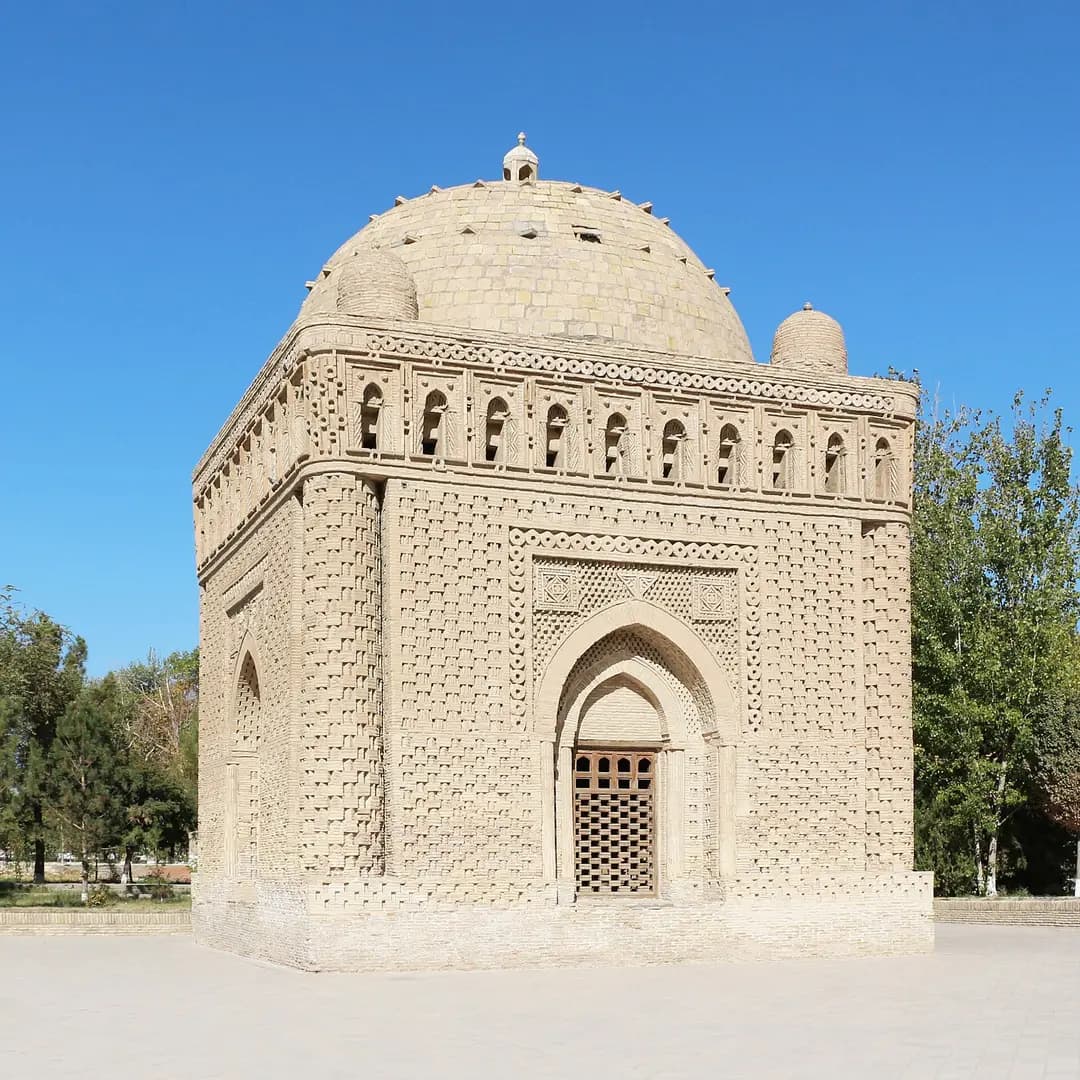
The Samanid Mausoleum is very small: a cube about ten metres on each side, crowned by a hemispherical dome. It has no tiles, no mosaics and no towering portals. And yet many architectural historians call it one of the finest buildings in Central Asia, and travellers often admit it was the thing they remembered most from Bukhara. Here is the secret.
The dynasty and when it was built
The Samanids ruled a vast state across Transoxiana and Khorasan in the 9th and 10th centuries, with Bukhara as their capital. Under them the city became one of the leading centres of learning and literature in the Islamic world: writers worked in Persian here, and poets and scholars served at court. The dynasty's most famous ruler was Ismail Samani, who died in 907.
The mausoleum was built in the late 9th or early 10th century as a family tomb. It is traditionally called the Mausoleum of Ismail Samani, although other members of the dynasty are also buried here. It is one of the oldest surviving buildings of the Islamic era in Central Asia.
How it survived a thousand years
There is a popular explanation for why the mausoleum survived when the Mongols destroyed Bukhara. Over the centuries a cemetery grew up around it, and the building was gradually half-buried in earth and sediment. It was simply overlooked. In the 1930s archaeologists cleared the mausoleum, and it emerged almost in its original state. Whether the burial was really the reason is hard to say, but the building's state of preservation is genuinely astonishing.
The second reason is the builders' skill. Walls almost two metres thick, carefully selected bricks and a well-thought-out transition from the square base to the dome via arched squinches. The building has come through many earthquakes.
Brick that looks like lace
The mausoleum's defining feature is its brickwork. Here fired brick is not just a building material but the decoration itself. Bricks are laid in different directions, projecting and receding to form woven patterns, circles, diamonds and a basket-weave texture. Close up, the wall looks like fabric or carving.
Look out for the details:
- corner columns that seem to grow out of the walls;
- a gallery of small arched openings beneath the dome;
- four identical facades: the building has no "main" side;
- small domes at the corners of the roof around the main one;
- the transition inside from the square to the circle of the dome.
Scholars see in the mausoleum's symbolism a blend of Islamic traditions and older ideas: the cube as an image of the earth and the dome as an image of heaven.
How the mausoleum "changes" through the day
Because all the decoration relies on the relief of the brick, it depends entirely on the light. That is what creates the effect of a living building:
- In the morning the low sun strikes from the side, and the patterns on the east facade become deep and sharply contrasted.
- At midday the light falls from above, shadows are short and the walls look almost smooth and sand-coloured.
- In the evening the west side turns a warm honey colour and the pattern of the brickwork stands out again.
- Inside, light filters through the lattice openings and falls on the brick in patterns.
If you can, visit the mausoleum twice: in the morning and before sunset. It does not take long, as it stands in a park close to the centre.
There is a local custom of walking around the mausoleum several times and making a wish. You will see people quietly circling the building; this is part of a living tradition, so treat it with respect.
What is nearby
The mausoleum stands in Samanid Park on the western side of the old city. Close by:
- Chashma-Ayub - a mausoleum with a conical dome over a spring, linked to the legend of the Prophet Job. Inside is a small water museum.
- Remains of Bukhara's city wall - sections of mud-brick fortifications with a gate.
- Bolo-Hauz Mosque and the Ark - a 10-15 minute walk.
- The farmers' market - next to the park, good for fruit, dried fruit and bread.
The mausoleum itself takes 20-30 minutes; with Chashma-Ayub and a walk in the park, about an hour. Entry inside is usually paid, at an approximately modest price - check on site.
Tips for photographers
- Shoot the brickwork at an angle rather than straight on, so the relief shows better.
- Try to catch the mausoleum's reflection in the park pond when the water is still.
- Do not forget the interior: point the camera straight up at the centre of the dome for an almost geometric pattern.
- There may be lighting in the evening, but the best light is natural, an hour before sunset.
A trip from Navoi
Navoi is the nearest large city to Bukhara, about 100-110 km away, roughly an hour and a half by car. Many Navoi residents go to Bukhara for the weekend, and tourists stop in Navoi on the way from Samarkand. A convenient option is a shared ride via Yo'ldosh: you book a seat in a verified driver's car and pay less than for a whole taxi. You can leave early, see the mausoleum in the morning light and be back by evening.
Trips are on the Navoi - Bukhara route page, and travel tips are in the for passengers section.
Cover photo: Bgag, CC0, Wikimedia Commons.
