Mullah Kyrgyz Madrasa and the Old Centre of Namangan
A portal where brick is laid like lace, the Khoja Amin mausoleum and the Ota Valikhon Tura mosque — what to see in central Namangan and what made its craftsmen famous.
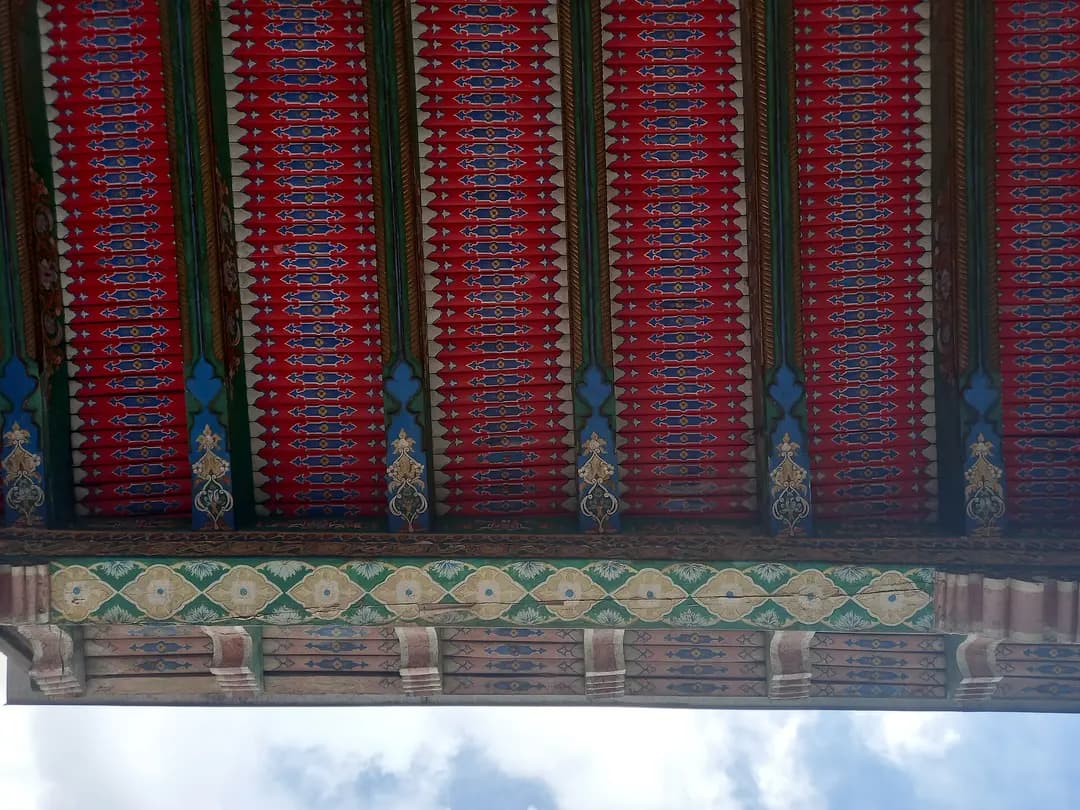
Namangan is the second most populous city in Uzbekistan after Tashkent, yet visitors tend to know it for its flower festival and gardens rather than its architecture. The city centre, however, still has buildings that show the distinctive style of Namangan's craftsmen. The most important of them is the Mullah Kyrgyz madrasa, whose portal locals call one of the most beautiful in the Fergana Valley.
The history of the madrasa
The madrasa was built in the early 20th century with funds from Mullah Muhammad Kyrgyz, a wealthy townsman who, according to tradition, wanted to leave the city a worthy place of learning. At that time Namangan was a major centre of trade and crafts in the valley, and the best local masters were invited to build it.
In Soviet times the building, like many madrasas, was used for other purposes. It was later restored and is open to visitors once again.
What makes the portal special
The madrasa is small, but the main facade draws all the attention. Here is what to look at:
- The brickwork. The builders laid fired brick in intricate geometric patterns that create the effect of lace. It is not a decorative facing but the structure itself turned into ornament.
- The tile inserts. Blue and white elements are neatly set into the brick pattern and emphasise the rhythm of the facade.
- The corner turrets (guldastas) at the edges of the portal give the building lightness and elegance.
- The proportions. A tall portal on a compact building is a characteristic device of the local school.
Watch how the light plays on it: in the morning and towards evening, shadows in the relief of the brickwork make the pattern three-dimensional, while at midday the facade looks flat.
The courtyard and hujras
Behind the portal is an inner courtyard surrounded by hujras, the cells where students once lived. It is quiet and shady, a good place to rest after walking around the hot city.
Namangan's craftsmen
Namangan has long been known for its artisans: woodcarvers, masters of ganch (carved plaster), blacksmiths and potters. Their work can be seen in the iwans of old mosques and in carved doors and columns. The Mullah Kyrgyz madrasa shows how the local school worked with brick at a time when other towns in the valley relied more on wood and tile.
What else to see in the centre
| Place | Why it is interesting |
|---|---|
| Khoja Amin mausoleum | 18th century, portal with glazed terracotta |
| Ota Valikhon Tura mosque | Early 20th century, large dome and iwan |
| Babur Park | Central park, a favourite place for walks |
| Chorsu bazaar | Fruit, dried fruit and Namangan flatbread |
The Khoja Amin mausoleum
A small 18th-century mausoleum with a portal decorated with carved glazed terracotta. It is one of the oldest monuments in the city and a place of pilgrimage.
The Ota Valikhon Tura mosque
An early 20th-century mosque with an expressive dome, built at the request of a local religious figure. It is an active mosque, so observe the dress code and do not disturb people at prayer.
The flower festival
Namangan is known as the city of flowers. Every spring, usually in May, it hosts a flower festival: parks and streets are decorated with floral displays, and visitors come from all over the country. If you plan to travel at this time, book accommodation and transport in advance. The exact dates vary, so check before you go.
Getting there from Tashkent
The distance between Tashkent and Namangan is about 290 km, roughly 4.5 to 5 hours. The road crosses the Kamchik Pass and then descends into the Fergana Valley.
Things to keep in mind:
- There is usually a checkpoint on the pass, so carry your passport.
- In winter and early spring there may be snow in the mountains, so check the forecast.
- The hairpin bends can cause motion sickness — sit in the front and take breaks.
A convenient way to get there is a shared ride on the Namangan — Tashkent route and in the opposite direction. On Yo'ldosh drivers publish their departure times and number of seats in advance: you can book one seat, see the driver's profile and save money compared with a taxi.
When to go
- April–May — orchards in bloom and the flower festival, the best season.
- June–August — warm, with plenty of fruit, but hot during the day.
- September–October — harvest time and mild weather, good for walking.
- Winter — the quiet season, but the pass can be difficult.
Tips
- Explore the centre on foot: the main sights are close to each other.
- Try Namangan flatbread and the local plov.
- Photograph the madrasa portal in the morning, when the light comes from the side.
- In mosques and mausoleums, cover shoulders and knees; women should wear a headscarf.
- On a day trip, leave Tashkent at dawn: that gives you 5 to 6 hours for the centre, lunch and the bazaar, and you will be back before dark.
- Namangan combines well with neighbouring towns in the valley — Chust, known for its knives and skullcaps, and Andijan. Shared rides run between them often.
Why it is worth a visit
The Mullah Kyrgyz madrasa is a small building, but it shows beautifully what craftsmen can achieve with simple brick. Together with its gardens, bazaar and hospitable people, Namangan turns out to be one of the most pleasant cities in the valley.
To get there without hassle, check the rides on the Namangan — Tashkent route and other destinations under all routes.
Cover photo: Jamshid Nurkulov, CC BY-SA 4.0, Wikimedia Commons.
