Navoi: A Young Industrial City with Deep History
Navoi grew up beside an industrial complex, yet around it lie the Sarmishsay petroglyphs, Nurata's holy spring and the Rabati Malik caravanserai. How to see it all in two days.
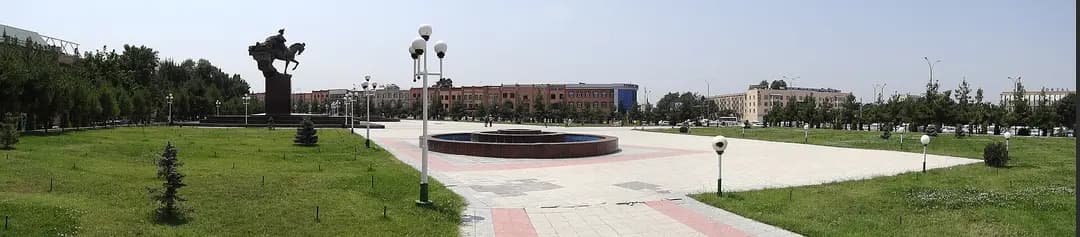
Many travelers drive through Navoi without stopping. On the highway between Samarkand and Bukhara it looks like a modern city of wide avenues with factory chimneys on the horizon, and that is accurate: Navoi grew up in the late 1950s as a satellite town for a large mining and metallurgical complex and chemical plants. But stay even one day and you will find green parks, a decent museum and, above all, remarkable surroundings. Within an hour and a half to two hours lie thousands of rock carvings, ancient caravanserais and a holy spring full of fish. Here is how to fit it all together.
Getting there
Navoi sits on the country's main tourist axis, so it is easy to reach:
| From | Distance | Travel time |
|---|---|---|
| Bukhara | about 100 km | 1.5 hours |
| Samarkand | about 170 km | 2.5 hours |
| Tashkent | about 470 km | 6–7 hours |
Trains pass through the city, and there is an airport. For flexible travel, shared rides are handy: cars run often on the Navoi — Bukhara route and on the Navoi — Samarkand route, and the long Navoi — Tashkent journey is more pleasant shared with fellow travelers.
The city itself
Navoi is a young, planned city: broad streets, plenty of greenery, residential districts and parks. Worth seeing:
- The central square and the monument to Alisher Navoi, the poet the city is named after.
- The regional history museum, with exhibits on the nature of the Kyzylkum Desert and the Nurata Mountains, archaeology and the region's development. Check opening hours.
- Parks and riverside promenades, where families stroll in the evening and the shade of the trees is precious in the heat.
- The bazaar, with fruit from the Zarafshan Valley, bread, dried fruit and everything you need for the road.
Half a day is enough for the city. Spend the rest on the surroundings. If you arrive in the evening, simply stroll around the center: Navoi has smooth sidewalks, plenty of lit alleys and fountains, and in summer it is far livelier after sunset than during the day, as locals come out to enjoy the cooler air.
Rabati Malik
The closest and most accessible ancient site is the ruined 11th-century Rabati Malik caravanserai, about 20 km from Navoi on the road to Bukhara. Its massive entrance portal survives from what was once a grand building. Next to it is a sardoba, an old domed water cistern that supplied travelers on the Silk Road. The site is open-air, and a visit takes about half an hour. It is a good stop on the way to Bukhara.
Sarmishsay
The Sarmishsay gorge in the Nurata Mountains, about 40 km northeast of Navoi, is one of the largest petroglyph sites in Central Asia. Thousands of images from different eras are carved into the rocks: mountain goats, bulls, hunters, battle scenes and mysterious signs. The oldest are attributed to the Stone Age.
Tips:
- go with a local driver, as part of the road to the gorge is unpaved;
- wear comfortable shoes and carry plenty of water, since there is almost no shade;
- the best time is morning or evening, when low light makes the carvings stand out;
- do not touch or trace the carvings: this is a fragile monument.
Nurata
Nurata is an ancient town at the foot of the Nurata Mountains, about 2–2.5 hours' drive from Navoi. It is home to the revered Chashma complex, with a spring full of sacred fish, a mosque and a mausoleum. Above the town are the remains of a fortress linked by tradition to Alexander the Great's campaigns. Near Nurata the road begins to Lake Aydarkul and desert yurt camps.
The Chashma complex is a pilgrimage site. Dress modestly, do not feed the fish bread without the caretakers' permission, and keep quiet.
Fitting it all into two days
- Day one. In the morning, see Navoi: the square and the museum. After lunch, visit Sarmishsay and return to the city in the evening.
- Day two. Leave early for Nurata to see Chashma and the fortress. On the way back, stop at Rabati Malik and the sardoba, then continue to Bukhara.
If you want a night in a yurt, add a third day: Nurata to Aydarkul.
Where to eat and stay
Navoi has several hotels and guesthouses of different levels; book ahead and confirm the terms. Food is simple: teahouses with plov and shashlik, cafes and lagman. In Nurata, travelers usually stay in guesthouses that serve home cooking.
Good to know
- Season. Spring and autumn are ideal. Summers in the Kyzylkum and at Sarmishsay are very hot, so set off at dawn.
- Industrial sites. Do not photograph factories or restricted areas.
- Cash. In Nurata and along the roads, cards are not accepted everywhere.
- Connectivity. Signal may drop in gorges and the desert, so tell someone your route.
How to travel
Navoi is a convenient stop between Samarkand and Bukhara. On Yo'ldosh you can find a seat in a verified driver's car on the Navoi — Bukhara, Navoi — Samarkand and Navoi — Tashkent routes: book a single seat and leave when it suits you. All directions are on the routes page.
Cover photo: Adam Jones from Kelowna, BC, Canada, CC BY-SA 2.0, Wikimedia Commons.
