Ulugh Beg Observatory: what remains of the great sextant
What a visitor sees at the observatory and museum, how Ulugh Beg compiled his star catalogue and how to combine the visit with Afrasiab in one day.
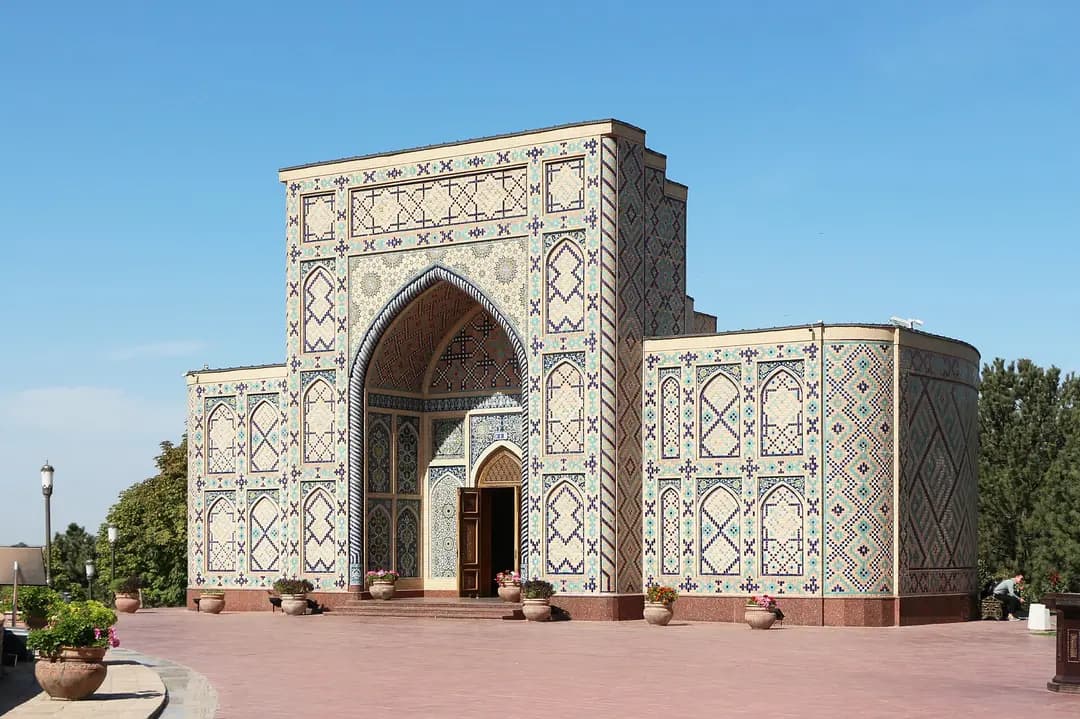
The Ulugh Beg Observatory is one of the most unusual monuments of Samarkand and a reminder that the Timurid capital was not only a city of commanders but also a centre of science. It was built by Timur's grandson Ulugh Beg, a ruler and scholar, in the 1420s on Kukhak hill in the north-east of the city. Today only the underground part and a small museum remain of the huge building, but the place still makes a strong impression.
Who Ulugh Beg was
Mirza Ulugh Beg (1394-1449) ruled Samarkand after the death of his father Shah Rukh and at the same time devoted himself to astronomy, mathematics and education. He founded a madrasa in Samarkand where secular sciences were taught and gathered leading scholars around him. Ulugh Beg believed that exact knowledge of the sky mattered for the calendar, navigation and farming. But his scientific interests aroused the displeasure of part of the clergy. In 1449 Ulugh Beg was killed on the orders of his own son, and the observatory was abandoned.
What the observatory was
The observatory building, constructed in 1428 to 1429, was circular and reached about 30 metres in height, decorated with tiles and painting. The main instrument was a huge sextant (in effect part of a giant graduated circle) with a radius of about 40 metres. It was aligned along the meridian and could be used to observe the positions of the Sun, Moon and stars with high accuracy.
Observations went on for years. On their basis Ulugh Beg and his colleagues compiled the Zij-i Sultani, a star catalogue giving the positions of 1,018 stars. The catalogue proved so accurate that astronomers in Europe and Asia used it for centuries. Ulugh Beg also refined the length of the year, with a difference from modern data of about a minute.
What you can see today
Of the building itself only the underground part survives: the trench in which the arc of the sextant lay. It was found in 1908 by the Samarkand archaeologist Vasily Vyatkin, who managed to locate the observatory from old descriptions. Today a visitor can descend to a marble-lined section of the arc and see the scale divisions.
Nearby a small museum operates, presenting:
- a model of the observatory and instruments used at the time;
- copies of star charts and pages of astronomical works;
- a portrait of Ulugh Beg and materials on his life and the scholars of his circle;
- the story of the excavations.
A monument to Ulugh Beg stands on the grounds, and around it opens a view of the city and surrounding hills.
How to spend your time
A visit usually takes 40 to 60 minutes. It is best to come in the morning before the heat. Be sure to go down to the underground part of the sextant and listen to a guide: it helps to grasp the scale of the idea.
Combining with Afrasiab
Not far from the observatory is Afrasiab hill, where the remains of ancient Samarkand lie. A museum on the hill holds the famous seventh-century frescoes depicting embassies from various countries. Remains of city walls stand nearby and you can climb to a viewpoint. A good one-day plan:
- Morning. The Ulugh Beg Observatory.
- Midday. The Afrasiab museum and a walk across the hill.
- Afternoon. The Gur-Emir mausoleum, the Bibi-Khanym Mosque and the Registan.
- Evening. Shah-i-Zinda at sunset.
Tickets and hours
Entry is paid. Prices and hours change, so check current information on the spot or from official sources. Foreigners are usually charged more than residents. Before you go, check whether restoration is under way: part of the grounds may be closed.
How to get there
It is about 5 kilometres from the centre of Samarkand to the observatory. You can go by taxi or minibus. From Tashkent to Samarkand there is a high-speed train, as well as buses and shared rides. To return to the capital after a day in Samarkand, open the Samarkand to Tashkent page. In the Yo'ldosh app you can book a seat with a driver and choose a convenient departure time.
Practical tips
- Bring water and a hat: there is little shade on the hill.
- Wear comfortable shoes for climbing steps.
- If astronomy interests you, ask the guide to tell you about the catalogue and observation methods.
- Do not forget your camera: the grounds offer a lovely view.
- Check current information on prices and hours.
When to come
The best time is spring and autumn. In summer come in the morning, and in winter dress warmly.
Plan your trip
To return from Samarkand to Tashkent, open the Samarkand to Tashkent page. Other directions are in all routes. Drivers travelling between these cities will find the for drivers page useful.
Cover photo: Bgag, CC0, Wikimedia Commons.
