Asaka: the car-making town of the Andijan region
A small town twenty minutes from Andijan where cars for the whole country are assembled. Here is how Asaka works and what to see in and around it.
If you have travelled around Uzbekistan, you have almost certainly ridden in a car built in Asaka. The white Cobalts, Nexias and Damas vans that fill the highways and city streets roll off the assembly line of the plant in this small town in the Andijan region. For a traveller, Asaka is not a museum city but a living, working town of the Fergana Valley that is easy to see in half a day from Andijan.
Where Asaka is
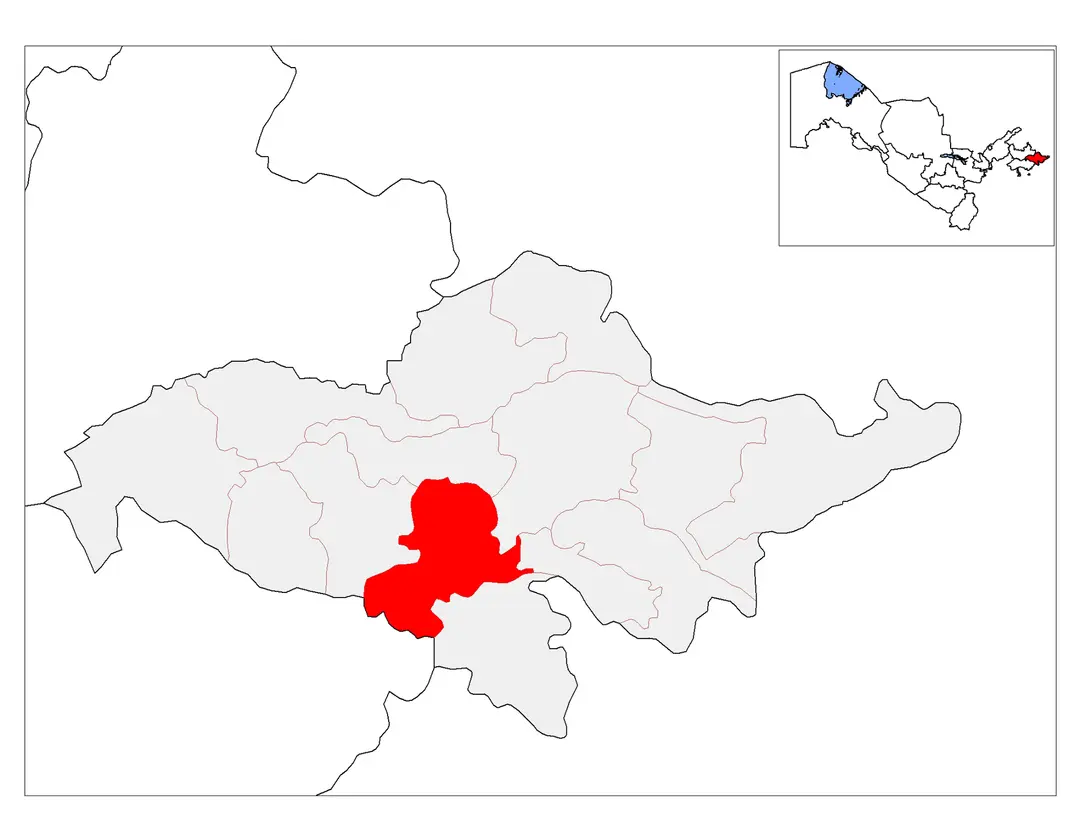
Asaka lies in the south-western part of the Andijan region, roughly 20–25 km from Andijan. The drive takes about 25–35 minutes depending on traffic leaving the regional capital. Roads to Fergana and Margilan pass nearby, so Asaka often ends up on the way for people travelling around the valley between its larger cities.
The landscape is typical of the valley: flat fields of cotton and wheat, orchards, irrigation canals lined with poplars, and on a clear day the mountains that ring the valley to the south on the horizon.
A town that grew around a factory
The car plant in Asaka opened in the mid-1990s and became the first large car manufacturer in Central Asia. Since then it has changed its name and owners several times and the model range has been updated, but for local people it is still simply "the factory". It sets the rhythm of the town: in the morning and evening you notice the shift change on the streets, and housing blocks, schools, colleges and sports grounds have grown up around it.
One thing to keep in mind: the plant itself is a secure industrial site and you cannot just walk in. Tours are sometimes arranged for student groups or official delegations, but as a tourist you should plan on a walk around town rather than a visit to the workshops. Do not photograph the gates or guarded areas.
What to see in Asaka
Asaka is small, and its main "sights" are everyday life:
- The central bazaar. Fruit from local orchards, dried fruit, nuts and fresh tandoor bread. In season (June to September) the cherries, apricots, grapes and melons are especially good.
- Central streets and park. Wide avenues, tidy squares and fountains; the town is relatively young in its architecture and looks neat.
- Teahouses and plov. As everywhere in the valley, teahouses serve plov, shurpa soup, samsa and lagman at lunchtime. Fergana-style plov is made with yellow carrots and usually comes with a tomato and onion salad.
- Car markets and services. If you like cars, it is interesting to see the whole ecosystem that has grown around the plant: workshops, spare-parts shops and dealerships.
What is nearby
Asaka works well as part of a day trip around the valley:
- Andijan. The regional capital, with the Jami mosque and madrasa, the Babur literary museum in the quarter where, according to tradition, he spent his childhood, and Babur Park on Bogishamol hill outside the city.
- Marhamat and Mingtepa. South of Asaka lies Marhamat, and near it the Mingtepa site: traces of an ancient city linked with the old state of Dayuan.
- Margilan and Fergana. An hour or an hour and a half to the west is Margilan, the silk-weaving centre with its atlas and adras workshops.
How to get there
The easiest option is to reach Andijan first and continue to Asaka from there. Minibuses and taxis run between the two, but a shared ride is the most convenient: on the Asaka – Andijan route, drivers regularly post trips on Yo'ldosh. You pick a time, book a seat in the app and pay for one seat rather than the whole car.
From Tashkent to Andijan the road crosses the Kamchik pass and takes roughly 5–6 hours. In winter there can be restrictions on the pass because of snow and ice, so check road conditions before you set off.
Practical tips
- Best time. Spring (April to May) and early autumn (September to October). Summers in the valley are hot, often above 35°C in the afternoon, so plan walks for the morning and evening.
- Money. There are ATMs in the centre, but cash is easier at the bazaar and in small cafes.
- Clothing. The town is secular, but modest clothing is appropriate in residential neighbourhoods and at the bazaar.
- Language. Many people understand Russian, especially the middle-aged and older generation, and a couple of Uzbek phrases ("Assalomu alaykum" for hello, "Rahmat" for thank you) always earn a smile.
- Time needed. Two or three hours are enough for Asaka itself; add Andijan and Marhamat and you have a full day.
Who will enjoy Asaka
Asaka does not compete with Samarkand or Bukhara, and that is exactly its value. Come here if you want to see the modern Fergana Valley: industrial, businesslike and still very hospitable. Car enthusiasts will enjoy visiting the place where nearly every car on the country's roads comes from, and everyone else can wander the bazaar, have plov for lunch and feel the pace of a small valley town.
If you are planning a trip around the valley, take a look at all routes to see which cities people travel between most often. For a short hop to Andijan and back, booking a seat on a shared ride on the Asaka – Andijan route is the simplest choice.
Cover photo: Jamshid Nurkulov, CC BY-SA 4.0, Wikimedia Commons.
