The Fayzulla Khodjaev House: How Bukhara's Wealthy Merchants Lived
A late 19th-century merchant's home with carved reception rooms and quiet courtyards, the story of its owner, and why visitors love dressing up for photos here.
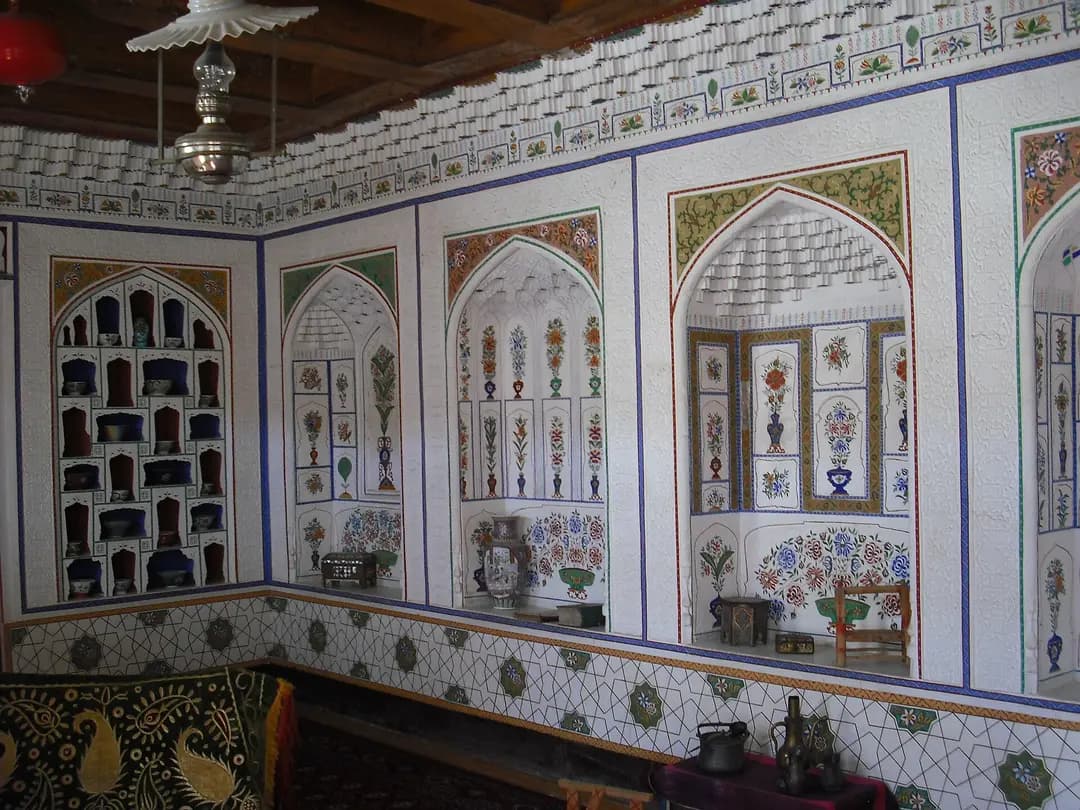
Bukhara's monuments mostly tell the stories of rulers and saints: madrasas, mosques, mausoleums and the emir's fortress. But how did ordinary townspeople live, even very wealthy ones? The answer lies in the Fayzulla Khodjaev House Museum, one of the best-preserved merchant homes in old Bukhara. It is worth coming if only to see what was hidden behind the blank mud walls of the mahalla.
Whose house it was
The house was built in the late 19th century, around 1891, for a wealthy merchant, Ubaydulla Khodjaev. The family grew rich trading karakul, the valuable lambskins exported from Bukhara to Russia and Europe. Karakul was one of the emirate's main exports, and the merchants who dealt in it could afford genuine palaces.
The merchant's son, Fayzulla Khodjaev, was born in 1896 and became one of the most prominent figures in the region's history. He studied in Russia and joined the Young Bukharans, a movement calling for reform of the emirate. After 1920 Fayzulla Khodjaev headed the government of the Bukhara People's Soviet Republic and later led the government of the Uzbek SSR for many years. He was arrested in 1937 and shot in 1938, and was later rehabilitated. The house where he spent his childhood and youth eventually became a museum.
How a merchant's house is laid out
From the street the house looks like an ordinary blank wall with wooden gates. This is typical of Bukhara: all of life faced inwards, onto courtyards. Step through the gate and you enter a completely different world.
The house is divided into two parts:
- Tashkari - the outer, men's section, where guests were received and business conducted. The grandest rooms are here.
- Ichkari - the inner section for women and family, closed to outsiders.
The rooms are arranged around courtyards and divided into summer and winter rooms. Summer rooms are tall, with iwans and large openings to catch the breeze. Winter rooms are more enclosed and easier to heat.
What to see inside
The mehmonkhona, or guest hall. The pride of the house. The walls are covered with carved ganch plaster, and many niches are decorated with delicate patterns; they once held porcelain and tableware showing off the owners' wealth. The ceiling is painted and carved in wood. With light coming in through the windows, the hall looks like lace.
Iwans and wooden columns. Carved columns with distinctive bases are a fine example of Bukhara woodcarving.
Family rooms. Everyday objects are collected here: chests, carpets, quilts, tableware and kitchen utensils. They make it easy to imagine how a large merchant family lived.
The Fayzulla Khodjaev exhibition. Photographs and documents about his life and the era of change in the early 20th century.
Why people dress up for photos here
One popular reason to visit this house is the chance to try on national costumes: embroidered robes, skullcaps, women's dresses and jewellery. Photos are taken right in the guest hall or in the courtyard, and the interiors make a superb backdrop. Families with children, couples and anyone wanting an unusual picture from Bukhara all enjoy it.
The service is usually paid; the price is approximate and depends on the costumes and number of photos, so ask on site. If you just want to see the house, costumes are optional.
Practical information
- Where: in a residential quarter of the old city, about 10-15 minutes' walk from Lyabi-Hauz. It is easy to find with the map on your phone.
- How long: 40-60 minutes, longer with a costume photo session.
- Tickets: sold at the entrance; prices are approximate and change.
- Guide: staff often tell the family's story. If you can, listen in; it brings the visit to life.
The house is best visited during the day, when light from the courtyards makes the carving stand out. It stays cool inside even in summer: thick walls and shaded iwans act as natural air conditioning.
Details worth noticing
Look out for the small things people usually miss: wooden doors with carved panels and metal knocker rings, narrow lattice windows that cast patterned light, the difference in ceiling height between the formal rooms and the living rooms, and small niches for lamps. It is details like these that show how much handwork Bukhara families put into their homes.
What to see nearby
The visit combines well with a walk around the western part of the old city: Po-i-Kalyan, the trading domes and Lyabi-Hauz are not far away. Compare the merchant's house with the mosques and madrasas and you will see that the craftsmen decorating private homes worked to the same high standard.
A trip from Bukhara to Navoi
Navoi is an industrial city about 100-110 km from Bukhara, roughly an hour and a half by car. Many travellers pass through it on the way to Samarkand, and locals often travel between the two cities on business. A shared ride via Yo'ldosh suits this trip well: you book one seat in a verified driver's car and pay less than for a private taxi. From Navoi you can also continue to Nurata, with its fortress of Alexander and sacred spring.
See trips on the Bukhara - Navoi route page. More about booking is in the for passengers section.
Cover photo: Jasper van Osnabrugge, CC BY 2.0, Wikimedia Commons.
