Khiva's Juma Mosque and Its 213 Carved Columns
What makes the columned mosque at the heart of Itchan Kala unique, how to tell thousand-year-old columns from newer ones, and when the hall looks its best.
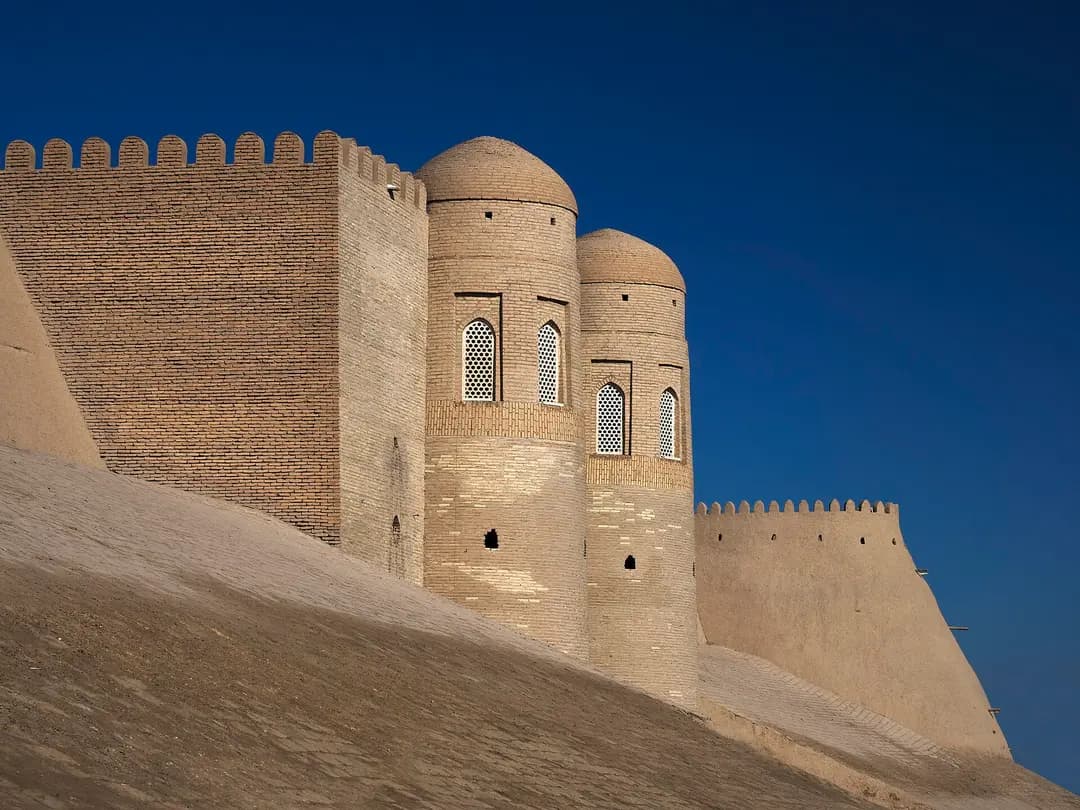
From outside, Khiva's Juma Mosque is almost invisible: blank walls, a modest entrance off Itchan Kala's main street and a slender minaret beside it. But step over the threshold and you are in one of the most unusual interiors in Central Asia, a dim hall whose roof is held up by a true forest of wooden columns. There are 213 of them, and some are around a thousand years old.
A mosque without portals or domes
Most mosques in the region follow the courtyard-and-iwan plan: a spacious open courtyard, tall portals and domes. Khiva's Juma Mosque is different. It is a hypostyle mosque: one enormous room under a flat wooden roof, with no courtyard, portals or domes. The hall measures roughly 55 by 46 metres. The columns stand in rows about three metres apart, and from any point the hall seems endless.
This type of mosque is considered very ancient in Central Asia. A Friday mosque on this site was mentioned by Arab geographers as early as the 10th century. The present building dates from the late 18th century, around 1788-1789, but the builders did not start from scratch: they reused columns from Khiva's earlier mosques and, according to tradition, from other towns of Khorezm.
How to tell the columns' ages
The real pleasure of a visit is studying the columns and trying to work out which are old. No two are alike, but each era has common features.
The oldest columns (10th-12th centuries):
- simpler, slender silhouettes;
- shallow carving with stricter ornament, geometric or floral;
- some still bear inscriptions in Kufic script, an angular form of Arabic lettering;
- darkened, cracked wood.
There are only a few of these, and guides usually point out the best known. Ask the attendant or a guide to show you; without help they are easy to miss.
Columns from the 14th-16th centuries:
- richer carving with interlaced motifs;
- more complex silhouettes with swellings.
Columns from the 18th-19th centuries, the majority:
- lush floral carving with deep patterns;
- a characteristic jug-shaped swelling at the base;
- stone bases on which the columns were set to protect the wood from damp.
Look at the bases and tops of the columns. Many have a small "cushion" under the capital, on which the ceiling beams rest. Columns were often set on stone with a spacer so the wood would not rot, which is why they have lasted for centuries.
Light: when the hall is most beautiful
The roof has two open light wells. Trees grow beneath them, one of the most photogenic details of the interior. The rest of the space lies in soft half-darkness.
The best time to visit is around midday, when the sun is high and bright shafts of light fall through the openings. They pick out individual columns from the gloom, and the hall looks like a stage. In the morning and evening the light is softer and more diffuse, with less contrast; that is good for studying the carving calmly, but you will not get the dramatic beams.
In summer heat the mosque is one of the best refuges in Itchan Kala: thick walls and a solid roof keep it cool, so a midday visit doubles as a break from the sun.
The Juma Mosque minaret
Next to the mosque stands a minaret about 33 metres tall. You can climb it, usually for a fee separate from the combined ticket; the price is approximate. The staircase is narrow and dark, and at the top a small platform overlooks the main street, Kalta Minor and the madrasa domes. If you would rather not tackle the taller Islam Khodja Minaret, this is a good alternative.
Practical tips
- Ticket. Entry to the mosque is usually included in the Itchan Kala combined ticket. Check current conditions at the ticket office by the west gate.
- Time. Allow 20-40 minutes for the mosque, about an hour with the minaret.
- Photos. A tripod or steady support helps in the low light; flash ruins the atmosphere. Photography may carry a separate fee, so check.
- Behaviour. Do not touch the columns: the old wood is fragile and oils from hands damage it.
- Clothing. Although the mosque now functions as a museum site, it is a religious building, so dress modestly.
Fitting it into your route
The Juma Mosque stands in the centre of Itchan Kala on the main street between the west and east gates. A good sequence: Kalta Minor and Kunya-Ark in the morning, the Juma Mosque and its shafts of light around noon, then the Islam Khodja Minaret and the Pahlavan Mahmud Mausoleum.
The road from Urgench
Most travellers reach Khiva via Urgench, which has the airport and a major railway station. Urgench to Khiva is about 30-35 km, roughly 40 minutes by car. You can take a seat in a shared ride via Yo'ldosh: drivers publish trips, you book a seat in the app and pay less than for a whole taxi. Leave in the morning and by midday, when the light in the Juma Mosque is best, you will already be in Itchan Kala.
Trips are on the Urgench - Khiva route page. If you are a driver who often travels this way, see the for drivers section.
Cover photo: Petar Milošević, CC BY-SA 4.0, Wikimedia Commons.
