Gur-Emir: Timur's mausoleum and its secrets
The history of the Timurid burial place, what to see inside, visiting rules and the famous legend about the opening of the tomb in June 1941.
Gur-Emir means the tomb of the emir in Persian. This mausoleum in Samarkand is known above all as the resting place of Amir Timur, or Tamerlane, the great conqueror who founded a vast empire. Beside him are buried his sons, grandsons and spiritual teacher. For a traveller Gur-Emir is one of the most beautiful and solemn buildings in the city, with a ribbed blue dome and rich interior decoration.
History of the mausoleum
Timur originally ordered the mausoleum to be built in the early fifteenth century for his favourite grandson Muhammad Sultan, who died on campaign. Construction took place in 1403 to 1404. Timur himself died in 1405 at Otrar during a campaign against China, and his body was brought to Samarkand and buried in this same mausoleum. Later another grandson, Ulugh Beg, completed and expanded the complex. Over time other members of the dynasty were buried beside Timur.
Those who rest in the mausoleum are:
- Amir Timur (1336-1405);
- his sons Shah Rukh and Miran Shah;
- his grandsons Muhammad Sultan and Ulugh Beg;
- Timur's spiritual teacher Mir Said Baraka.
What to see outside
Gur-Emir looks striking even from afar. The building is crowned with a ribbed turquoise-blue dome that seems almost to glow against the sky. The dome rests on a cylindrical drum decorated with inscriptions, while the facade is covered in majolica and brick calligraphy. In front of the mausoleum remain the ruins of the madrasa and khanqah that made up the complex.
What to see inside
Inside, the mausoleum amazes with the richness of its finish. The walls and dome are covered in gilding and painting in dark blue, gold and white. The hall is lit by soft light filtering through latticed windows. In the centre stand the tombstones.
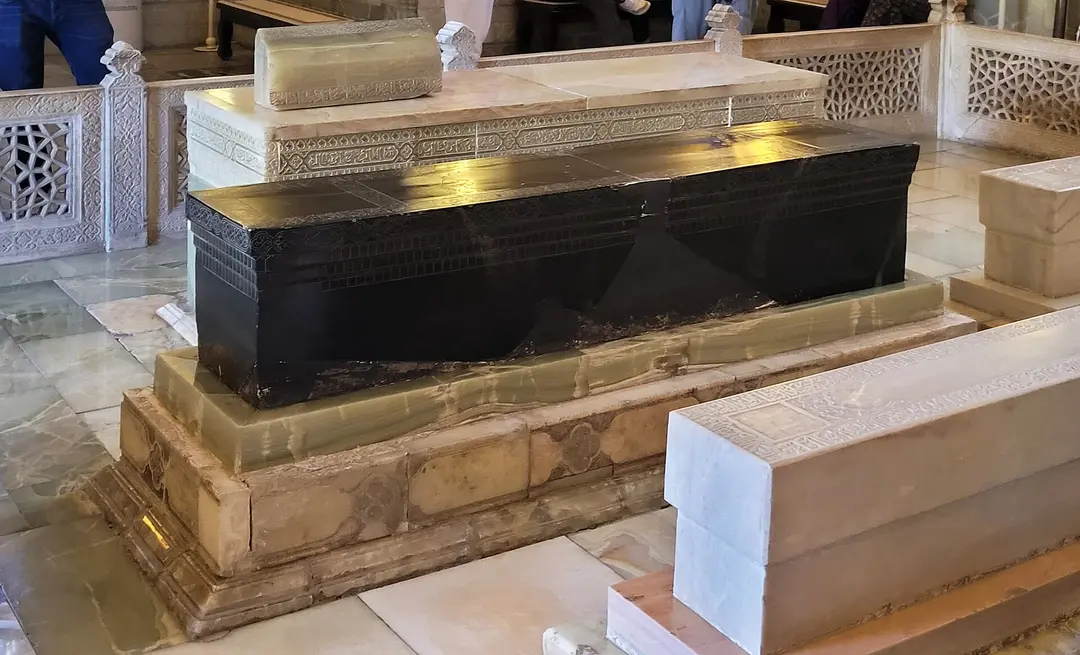
Timur's tombstone stands out: it is made of dark green jade, one of the hardest and rarest stones. According to the story this slab was brought as a trophy and became one of the symbols of the ruler's power. The other tombstones are made of marble and other stone. The actual graves are in an underground crypt closed to ordinary visitors, and the monuments you see are cenotaphs.
The legend of the opening of the tomb
One of the most famous legends of the twentieth century is tied to Gur-Emir. In June 1941 Soviet scientists led by the anthropologist Mikhail Gerasimov opened Timur's tomb to study the remains and reconstruct his appearance from the skull. According to the tale, the tombstone bore an inscription: whoever opens my grave will unleash a war more terrible than any before. The opening took place on 20 to 22 June, and on 22 June Germany attacked the USSR. Later the remains were returned to the grave with the proper rites.
Remember that this story remains a legend: the words on the tombstone are known in different versions, and the coincidence of dates gives it drama. But guides retell it willingly, and it is worth hearing on the spot.
Visiting rules
- Clothing. Dress modestly: shoulders and knees covered. A scarf is advisable for women.
- Behaviour. The mausoleum remains a place of respect. Speak quietly and do not touch the tombstones.
- Photography. Rules for filming inside may differ, so check on the spot. Photograph without flash in any case.
- Tickets and hours. The entry fee depends on the category of visitor and may change. It is best to confirm hours in advance.
When to come
Morning is a calm time with soft light. Sunset makes the dome especially beautiful from outside. In summer come early before the heat; in winter it is cold inside but visitors are fewer. A visit usually takes 30 to 60 minutes.
How to get to Samarkand
From Tashkent you can reach Samarkand by high-speed train, bus or car. Shared rides suit those who want to leave at a convenient time and split costs: see trips on the Tashkent to Samarkand page. In the Yo'ldosh app you book a seat and see the driver's profile and departure time.
Near Gur-Emir
The mausoleum is close to other major monuments. A few minutes' walk away stand the Bibi-Khanym Mosque and the Registan square. A good order of visit: Gur-Emir in the morning, the Registan and Bibi-Khanym in the afternoon, Shah-i-Zinda in the evening.
Practical tips
- Carry water: the centre is hot in summer.
- Do not buy souvenirs from the first seller; compare prices.
- Watch opening hours: on holidays the schedule may change.
- Check current prices and rules before you travel.
Plan your trip
To get to Samarkand, open the Tashkent to Samarkand page. Other directions are in all routes. Drivers who travel to Samarkand will find the for drivers page useful.
Cover photo: Bgag, CC0, Wikimedia Commons.
