Kalta Minor and the Islam Khodja Minaret: Two Symbols of Khiva
Why one minaret was never finished while you can climb the other up a hundred steep steps, and where the best view over Khiva really is.
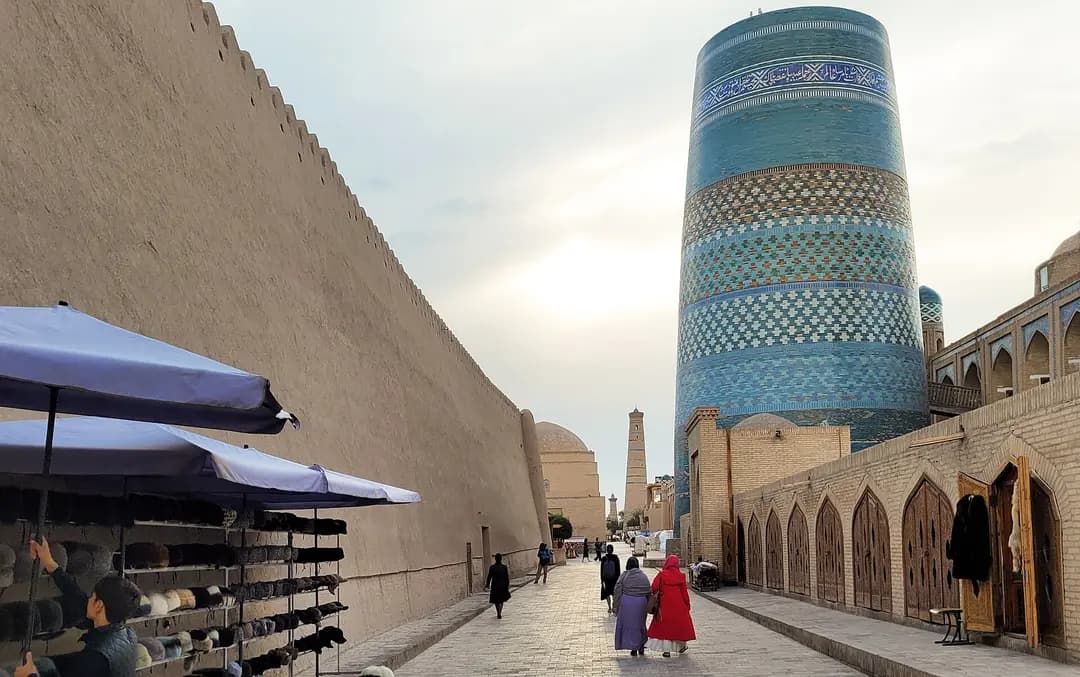
Almost every photo of Khiva features one of two minarets, and often both: the short, stout Kalta Minor, covered entirely in turquoise glaze, and the tall, slender Islam Khodja Minaret, striped with blue and white tiles. Only a few hundred metres and half a century separate them, but their stories are completely different. One became a monument to unfulfilled ambition, the other a symbol of an attempt at reform in the early 20th century.
Kalta Minor: the minaret that was never finished
Kalta Minor stands just inside the western gate of Itchan Kala, beside the Muhammad Amin Khan Madrasa. The name means "short minaret", a very accurate description. It is about 14 metres in diameter at the base and about 29 metres tall. For a base that wide, that is very little: the plan was for it to become the tallest minaret in Central Asia.
Construction was begun in the early 1850s by the khan of Khiva, Muhammad Amin Khan. In 1855 the khan was killed on a military campaign, and work stopped for good. So the minaret remained a stump, a massive tower without a top.
Several legends have grown up around the story:
- A view of Bukhara. The khan supposedly wanted the minaret tall enough to see Bukhara, hundreds of kilometres away across the desert.
- The runaway master builder. Another version says the emir of Bukhara struck a deal with the architect to build an even taller minaret for him. When the khan found out he was furious, and the builder fled, abandoning the project.
As so often, the legends are more exciting than the documents, but the real reason, the khan's death, is dramatic enough in itself.
Why it is so beautiful. Kalta Minor is the only minaret in Central Asia entirely clad in glazed brick and majolica. Bands of turquoise, blue and white patterns run from bottom to top. In sunlight the minaret literally gleams, and at sunset it turns a deep blue-green.
You cannot climb Kalta Minor; there is no accessible staircase inside. Admire it from outside, from different distances.
The Islam Khodja Minaret: Khiva's tallest
In the south-eastern part of Itchan Kala rises the Islam Khodja Minaret, the highest point in the city at about 57 metres. The minaret and the small madrasa beside it were built in 1908-1910 on the initiative of Islam Khodja, grand vizier to the khan of Khiva.
Islam Khodja was known as a reformer. He supported building a secular school, a hospital and a post office, and advocated modernising the khanate. This made him enemies among the conservative nobility, and in 1913 he was assassinated. The minaret became a monument to his era and was the last major building project of the khans of Khiva.
The minaret tapers towards the top, and its shaft is ringed with alternating bands of turquoise and white tiles and brick. The Islam Khodja madrasa usually houses an exhibition of Khorezm applied arts: woodcarving, ceramics and metalwork.
Climbing Islam Khodja: what to know
The climb is paid separately from the Itchan Kala combined ticket; the price is approximate, so check at the ticket office. Inside is a spiral staircase of a little over a hundred steps. Some tips:
- The stairs are narrow and dark, with high, uneven steps. Bring a torch or use your phone.
- Passing people coming down is awkward, so climb at a quiet time, in the morning.
- The viewing windows at the top are small and space is tight.
- The climb is not recommended for people afraid of heights or with heart or knee problems.
- Do not climb in the midday heat: it is stuffy inside.
Your reward is a view over the whole of Itchan Kala: a maze of flat roofs, domes, green courtyards and, of course, Kalta Minor, seen from here in all its bulk.
Where the best view is
The most common question is where to see the minarets and the city as a whole. Here are several spots:
- From the Islam Khodja Minaret - maximum height and a view of the whole city.
- From the Ak-Sheikh-Bobo tower in Kunya-Ark - lower, but with an excellent view of Kalta Minor and the western part of town. Especially good at sunset.
- From the wall by the north gate - a panorama with the minarets in profile.
- From the main street by the west gate - the classic shot of Kalta Minor framed by the street.
- From rooftop cafes - several terraces look out on Islam Khodja.
Morning or evening is best for photographing Kalta Minor, as the glaze glares at midday. Islam Khodja is most striking against a blue sky, and in the evening, when lit up, both minarets can be seen from many points in the old city.
Practical tips
- Visit Kalta Minor at the start of your walk; it is right by the entrance.
- Plan the Islam Khodja climb for the morning and Ak-Sheikh-Bobo for sunset.
- Bring water and a hat: there is little shade in Itchan Kala.
Between Khiva and Urgench
Most people fly or take the train into Urgench and stay in Khiva. The cities are about 30-35 km apart, roughly a 40-minute drive. A shared ride via Yo'ldosh is a convenient way to travel: you book one seat in a verified driver's car, the trip costs less than a private taxi, and you can choose a departure that fits your flight or train.
See trips on the Khiva - Urgench route page and all directions in the routes section.
Cover photo: Bgag, CC0, Wikimedia Commons.
