Hast Imam and the Uthman Quran: Tashkent's Spiritual Heart
The Barak Khan madrasa, the Kaffal Shashi mausoleum and a library holding one of the oldest Quran manuscripts. How the complex is laid out, what to see and how to behave during your visit.
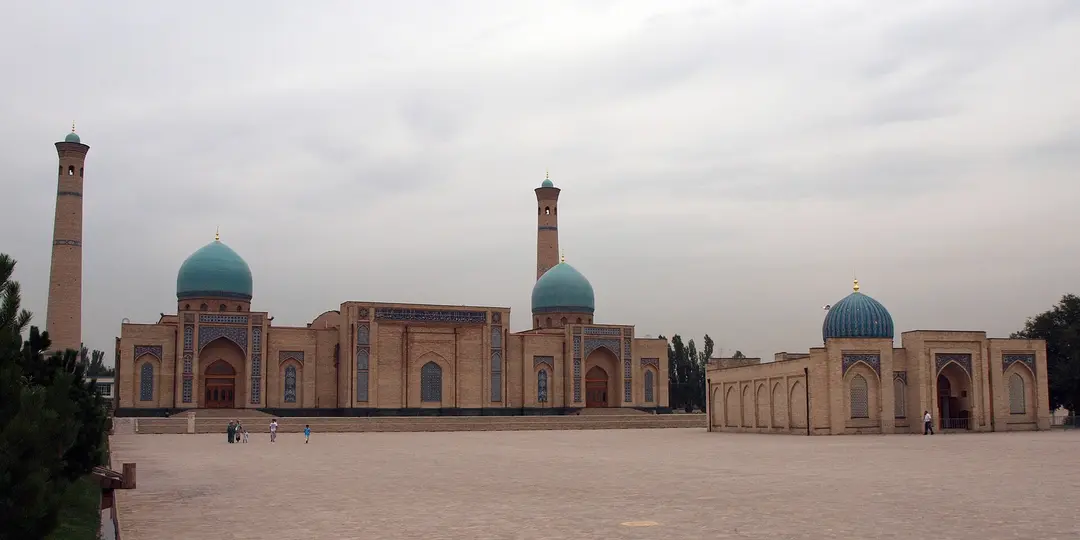
Tashkent is often seen as a modern city of wide avenues, and that is fair: earthquakes and redevelopment have wiped out much of its old fabric more than once. But in the northern part of the old town there is a place where several centuries of continuity have survived. The Hast Imam (Hazrati Imam) complex is the spiritual heart of the capital. It brings together mosques, madrasas, a mausoleum and a library that holds a relic of worldwide importance — the Uthman Quran.
Who Hazrati Imam was
The complex is named after Abu Bakr Kaffal Shashi, a 10th-century theologian, jurist and poet and one of the first imams of Tashkent (in ancient times the city was called Chach or Shash). "Kaffal" means "locksmith": according to tradition, he was a skilled craftsman. Kaffal Shashi is revered as the patron saint of the city, and his mausoleum is a place of pilgrimage.
What the complex includes
Hast Imam is an ensemble of buildings from different periods around a large square. Walk around it in a loop:
The Barak Khan madrasa
A 16th-century madrasa built under the Shaybanids. It is the most striking historic building in the complex, with a tall portal covered in blue tile mosaic and domes on either side. The hujras around the courtyard now house craft workshops, where you can watch woodcarving, embroidery and miniature painting and buy souvenirs.
The Kaffal Shashi mausoleum
A 16th-century mausoleum over the saint's grave. Simple and austere from the outside, with a dome and portal. It is a place of prayer, so keep quiet.
The Tillya Sheikh mosque
A 19th-century mosque with graceful minarets. For a long time the famous Quran manuscript was kept here.
The Hazrati Imam mosque
The complex's new main Friday mosque, built in the 2000s in a traditional style with two tall minarets, carved wooden columns and domes. It has become the visual centre of the square.
The Muyi Muborak madrasa
A 16th-century madrasa whose name means "Sacred Hair": according to tradition, a hair of the Prophet Muhammad is kept here. Today the building houses a library and museum with a collection of ancient manuscripts, and this is where the Uthman Quran is displayed.
The Uthman Quran
According to tradition, this copy of the Quran is associated with Caliph Uthman, under whom the canonical text of the Holy Book was compiled in the 7th century. Tradition holds that Uthman was reading this very manuscript when he was killed, and marks on one of the pages are believed to be traces of his blood.
What is known about the manuscript:
- It is a huge codex on parchment, written in early Kufic script without vowel marks.
- Scholars place it among the earliest known copies of the Quran.
- According to tradition, Timur brought it to Transoxiana, and it was kept in Samarkand for a long time.
- In the 19th century it was taken to St Petersburg, and after the revolution it was returned to Central Asia.
Today the Quran is kept in a special display case in the library hall. It is one of the most precious collections in the entire Islamic world, and many pilgrims come to Tashkent specifically to see it.
Visiting etiquette
- Dress. Covered shoulders and knees are required. Women need a headscarf, which can sometimes be borrowed at the entrance.
- Shoes come off before entering mosques and prayer halls.
- Photos. Photography is fine in the courtyards and on the square. In the room with the Quran it is usually forbidden — check with the attendant.
- Fridays. At midday Friday prayers draw thousands of people and the square is packed. Visitors should come on another day.
- Tickets. There is a fee to enter the library; it is modest and changes from time to time.
- Quiet. Do not disturb worshippers or walk in front of people at prayer.
How to get there
The complex is in the old town, not far from Chorsu bazaar. From Chorsu metro station it is about a 15–20 minute walk, or a short taxi ride. A good plan is to combine the visit with a walk around Chorsu and the Kukeldash madrasa.
Hast Imam on a wider trip
Many travellers start or finish their journey around Uzbekistan in Tashkent. If you are coming from other cities:
| From | Distance | Travel time |
|---|---|---|
| Samarkand | ~300 km | 4–4.5 hours |
| Bukhara | ~570 km | 7–8 hours |
A shared ride is a convenient option. On the Samarkand — Tashkent and Bukhara — Tashkent routes drivers post trips on Yo'ldosh every day, so you can book a single seat and time your arrival to visit Hast Imam at leisure the next morning.
When to visit
- Weekday mornings — fewer people and soft light for photographing the madrasa portal.
- Spring and autumn — comfortable weather for a walk through the old town.
- In summer, come early: there is almost no shade on the big square.
- Ramadan has a special atmosphere, especially in the evening after iftar, but be considerate.
Why it is worth coming
Hast Imam shows Tashkent as a city with deep roots. In one place, just minutes from the main bazaar, you can see a medieval madrasa, a new mosque, craft workshops and one of the oldest manuscripts of the Quran.
If you are planning a trip to the capital, look at the Samarkand — Tashkent and Bukhara — Tashkent routes and other destinations under all routes.
Cover photo: :ru:User:(WT-ru) Digr, CC BY-SA 3.0, Wikimedia Commons.
