Carpets of Uzbekistan: Silk, Wool and Sumak
Where carpets are woven in Khiva, Samarkand and Bukhara, how to tell handmade from factory-made and what to know about taking a carpet abroad.
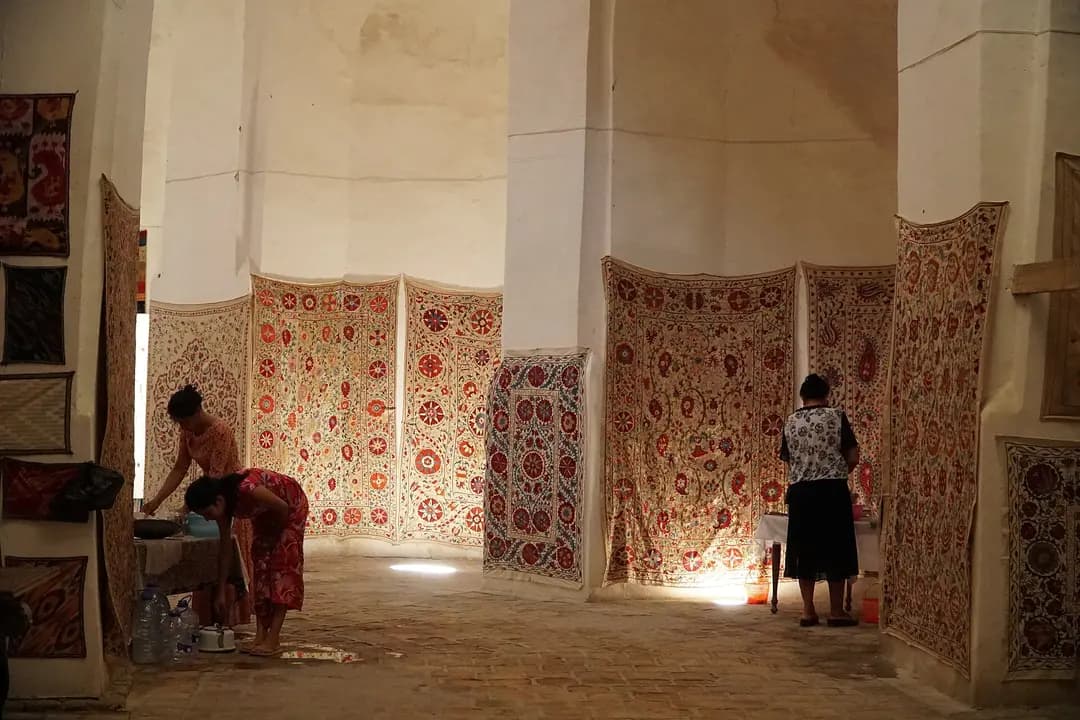
A carpet is one of the most desirable souvenirs from Central Asia: beautiful, practical, and it reminds you of the trip for years. Weaving has developed in Uzbekistan for centuries, and each region has its own style. But buying a carpet is not simple: prices differ widely, and an unprepared person finds it hard to understand materials and technique. Here are the main types of carpet, how to choose a good one and about taking it abroad. The towns for carpet hunting lie on popular routes, such as Bukhara — Khiva and Samarkand — Bukhara.
The main types of carpet
Silk carpets
The finest and most expensive. Silk gives a soft sheen and allows a very small pattern. Silk carpets are woven in Samarkand, Bukhara and Khiva. They are valued for the shimmering colour that changes with the angle of light. They are closer to a work of art than a household item.
Wool carpets
Durable, warm and practical. Wool is dyed with natural or modern dyes, and the pattern may be geometric or floral. Such carpets suit everyday use, are easier to clean, and the price is usually more affordable than silk.
Sumak and flatweave carpets
Sumak is a dense flatweave carpet where the pattern is created by the way threads are interlaced rather than by knots. It looks like a tapestry: expressive and graphic. These pieces are light and easy to carry, and can be used on the floor, on the wall or as a throw. Flatweave kilims are related to them.
Suzani and embroidered textiles
Not quite carpets, but a closely related subject: silk-embroidered cloth panels with floral patterns that hang on a wall or lie on a bed. They are often bought along with carpets.
Where carpets are woven and bought
- Khiva. Khorezm carpets are known here, woven in workshops including in the old town. Turkmen and Khorezm traditions sit side by side: bright red tones and geometric "guls" (medallions).
- Samarkand. The city is famous for silk carpets. Workshops show the whole process, from silkworm to loom. Samarkand carpets are often distinguished by a rich colour range and a small pattern.
- Bukhara. An ancient centre of carpet weaving. Bukhara carpets are valued for deep red shades and characteristic ornaments. You can buy in the trading domes and in workshops.
Many workshops are open to visitors: you can watch weavers at work and understand how much labour goes into one square metre.
How to tell handmade
- Turn the carpet over. On a handmade carpet the pattern on the back is almost as crisp as on the front. A machine-made one shows even lines and a uniform base.
- Look at the knots. In handwork they can be seen in rows, slightly uneven. The more per unit of area, the finer the carpet.
- Check the edges and fringe. On a handmade carpet the fringe is part of the warp, not sewn on separately.
- Judge the colour. Natural dyes give living, slightly uneven shades.
- Ask about the material and the time taken. The master should easily say what the carpet is made of and how long it took to weave.
If in doubt, do not rush to buy: compare several workshops and talk to the sellers.
How to choose a carpet
- Decide where it will go: on the floor, on a wall or as a throw.
- Set a budget in advance: prices range very widely.
- Think about size and whether the carpet will fit in your luggage.
- Ask politely for a discount; bargaining is usual, but respect the labour.
- Ask for a receipt or purchase document.
Taking a carpet abroad
Rules for exporting carpets may change, and some items, especially antique ones, need a special permit. What to do:
- Check the current export rules in official sources and with the seller before buying.
- Get a document confirming the purchase, stating the item and price.
- If the carpet is antique, ask the seller about the necessary documents: without them export can be banned.
- Keep the receipt and documents until you cross the border.
- Find out the customs rules of the country you are returning to.
Many shops and workshops help with paperwork and packaging, and sometimes shipping.
Care
Silk carpets do not like wet cleaning or direct sunlight. Wool ones can be vacuumed and occasionally shaken out in the open air. If in doubt, ask the master for advice. Store the carpet in a dry place, and if storing it rolled, wrap it in cloth, not plastic.
How to organise your shopping
A carpet is a large item, so consider transport. For carrying between cities by car, warn the driver in advance: a rolled carpet takes a lot of space. On Bukhara — Khiva and Samarkand — Bukhara via Yo'ldosh you can message the driver and check that the purchase will fit. See all directions on the all routes page.
Bottom line
A real carpet is history turned into thread. Take your time, look closely and ask questions, and the purchase will give you pleasure for decades.
Cover photo: Adam Harangozó, CC BY-SA 4.0, Wikimedia Commons.
