Wood Carving in Khiva: Columns, Doors and Caskets
The Khorezm carving school, the workshops of Itchan Kala and what you can take home, from caskets and Quran stands to carved doors.
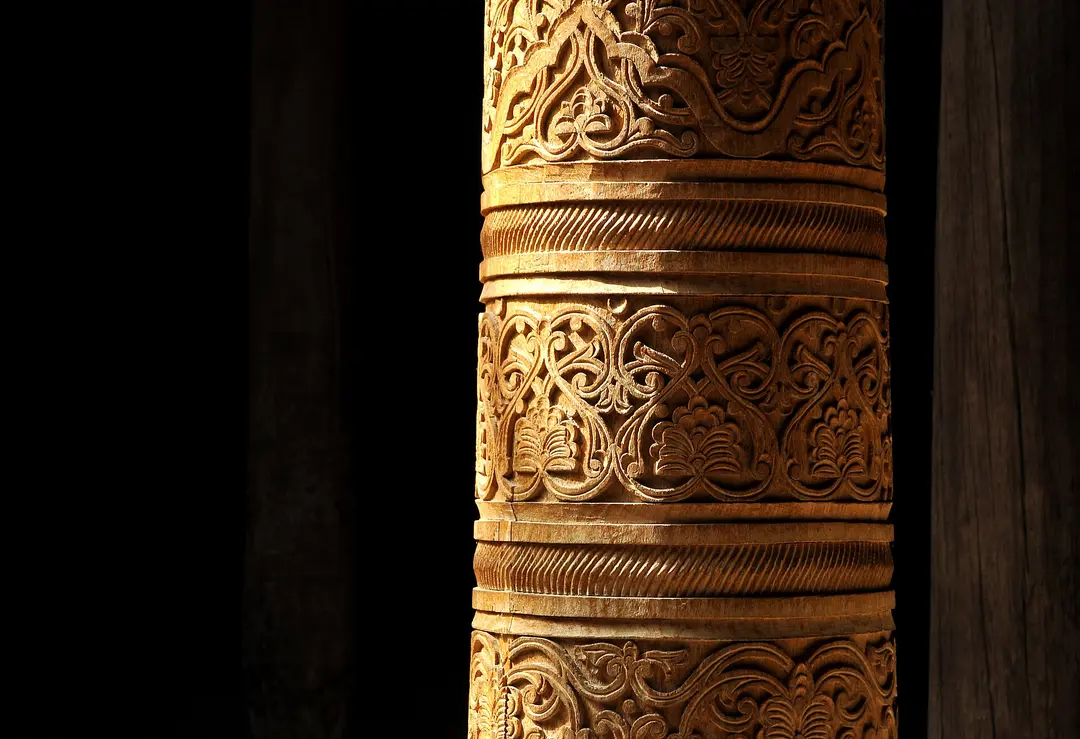
Khiva is perhaps the most "wooden" city in Uzbekistan. Here wood carving is not merely a craft but part of the architecture: it decorates the columns of mosques, the doors of palaces, ceiling beams and ceremonial gates. Entering Itchan Kala, the old town, you step into a world of warm wood tones, fine pattern and handwork. Here is the Khorezm carving school and what you can take home. From Urgench, Khiva is easy to reach on Urgench — Khiva.
Carving as the face of Khiva
Wood works in Khiva on a par with clay brick and tilework. The most impressive examples:
- The columns of the Juma Mosque. The city's main congregational mosque has a forest of carved wooden columns, some of which, according to tradition, are many centuries old. Each column is unique in pattern, and two identical ones cannot be found. Inside, the mosque looks like a forest where light is softly diffused.
- Carved doors. The doors of palaces, madrasas and homes are covered in patterns, and you can tell from them how respected the owner was.
- Aivans with wooden columns. The terraces and canopies of palaces, such as Tash Khauli, with fine carving on ceilings and posts.
Dense wood is traditionally used for carving, such as elm (karagach) and mulberry. It is strong and holds fine detail well.
The Khorezm carving school
Khorezm carving has its own recognisable style. It is characterised by:
- Floral ornament. Shoots, petals, flowers, leafy branches woven into complex compositions.
- Geometry. Stars and polygons repeating by strict laws.
- Calligraphy. Inscriptions, including wishes and fragments of sayings, carved on doors and stands.
- A mix of relief and pierced carving. Part of the pattern is cut into the surface, part cuts right through the wood, creating a play of light and shadow.
The master works by hand with a set of chisels and gouges. Patience and an eye are crucial: a mistake at the last stage can ruin days of work.
The workshops of Itchan Kala
Many workshops operate in the old town, often right in the rooms of old madrasas and houses. Here you can:
- see how a pattern is born and talk to the master;
- choose finished pieces or order work to size;
- understand how hand carving differs from machine stamping.
Look at the depth and crispness of the design, the evenness of lines and the quality of surface finish. Handwork is never perfectly symmetrical, and that is its merit.
What to bring home
- Quran stands (rahlas). Folding stands with carving, beautiful and easy to store. This is one of the most characteristic Khorezm souvenirs.
- Caskets. Wooden boxes for jewellery and small things.
- Carved panels and frames. For home decoration.
- Trays, boards and tableware. Practical items with a pattern.
- Musical instruments. Carved bodies of dutars and other instruments.
- Miniature doors and columns. For collectors and decor lovers.
Large items such as doors can be made to order and shipped by masters, but this is best arranged in advance, checking the rules on taking items out of the country.
How to choose a good piece
- Ask what wood it is made of and how it was dried.
- Check for no cracks or warping.
- Examine the carving from all sides: the depth of the pattern should be even.
- Ask to see the master work, to confirm it is handmade.
- Compare prices at several workshops and do not hesitate to bargain politely.
Practical travel tips
- Khiva is compact and Itchan Kala can be walked in a day, but allow a few more hours for the workshops.
- The best time to visit is spring and autumn; in summer it is hot in the daytime.
- Bring cash for small purchases.
- Ask for packaging for fragile and carved items.
- If you have a lot of purchases, arrange transport with the driver in advance.
You can get from Urgench to Khiva in roughly 30-40 minutes. The Urgench — Khiva option with Yo'ldosh is convenient because you know the seat price and departure time in advance. See all directions on the all routes page.
Bottom line
Khiva carving is a chance to hold a piece of living tradition. Walk through the workshops, talk to the masters and choose a piece that will remind you of the trip.
Cover photo: LBM1948, CC BY-SA 4.0, Wikimedia Commons.
