Sumalak: The Nowruz Dish Made from Sprouted Wheat
How sumalak is stirred through the night, why a whole neighbourhood cooks it together, and where to taste it in March when Uzbekistan celebrates Nowruz.
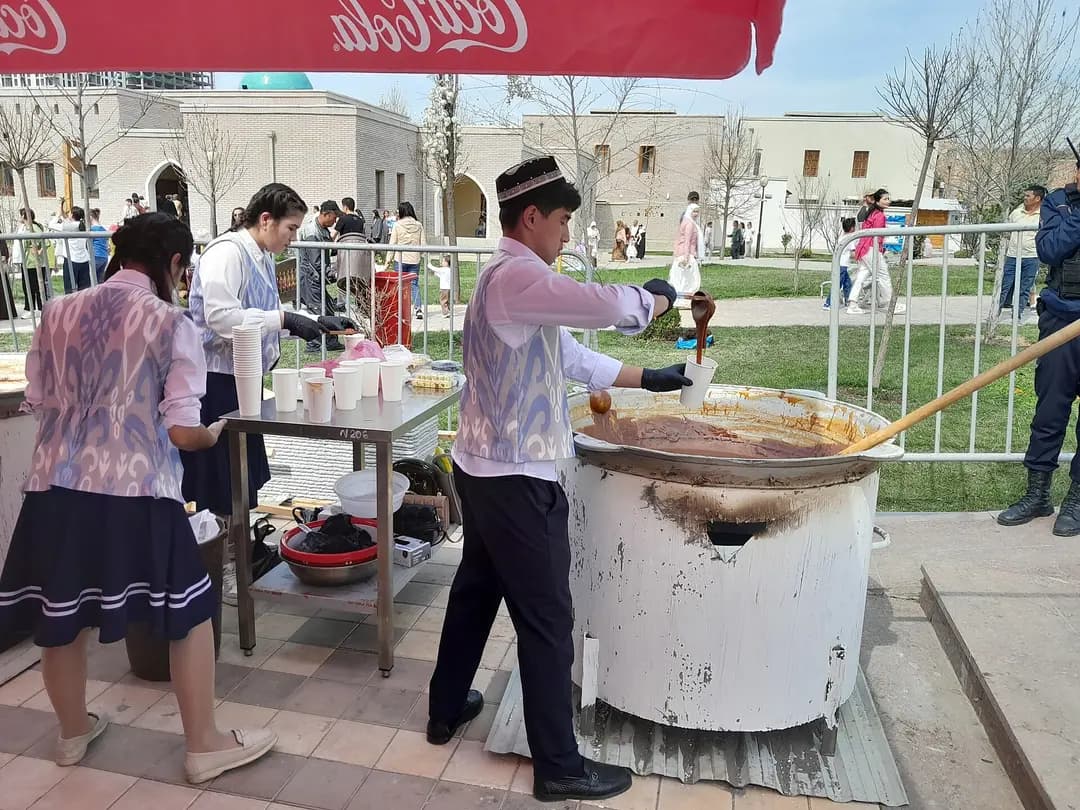
In March, when the sun already warms the afternoons but evenings are still cool, fires are lit under huge cauldrons in courtyards across Uzbekistan. This is how preparation for Nowruz begins, and its main dish is sumalak. It is a thick, sweet paste made from sprouted wheat, cooked for a very long time and always together.
What sumalak is
Sumalak is made from wheat sprouts, flour and water. The taste resembles a dark caramel paste with a slight bitterness and a nutty note. No sugar goes into the recipe: the sweetness comes from the wheat itself, which develops natural sugars during sprouting.
There are only a few ingredients, yet the preparation takes weeks. That is why sumalak is seen as a symbol of patience, renewal and hope for a fertile year.
How it is cooked
The process has several stages:
- Sprouting. Two to three weeks before Nowruz the grain is soaked and kept in damp cloth until shoots appear.
- Grinding. The sprouted wheat is put through a grinder, the juice is squeezed out and mixed with flour.
- Cooking. The mixture is poured into a cauldron with clean smooth stones or a few walnut kernels on the bottom. They keep the dish from burning.
- Stirring. Sumalak simmers on low heat for 12 to 16 hours, stirred constantly with a long paddle.
Readiness is judged by thickness and a deep dark colour. In the morning, when the group of women and neighbours finally opens the cauldron, the dish is handed out to anyone who wants it.
The whole neighbourhood: why it matters
Cooking sumalak turns into a small festival. In the evening neighbours gather, women sing folk songs, children run around, and the elders take turns sitting by the cauldron. It is believed that anyone who helps stir receives luck and health for the whole year. That is why everyone is invited, not just relatives.
Before eating, people usually voice wishes for a good harvest and peace. A portion is often taken to neighbours who could not come and to elderly people.
Where and when to try it
Sumalak is cooked mainly during Nowruz, celebrated in Uzbekistan in March. You will rarely find it in an ordinary cafe: it is festive food, made in neighbourhood courtyards, on city squares and at public celebrations. In Tashkent, Samarkand and other cities, fairs are held on the holiday where you can see the cauldrons and taste the treat.
Tips for finding it:
- look for open-air celebrations and fairs in city centres during Nowruz;
- ask your guesthouse host where sumalak is being cooked in their neighbourhood. You will often be invited gladly;
- come in the evening to watch the process, or in the morning to taste the finished dish.
Exact dates and event programmes change from year to year, so check them in advance.
How to eat sumalak
Sumalak is served in small portions, usually in a bowl, and eaten with a spoon or with flatbread. The flavour is unusual, and the first reaction of many travellers is surprise: it is not a dessert in the usual sense. If you do not like it from the first spoonful, try it with tea or a little bread, and the taste opens up.
- Portions are small and the dish is very nourishing. You cannot eat much at once.
- Decline politely if you do not want it, but at least taste it: it is a gesture of respect to your hosts.
- The dish contains flour, so it is not suitable for anyone avoiding gluten.
Other Nowruz dishes
Sumalak is not the only treat on the festive table. It is joined by:
- plov and samsa for guests;
- khanum and manti;
- halva and navat with tea;
- kuksi (a green flatbread with herbs) and other spring dishes.
By tradition the table should hold many different dishes, and every host wants to treat you to something special.
Getting to Samarkand for Nowruz
Many people go to celebrate the holiday in the old cities, where the festive atmosphere is especially vivid. From Tashkent to Samarkand it is convenient to drive along the fast highway: the road takes about 3.5 to 4 hours by car. On holidays train tickets sell out in advance, so shared rides help. For example, on the Tashkent — Samarkand route drivers post trips with different departure times. You pick the one that suits you, book a seat in the Yo'ldosh app and travel for less than a taxi would cost. All routes are listed on the all routes page.
Practical tips for Nowruz visitors
- March in Uzbekistan is changeable: warm by day, cool in the morning and evening. Bring a light jacket.
- Book accommodation in advance for the holiday days, especially in Samarkand and Bukhara.
- If you are invited into a home, bring a small gift such as sweets or fruit.
- Ask permission before photographing people near the cauldron.
- On holidays some venues work reduced hours.
Why sumalak is worth tasting
Sumalak is a rare case where food explains a culture better than any museum. What matters here is not the flavour or the recipe but the night vigil, the shared songs and the feeling that spring is arriving for everyone at once. If you happen to be in Uzbekistan in March, find at least one courtyard with a cauldron, sit there for a while and listen to the conversations. It is one of the warmest moments of a trip.
Cover photo: Miss Kamola, CC BY-SA 4.0, Wikimedia Commons.
