Tashkent to Nukus: plane, train or 1,100 km behind the wheel
Nukus is the capital of Karakalpakstan, home of the Savitsky Museum and the gateway to the Aral Sea. We look at direct flights, desert trains and the drive with an overnight stop.
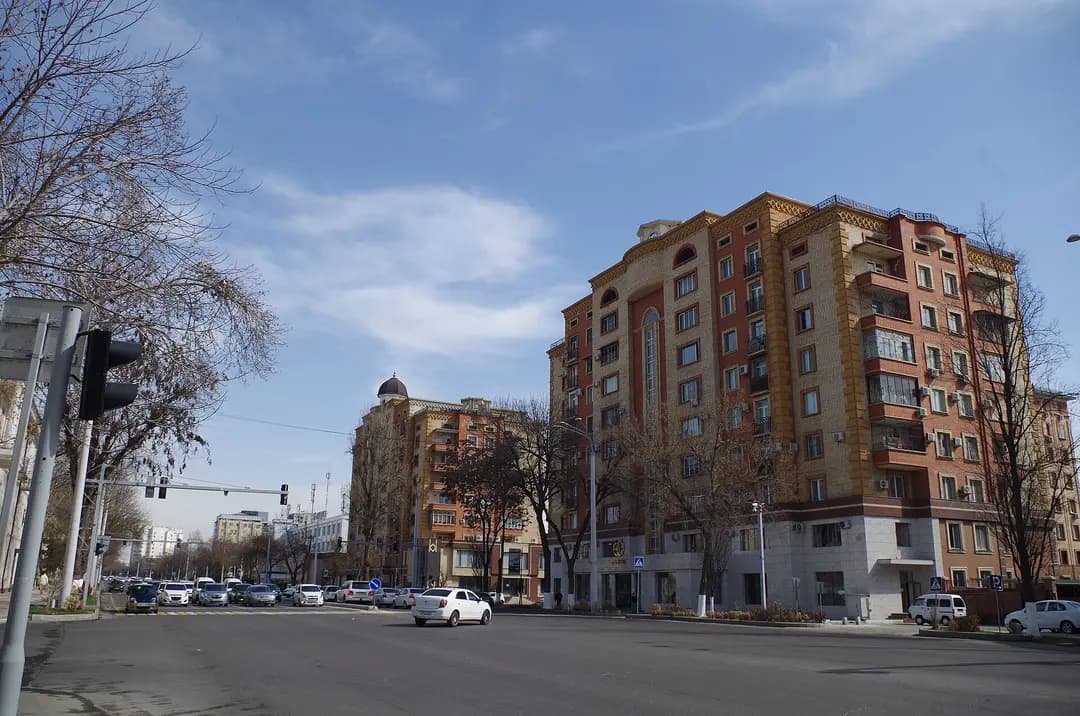
Nukus is the large Uzbek city furthest from the capital and the administrative centre of the Republic of Karakalpakstan. People come here for different reasons: to see the famous Savitsky Museum with its collection of Russian avant-garde art, to travel on to the former shore of the Aral Sea at Muynaq, to visit relatives, or for work. Either way, you first have to cover more than a thousand kilometres. Here is how.
The numbers
- Road distance: about 1,100–1,200 km depending on the route.
- Plane: about 1.5–2 hours in the air.
- Train: a long journey, usually more than half a day, partly overnight.
- Car: 13–15 hours of driving; an overnight stop is sensible.
The plane: the fastest way
There are direct flights between Tashkent and Nukus, and for most people this is the most rational choice. Nukus airport is not far from the city, 15–20 minutes by taxi from the centre. The number of flights depends on the season, and fares rise sharply closer to the date, so it is best to book ahead.
Flying is especially good if you are going to Nukus for the museum and Muynaq for two or three days: fly in the morning, visit the museum the same day, and head to the Aral Sea the next.
The train: across the Kyzylkum desert
Trains from Tashkent to Nukus run through the centre of the country and across the Kyzylkum desert. It is a long journey, but in a compartment it can be quite comfortable: sleep, read and watch the endless desert. People choose the train if they dislike flying, carry lots of luggage or want to save money.
Things to bear in mind:
- There are few departures, and tickets sell out early around holidays.
- Journey times differ between trains, so check the timetable on the railway's website or app.
- Bring food and water. There is not always a restaurant car, and it is hard to buy anything at desert stops.
By car: 1,100 km with an overnight stop
By car it is over a thousand kilometres to Nukus, and you should not try to do it in one day. The most logical route goes through Samarkand and Bukhara, then across the Kyzylkum to Khorezm and on to Karakalpakstan. A convenient plan:
- Day one: Tashkent to Bukhara, about 570 km.
- Day two: Bukhara to Urgench or Khiva, about 450 km across the desert, then roughly another 150 km to Nukus.
You can stretch it to three days if you want an evening in Khiva. Either way, cross the desert in daylight and fill up at every opportunity.
Shared rides: when you need door-to-door
Many people from Karakalpakstan work and study in Tashkent, so cars travel between the cities regularly, especially before weekends and holidays. On Yo'ldosh you can find a trip on the Tashkent — Nukus route, with the departure time, price per seat and driver's profile. On such a long route it is important to check in the chat beforehand whether there will be an overnight stop, where you will stop along the way and how much luggage you can bring.
A seat in a car is usually cheaper than a high-season plane ticket and much cheaper than a private taxi, and the driver drops you at a specific address in Nukus.
The way back: Nukus to Tashkent
From Nukus to the capital the choice is the same: plane, train or car. A few tips for the return trip:
- If you have an international flight from Tashkent, do not plan to arrive from Nukus the same day with no margin: leave several hours at least, or stay overnight in Tashkent.
- Return trains on Sundays and after holidays fill up faster.
- Shared rides on the Nukus — Tashkent route often leave early in the morning to cross the desert in daylight. That is handy if you need to be in the capital by the next evening.
What to see in Nukus
- The Savitsky Museum of Art. One of the world's leading collections of Russian avant-garde art, plus a collection of Karakalpak applied art. Allow at least half a day.
- The Mizdakhan necropolis near Khodjeyli, an ancient cemetery on hills and one of the most atmospheric places in the region.
- Muynaq and the ship graveyard, a separate trip of about 200 km, best done as a full day.
Comparison
| Option | Time | Pros | Cons |
|---|---|---|---|
| Plane | 1.5–2 h in the air | fast | fares rise near the date |
| Train | over half a day | cheap, you can sleep | few departures |
| Car with overnight stop | 2 days | stops, Bukhara and Khiva on the way | slow |
| Seat in a car | 13–15 h | door-to-door, cheaper than a taxi | a long day |
What to bring
Karakalpakstan is different from the central regions of the country: distances are longer, settlements fewer and the climate sharply continental. So pack:
- cash: cards are accepted in Nukus, but not guaranteed in the districts or at roadside cafes;
- light, covering clothes and a hat in summer, and a warm jacket and hat in winter, when strong winds blow;
- sunglasses, as the sun is dazzling in the desert and by the Aral Sea even on cool days;
- spare water and snacks for any trip outside the city;
- a power bank, since you cannot always charge your phone on long journeys.
When to go
Spring and autumn are best. Summer in Karakalpakstan is very hot and dusty, and winter is cold and windy, although you can travel all year round.
Trips on the Tashkent — Nukus and Nukus — Tashkent routes are published on Yo'ldosh, and other directions are on the routes page.
Cover photo: Artemev Nikolay, CC BY-SA 4.0, Wikimedia Commons.
